Why Demolition Notice Monitoring Needs Searchable Session Archives
A Schoolhouse Demolished Before the Dealer Arrived
A salvage dealer in southeastern Pennsylvania tracked a demolition permit for a 1926 elementary school through the county's online portal in October. The building had original terrazzo flooring, six-over-six wood-sash windows, slate blackboards, and solid oak classroom doors. He opened the permit page in a browser tab alongside a dozen other filings he was reviewing that week. Two weeks later, when he went to retrieve the tab to contact the demolition contractor, it was gone -- lost to a browser update that cleared his session. He spent 40 minutes trying to reconstruct the filing through the county portal's cumbersome search interface. By the time he reached the contractor, the interior strip-out was already complete and the materials were in a dumpster.
The EPA estimates 600 million tons of C&D debris, with approximately 145 million tons sent to landfill. Salvageable architectural elements represent a small but high-value subset of that waste stream. The window between a demolition permit filing and the start of demolition work is the only opportunity to redirect those materials from landfill to reuse. Missing that window means the materials are gone permanently.
Demolition schedule salvage sourcing depends on consistent monitoring of municipal portals, and those portals are notoriously difficult to track. Many cities publish permit data through open data platforms -- Chicago's building permit portal, for example, lists thousands of filings -- but the interfaces are designed for one-time lookups, not ongoing monitoring. Each visit generates a page of results that exists only as long as your browser tab stays open.
The scale of demolition activity makes systematic monitoring essential. The EPA reports that approximately 145 million tons sent to landfill, much of it from buildings that contained salvageable materials. Every demolished building represents materials that could have been reclaimed if a dealer had found the permit filing in time, contacted the contractor, and arranged access before the wrecking crew arrived. The window is narrow, and any delay -- including the delay caused by losing a permit tab in a sea of open browser pages -- can mean the difference between salvage and landfill.
From Permit Tabs to a Searchable Demolition Session Archive
The core problem is that demolition notice monitoring produces information in tabs -- and tabs are ephemeral. A dealer who checks three county portals each week might open 20 to 40 permit pages during each session. Those pages contain addresses, filing dates, permit statuses, property descriptions, and sometimes contractor contact information. All of that data lives only in the browser until the tab is closed.
TabVault solves this by building a searchable demolition session archive from your browsing. Every permit page you view during a monitoring session gets indexed locally on your machine. The full text of each page -- address, permit number, filing date, property type, demolition timeline -- becomes searchable long after you close the tab. This is the shift from treating your browser as a temporary workspace to turning chaotic browser sessions into a searchable private database of demolition leads.
Consider the practical difference. Without indexing, tracking demolition permits online means maintaining bookmarks, copying permit details into spreadsheets, or keeping tabs open indefinitely. Each approach has obvious failure modes: bookmarks lose page content when the portal updates, spreadsheets require manual data entry that busy dealers skip, and open tabs crash, close accidentally, or become unmanageable at scale.
With TabVault, you browse the portal normally and every page is captured. A week later, you search "1926" and "elementary" and the school permit page surfaces from your archive. A month later, you search an address and find that you viewed a permit filing for that property six weeks ago. Your monitoring history becomes a building demolition lead capture system that accumulates data over time rather than losing it with each closed session.
The practical advantage is compounding awareness. After six months of indexed demolition monitoring, your archive contains a searchable record of every permit you viewed -- addresses, filing dates, property types, contractor names, and permit statuses. This is not a static database you built manually. It is a byproduct of your normal browsing routine, captured automatically and made searchable without any additional data-entry effort. When a new permit filing appears for a building on a street where you already indexed three prior permits, a quick address search reveals the full demolition history of that block -- intelligence that informs whether the remaining buildings are likely to follow.
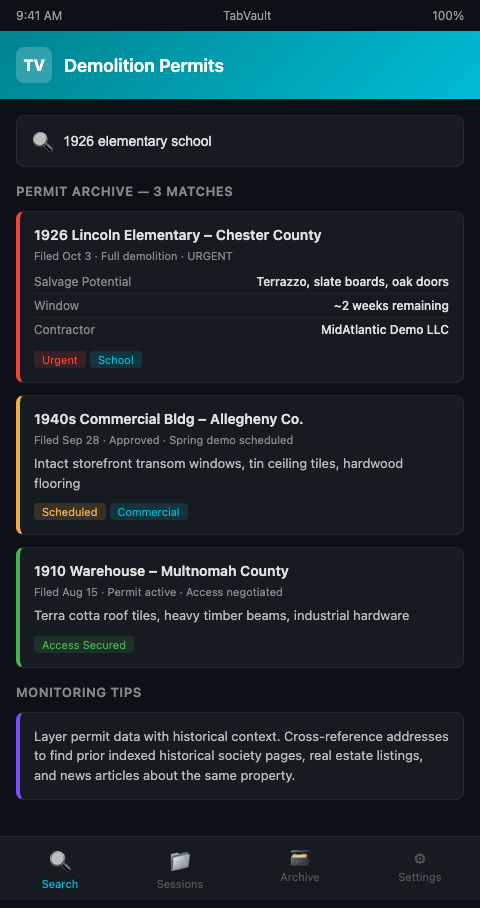
The value is especially clear for dealers who monitor multiple city portals across regions. A dealer in the Philadelphia metro area might track demolition filings in Philadelphia, Chester County, Montgomery County, and Delaware County -- four separate portals with four different interfaces. An indexed archive collapses all of them into one search: query "slate roof" and retrieve matching permit pages from any portal you visited, regardless of which county issued the filing.
How Demolition Notice Monitoring Creates Sourcing Opportunities
Understanding how permit data translates into salvage opportunities requires knowing what to look for on a permit page.
Property age and type. Older buildings contain more salvageable materials. A demolition permit for a 1950s ranch house yields different inventory than one for a 1905 Victorian commercial building. The permit page often includes the year built or references to the property's historical status. Indexing this text lets you filter your archive by era.
Property size and scope. Larger buildings produce more material. Commercial buildings, schools, hospitals, and churches are particularly rich sources. Permit pages sometimes include square footage or building descriptions that help you estimate the salvage potential before visiting the site.
Demolition timeline. Some permits include scheduled demolition dates or contractor information. This data is critical for planning your outreach. A permit filed in January with a spring demolition date gives you weeks to negotiate salvage access. One filed with immediate authorization requires same-day action.
Contractor identification. Demolition contractors are key partners for salvage dealers. A permit page listing the contractor's name gives you a contact point for negotiating pre-demolition access. Indexing captures this name so you can later search your archive for all projects handled by a specific contractor, building a relationship history over time.
The National Trust for Historic Preservation has galvanized public support behind more than 350 endangered sites since 1988, but the vast majority of buildings demolished in the United States never appear on any preservation watchlist. Salvage dealers are often the last line of defense for the materials inside those buildings, and systematic permit cross-referencing with estate sale listings is how they identify opportunities before the wrecking ball arrives.
Advanced Demolition Monitoring Tactics
Layer permit data with historical context. When a permit filing catches your attention, search your archive for the address. You may have previously indexed a historical society page, a real estate listing, or a news article about the same property. That context helps you assess salvage potential -- a building described as "largely original" in a real estate listing three years ago likely contains more valuable materials than one described as "extensively renovated."
Track neighborhood patterns. The Waste Advantage Magazine analysis of construction waste management notes that the C&D waste management market is expected to reach $8.78 billion by 2025, with demolition projects generating significant volumes of salvageable components. Demolition permits cluster geographically. When one building on a block is permitted for demolition, adjacent properties often follow within months. Searching your archive by street name or neighborhood reveals these patterns, letting you anticipate future sourcing opportunities and establish contractor relationships early.
Monitor permit status changes. Permits move through stages: filed, approved, active, completed. Revisiting permit pages periodically and letting TabVault re-index them captures status updates in your archive. When a permit moves from "filed" to "approved," that is your signal to contact the contractor. This monitoring pairs well with multi-city portal tracking routines that other dealers in your market may not maintain.
Build a demolition history database. Over months, your indexed permit pages accumulate into a historical record of demolition activity in your region. This data has value beyond immediate sourcing: it reveals which neighborhoods are losing buildings fastest, which contractors handle the most demolitions, and which property types are most commonly demolished. That intelligence informs long-term business planning.
Index news coverage alongside permits. Local news outlets often cover demolitions of notable buildings. When you read a news article about a planned demolition, that page gets indexed with details the permit filing may lack -- neighborhood opposition, historical significance, architectural details mentioned by reporters. Your demolition monitoring archive becomes richer than permit data alone, combining official filings with journalistic context that helps you prioritize which sites are worth pursuing.
Pair permit data with estate sale and auction monitoring. A building permitted for demolition sometimes first appears as an estate sale or auction venue when the owner liquidates contents before demolition begins. Searching your archive for an address that appears on a new demolition filing might surface an estate sale listing from the same property that you indexed weeks earlier -- giving you a head start on identifying what materials the building contains before you ever visit the site.
Turn Permit Pages Into Permanent Leads
Demolition permits are the most time-sensitive leads in the salvage business, and municipal portals are the worst place to try to track them. TabVault turns every permit page you view into a permanent, searchable entry in your private archive. If your sourcing depends on demolition monitoring, join the waitlist and stop losing permits to closed browser tabs.
Imagine searching for a specific street address and seeing every demolition permit, historical record, and listing you ever viewed for that property -- all in one results list. That is what your archive looks like after a few months of indexed monitoring. Each permit page you view today becomes a searchable record tomorrow, and the cumulative effect across hundreds of monitored permits gives you a demolition intelligence database that no competitor can match without investing the same browsing time.