Managing Multi-State Vital Records Searches With Tab Indexing
The Multi-State Problem No One Warns You About
A researcher working an unknown parentage case in the Midwest recently described opening tabs for vital records offices in Ohio, Indiana, Michigan, Illinois, and Kentucky -- all in the same afternoon. By the next morning, she could not remember which portals she had already queried or which spellings she had tried in each. She started over on two of them, paying duplicate fees and losing half a day.
This is not unusual. The National Archives confirms that vital records such as birth and death certificates, marriage licenses, and divorce decrees are created by local authorities rather than the federal government. That decentralized structure means every state has its own portal, its own fee schedule, its own access restrictions, and its own indexing quirks. The FamilySearch Wiki on United States Vital Records documents that the start dates for civil registration vary enormously -- Massachusetts has records from the 1600s, while many southern states did not begin statewide registration until after 1900.
For researchers conducting a multi-state vital records search, the browser becomes the de facto workspace. You open a tab for each state portal, a tab for each county clerk's online index, and a tab for each third-party database that might fill gaps. Within an hour, you have thirty or forty tabs open, and the only thing connecting them is your memory of what you searched and what you found.
Building a Searchable Record of Every Portal You Touch
The core problem is not the number of tabs. The core problem is that closing those tabs erases the evidence trail. You cannot prove you searched a portal if the only record was a browser tab you closed last Thursday.
TabVault addresses this by turning chaotic browser sessions into a searchable private database. Every tab you open during a vital records cross-state tracking session gets indexed -- the portal URL, the page content, the search parameters visible on the page. When you later need to confirm whether you already checked Indiana's death certificate index for a particular surname variant, you search your own indexed history instead of reopening the portal and starting from scratch.
The practical workflow looks like this. You begin a session focused on a specific ancestor or case. You open the vital records portal for each relevant state. As you search each portal, TabVault indexes the content of every page you visit. When you finish for the day, you have a permanent, searchable record of every state you queried, every name variant you tried, and every result page you viewed.
This approach mirrors what professional genealogists already do with research logs, but without the manual data entry. The Board for Certification of Genealogists requires thorough documentation under its Genealogical Proof Standard -- researchers must record every source consulted, not just the ones that produced results. An indexed browser session captures that negative evidence automatically. The portal that returned zero results for "Kowalski" in 1923 is indexed just as thoroughly as the one that returned a matching birth certificate.
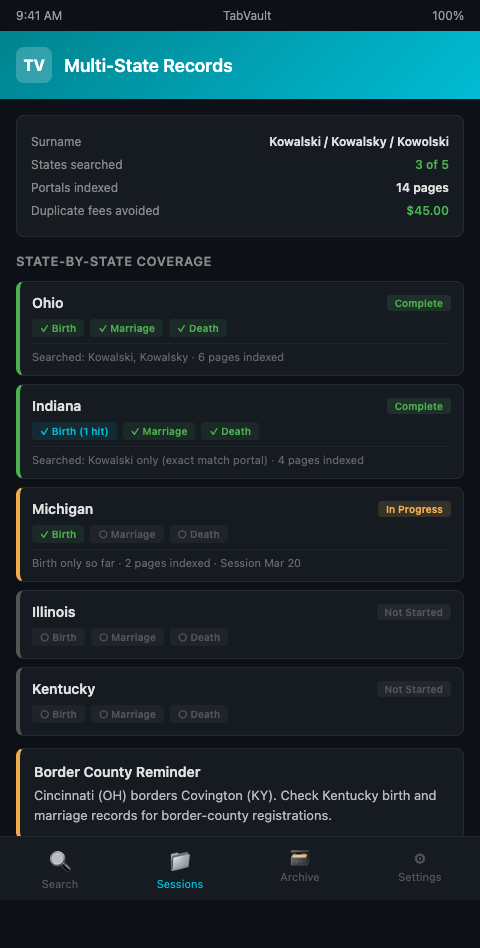
For researchers who also work with census and obituary records, the indexed vital records sessions become part of a larger searchable archive. A death certificate research indexing session from one week can be cross-referenced against a census lookup from three months ago, all through the same search interface.
Structuring Sessions by State and Record Type
The most effective approach is to organize your research sessions deliberately rather than mixing states and record types in a single marathon browsing session.
One state per session. Dedicate a session to a single state's vital records ecosystem. Open the state vital records office portal, the relevant county clerk sites, and any third-party indexes like FamilySearch or Ancestry that cover that state. When you finish, you have a clean, searchable block of research for that jurisdiction. The next session covers the next state.
Separate birth, marriage, and death passes. Within each state session, work through one record type at a time. Search all available state birth record databases for your target names, then move to marriage records, then death certificates. This prevents the common mistake of searching births in three states, switching to deaths in a fourth, and losing track of which record types you covered where.
Tag sessions with jurisdiction metadata. If your indexing tool supports session labels or notes, tag each session with the state abbreviation and record type. A session tagged "OH-BIRTH-1920s" is instantly findable months later when you need to verify your Ohio birth record coverage. Researchers tracking demolition notices across multiple city portals use a similar jurisdiction-tagging approach for their multi-municipality research.
Track fee payments alongside searches. Many state vital records portals charge per search or per certificate. By indexing the confirmation pages, you create a record of what you paid and when. This matters for professional researchers billing clients and for volunteer search angels documenting their expenses.
Advanced Tactics for Interstate Genealogy Record Search
The biggest efficiency gain comes from using your indexed sessions to identify gaps before you start a new research day. Pull up your TabVault archive, search for the case name or ancestor surname, and review which states and record types appear in your history. The states that do not appear are the ones you have not searched yet.
Watch for these common mistakes in multi-state research:
Assuming uniform availability. Reclaim The Records has documented through FOIA litigation that many states restrict access to records that should be publicly available. Their work has freed over 50 million historical records. Do not assume that a state's online portal reflects its full holdings -- some states have extensive records that are only accessible in person or through mail requests.
Ignoring border-county records. Families living near state borders frequently recorded events in whichever jurisdiction was more convenient. A birth in a border town might be registered in either state. Your interstate genealogy record search should include border counties on both sides, and your evidence logs should document which border counties you have checked.
Forgetting name variant coverage. Each state portal has different search algorithms. A search for "Kowalski" in Ohio might also return "Kowalsky" and "Kowolski," while the same search in Indiana returns only exact matches. Index your search result pages so you can verify which variants each portal actually tested.
Overlooking restricted-access record sets. Some states maintain separate indexes for records within privacy windows -- typically 50 to 100 years for birth records and 25 to 50 years for death records. These restricted indexes may require a different portal, a different request process, or proof of direct lineage to access. Document which portals you used for open records versus restricted records so you can retrace your steps when access rules change or when you obtain the necessary credentials to request sealed records. Maintaining this distinction in your indexed sessions prevents the common mistake of assuming a state has no relevant records when in fact you only searched the publicly available subset.
Neglecting to cross-reference newspaper records. Vital events were frequently reported in local newspapers before or alongside official registration. Researchers who also cross-reference obituaries and birth records across their indexed sessions often find newspaper mentions that fill gaps in the official record.
If you are spending hours each week on multi-state vital records research and losing track of which portals you have already searched, your browser is working against you. TabVault turns every search session into a permanent, searchable record -- so you never pay duplicate fees, never repeat a search you already ran, and never lose the thread connecting five states' worth of evidence. Join the waitlist to bring order to your interstate research.