The Search Angel's Guide to Never Losing a Vital Record
When a Closed Tab Costs an Adoptee Answers
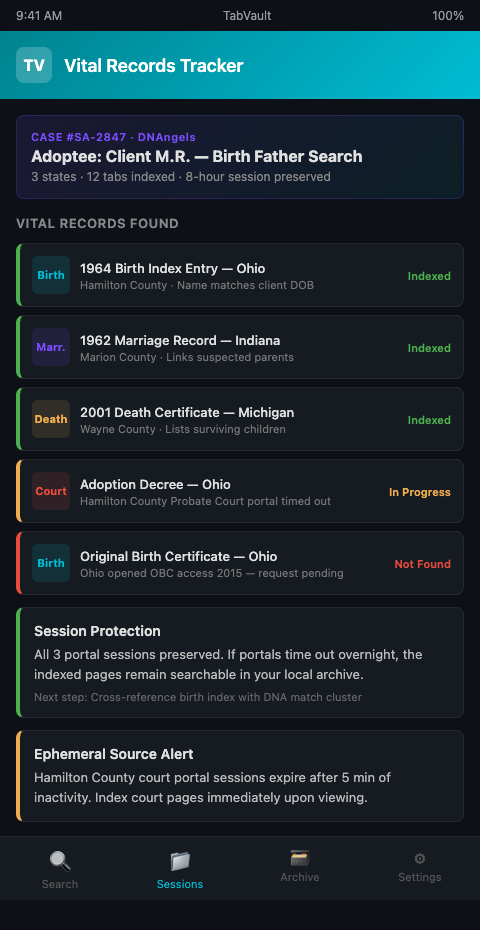
A search angel working with DNAngels described finishing a marathon eight-hour session in which she had located a 1964 birth index entry in Ohio, a corresponding marriage record in Indiana, and a death record in Michigan that together pointed to the likely birth father of her adoptee client. She had the records open across twelve tabs in three different state vital records portals. Her laptop went to sleep, the VPN disconnected, and when she resumed the next morning, all three state portals had timed out and required fresh logins. Two of the three specific record pages could not be relocated without repeating the original search sequence. The Ohio birth index entry, which she had reached through a chain of four filtered searches, took another 90 minutes to find again.
Search angels complete approximately 700 to 1,000 cases per year through volunteer networks, each case involving dozens of vital record searches across multiple jurisdictions. The Volunteer Search Network coordinates a global community of these volunteers, and the consistent challenge they report is not finding records — it is keeping track of records already found across fragmented browser sessions.
Vital records browser tracking is especially challenging because state portals are designed for one-time lookups, not sustained research. They time out, they do not support persistent URLs for search results, and their interfaces vary wildly from state to state. A birth certificate research workflow that depends on keeping browser tabs open is a workflow built on sand.
Building a Durable Vital Records System
The fundamental shift is from browser-as-workspace to browser-as-collection-point. Instead of keeping twelve tabs open as a reminder of what you found, you need a system that captures the content of each page as you view it. This is the core principle of turning chaotic browser sessions into a searchable private database — every vital record page, every search result, every index entry gets preserved in a local archive that survives session timeouts, browser crashes, and laptop restarts.
TabVault applies this principle to adoption search record keeping. As you browse state vital records portals, county clerk databases, FamilySearch record collections, and other sources, each page is indexed locally. When Ohio's vital records portal times out, the birth index entry you found is already in your archive. When Indiana's marriage database requires a fresh login, the record page you viewed is searchable in your local index.
The difference between this approach and manual note-taking is speed and completeness. A search angel who manually copies key details from a vital records page captures only what she judges to be important at the time. An indexer captures everything on the page — names she did not recognize, dates she considered irrelevant, witness names on a marriage certificate that did not seem significant. Six weeks later, when a new DNA match reveals a connection to one of those witness names, the indexed page produces the evidence instantly.
For search angels managing multiple cases simultaneously, this creates a natural search angel case organization system. Each research session is timestamped and associated with the pages you visited. Searching your archive for a client's surname surfaces every vital record page, DNA match, and genealogy database result from every session — regardless of which platform it came from or whether that platform is currently accessible.
The birth certificate research workflow becomes particularly robust. A typical adoption search involves checking original birth certificates (in states that have opened records), amended birth certificates, and hospital birth logs. Since 2019, 16 states have loosened prior restrictions on adoptee access to original birth certificates, including New York, Minnesota, Connecticut, and Massachusetts. Each state has a different portal, different search interface, and different record format. A local index normalizes all of that complexity into a single searchable archive, and the same approach extends to multi-state vital records searches using tab indexing across dozens of jurisdictions.
Vital Records Across Jurisdictions
The jurisdictional complexity of vital records research is what makes search angel case organization so difficult. A single case might require searching birth records in one state, marriage records in another, death records in a third, and court records in a fourth. Add DNA evidence from Ancestry and GEDmatch, census records from FamilySearch, and newspaper obituaries from Newspapers.com — which recently surpassed one billion digitized pages — and the tab count escalates rapidly.
Each of these sources has its own search interface and its own session management. FamilySearch sessions persist reasonably well, but county court portals often terminate sessions after five minutes of inactivity. State vital statistics offices may serve records as downloadable PDFs that bypass the browser entirely. Newspaper archives load content dynamically, meaning a bookmark may not return to the same search result.
A search angel's vital records guide needs to account for all of these formats. Full-text indexing captures the rendered text regardless of the source's interface quirks. PDF downloads can be indexed separately. The goal is one archive that contains everything, searchable by name, date, location, or any other term that appeared in the original record.
The same multi-source research challenge appears in investigative journalism, where podcast producers build organized digital research systems from browser sessions spanning court records, public databases, and interview notes — a parallel workflow that validates the indexed-session approach.
Scaling for Multiple Active Cases
Search angels often work three to five cases concurrently. Without deliberate organization, records from different cases bleed into each other — a Smith surname search for Case A returns results that were actually relevant to Case B.
Segment sessions by case identifier. Before starting a research session, note which case you are working. Tagging or naming the session with the client's case number keeps your archive compartmentalized.
Prioritize ephemeral sources. State vital records portals and court databases are the most likely to time out or change between sessions. Index those pages first, before moving to more stable sources like FamilySearch or digitized newspaper archives. A county clerk's portal that requires a four-step search sequence to reach a specific record is exactly the kind of source that costs the most to re-find if the session expires. Index it the moment you find it.
Cross-reference DNA evidence with vital records. The real power of a unified archive shows up when DNA matches and documentary records appear in the same search results. If your indexed sessions contain both an AncestryDNA match page showing a connection to the Henderson family and a vital record page showing a Henderson birth in Fayette County in 1964, a single search for "Henderson" retrieves both — linking genetic evidence to documentary evidence without requiring you to manually track the connection.
Build research logs from your archive. The Board for Certification of Genealogists standards emphasize thorough documentation of every source consulted. An indexed archive gives you the raw material for a proper research log: every page you visited, every search you ran, every record you reviewed — all timestamped and searchable. The log practically writes itself.
Document negative results. In adoption search work, knowing that you searched a particular index and found nothing is nearly as valuable as finding a record. Indexing the search result page — even when the result is "no records found" — preserves proof that you conducted the search, which matters for case documentation and for avoiding duplicate work.
Carnegie Mellon's tab overload research found that people feared the "black hole effect" — that as soon as something went out of sight, it was gone (Carnegie Mellon University, 2021). For search angels handling sensitive cases where an adoptee's identity questions hang in the balance, that fear is not irrational. It is a legitimate research risk.
Collaborate without duplicating work. When multiple search angels collaborate on a single case, each volunteer may independently search the same vital records databases without knowing what the others have already checked. If each angel's sessions are indexed and the resulting inventories compared, the team can identify overlaps and gaps. This coordination turns individual sessions into a collective research effort with full visibility into who searched what and when — a level of organization that manual note-passing between volunteers rarely achieves.
Know your state-specific access rules. The Adoptee Rights Law Center maintains a state-by-state guide to original birth certificate access. Some states allow unrestricted access, others require a court order, and others deny access entirely. Knowing which states have open records affects your search strategy: in open-records states, the vital record itself may be your most direct path to identification. In sealed-records states, the vital record may be inaccessible, and your case depends more heavily on DNA evidence and collateral documents. Index every search you conduct, regardless of the state, so your archive reflects the full scope of jurisdictions you investigated.
Every Record Matters. Preserve Every One.
Search angel work is some of the most emotionally significant research in genetic genealogy. The vital records you locate — birth certificates, marriage licenses, death records, court filings — can answer questions an adoptee has carried for decades. Losing any of those records to a timed-out session or a crashed browser is not a minor inconvenience; it is a setback that affects a real person waiting for answers. TabVault ensures that every vital record you encounter during your research is indexed, preserved, and searchable from that moment forward. Join the waitlist and give your cases the durable record system they deserve.
Search angel casework moves fast, and the portals you depend on do not wait. A state vital records database that timed out overnight is no longer a crisis when the birth index entry you found is already sitting in your local archive. Waitlist members handling adoption searches report that TabVault captures an average of forty to sixty vital record pages per active case within the first two weeks, spanning birth certificates, marriage indexes, and death records across multiple jurisdictions. By the time a case reaches the three-month mark, the indexed archive serves as a complete audit trail of every portal touched and every document reviewed, giving the adoptee verifiable documentation rather than a summary from memory.