Automating Research Deduplication With Full-Text Genealogy Search
The Invisible Cost of Redundant Research
FamilySearch's documentation on duplicate records in Family Tree describes how millions of duplicate entries accumulated in their collaborative database, requiring both automated detection and manual user effort to resolve. The same duplication problem exists in individual researchers' browser-based workflows, but it is far harder to detect because no automated system is watching for it.
The mechanism is straightforward. A genealogist investigating an unknown parentage case visits a DNA match profile on AncestryDNA in March, examines the match's family tree, checks shared matches, and searches for vital records connected to the match's ancestors. She records her findings in a spreadsheet or research log. Four months later, a new match appears whose shared match list overlaps with the earlier match. The genealogist begins investigating, visits some of the same profiles, runs some of the same vital records searches, and only realizes thirty minutes into the session that she has already done this work.
This pattern is not occasional. The hidden cost of duplicate research in parentage investigations compounds across every case and every month. The Board for Certification of Genealogists publishes standards for thorough, non-duplicative research as part of its professional ethics code, yet no practical tooling exists to enforce those standards at the session level. Professional genealogists who bill by the hour are effectively charging clients for work already completed. Volunteer search angels are burning limited free time on research they have already conducted. The waste is invisible because traditional browser workflows provide no mechanism for detecting it.
Research logs and spreadsheets catch some duplication, but only the duplication that the researcher remembers to check for. A log that says "Investigated Match #247 on March 15" does not tell the researcher whether the vital records search she is about to run in July will cover the same ground. Only full-text search across the actual content of past sessions can make that determination automatically.
The financial cost is real. The International Commission for the Accreditation of Professional Genealogists notes that professional genealogists typically charge between $50 and $200 per hour, with fees varying by expertise, geographic focus, and research complexity. A professional genealogist billing at $75 per hour who loses three hours per month to duplicated research costs her clients $2,700 over a year. Multiply that across a firm with five researchers and the annual waste reaches five figures. The time cost is equally significant for non-professional researchers: volunteer search angels working adoption cases have limited hours to dedicate to each client, and every hour spent re-doing completed work is an hour stolen from active investigation.
Full-Text Search as a Deduplication Engine
TabVault transforms the deduplication problem by turning chaotic browser sessions into a searchable private database where every page visited becomes a full-text-searchable record. The deduplication mechanism is simple: before diving into a new line of research, the genealogist searches the archive for the key terms she is about to investigate. If the search returns results from a prior session, she can review what was already found and pick up from where the earlier investigation left off rather than starting from scratch.
This is genealogy research deduplication automation in its most practical form. The researcher does not need a separate deduplication tool or a complex matching algorithm. She needs a search box connected to an archive of everything she has already examined. When the search returns a match profile she visited four months ago, along with the surrounding session context showing what else she explored during that visit, the duplication is caught before it costs her an hour of redundant work.
The mechanism works because full-text indexing captures everything on the page, not just what the researcher chose to record. A match profile page on AncestryDNA contains the match's username, predicted relationship, shared centimorgans, number of shared segments, linked tree information, and shared match count. All of that content enters the index. A search for any of those elements will surface the session. The researcher does not need to remember exactly what she was looking for last time. She needs to remember any identifying detail, and the archive does the rest.
The workflow integrates naturally with standard genealogy research optimization practices. At the start of each research session, the genealogist identifies the surnames, locations, or record types she plans to investigate. She runs those terms through TabVault's search. The results show her which of those avenues she has already explored, which she partially explored, and which are genuinely new territory. This pre-session check takes two or three minutes and routinely saves thirty minutes or more of redundant investigation.
Scaling and Long-Term Considerations
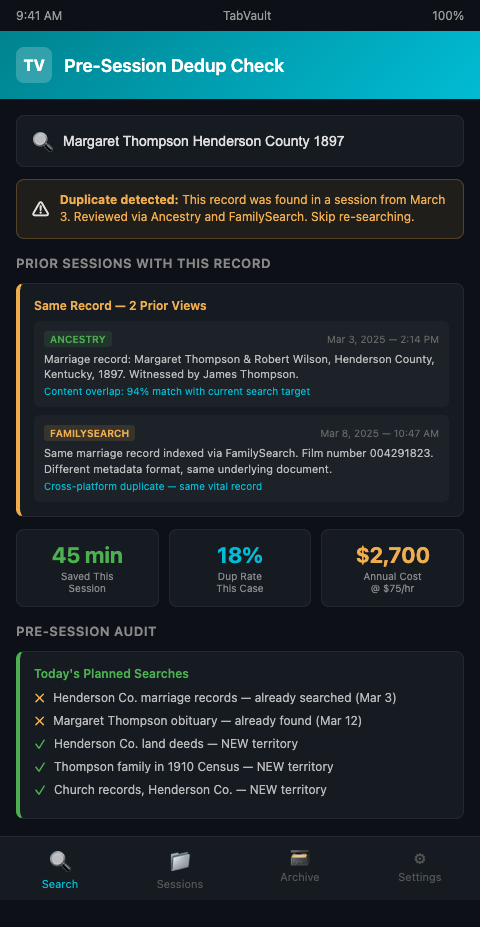
Full-text search duplicate detection goes beyond exact URL matching. A researcher might visit the same person's vital records through different database interfaces: once through Ancestry's record collection, once through FamilySearch's indexed records, and once through a state vital records portal. The URLs are different, but the content overlaps substantially. Full-text indexing catches this overlap because the person's name, dates, and locations appear in the indexed content regardless of which portal was used to access the record.
The same principle applies to automated matching in architectural salvage research, where different source databases may contain overlapping inventory records. Across fields, the deduplication value of full-text search lies in its ability to match on content rather than on access path.
Consider a specific example. A researcher investigating a match named Margaret Thompson in Henderson County, Kentucky, runs a vital records search on the state portal in March and finds a marriage record from 1897. In July, she encounters a different match whose tree also includes someone from Henderson County. She runs a vital records search again, finds the same 1897 marriage record, and only after reading through it realizes she has seen this exact document before. With full-text deduplication, her July search would have been flagged before she even opened the vital records portal, because "Margaret Thompson Henderson County 1897" already existed in her indexed archive from March.
The deduplication also catches partial overlaps. Perhaps in March she searched for "Margaret Thompson" and in July she searched for "M. Thompson Henderson." The names are entered differently, but the indexed page content from March contains both the full name and the location. A search for "Thompson Henderson County" before starting the July session would surface the March results immediately, revealing the overlap before any time is wasted.
Scaling Deduplication Across Long-Running Cases
The first scaling consideration is that deduplication value increases nonlinearly with case duration. A case that runs for two months has relatively little accumulated research to duplicate. A case that runs for eight months has a vast archive of prior sessions, and the probability of inadvertent duplication rises with every new session. The researchers who benefit most from automated genealogy record matching through full-text search are those working the longest and most complex cases.
The second consideration is team-based research. When multiple researchers contribute to the same case, duplication risk multiplies because each researcher has their own browsing history. A shared TabVault archive allows the second researcher to search against the first researcher's indexed sessions before beginning new work. This is the same principle behind shared research in reunion registries: pooled knowledge prevents pooled waste.
The third consideration involves eliminating redundant genealogy searches across related cases. A firm handling five unknown parentage cases in the same geographic region will inevitably encounter overlapping research. A vital records search in Henderson County, Kentucky, for Case A may produce records relevant to Case B. Without cross-case search capability, the firm runs the same searches independently for each case. With a searchable archive spanning all cases, the firm identifies these overlaps before the redundant work occurs.
The Carnegie Mellon tab overload study found that 25 percent of participants had experienced browser crashes from too many open tabs. Genealogists who keep tabs open specifically to avoid losing track of research they might need later are using tab hoarding as a crude anti-duplication strategy. An indexed, searchable archive replaces that fragile workaround with a durable system.
Finally, researchers should track their deduplication savings over time. Running a quick search before each session and noting whether it surfaced prior relevant work provides a concrete measure of time saved. After three months, most researchers find that the pre-session search prevents duplicate work in roughly one out of every five sessions, a return that compounds across every case they touch.
Measuring and Maximizing Deduplication Value
A fourth scaling consideration is platform-specific deduplication. Each genealogy platform presents records differently, and a researcher may not recognize that she is viewing the same underlying record through a different interface. A death certificate found on FamilySearch may also appear in Ancestry's record collection with different metadata formatting. Full-text search catches this overlap because the core data on the certificate, names, dates, and locations, appears in the indexed content regardless of which platform displayed it. This cross-platform deduplication is invisible to platform-native tools but automatic with a comprehensive session archive.
Finally, researchers should quantify their deduplication savings periodically. Tracking the number of pre-session searches that surface prior relevant work provides a concrete measure of time saved. Most researchers who adopt the pre-session search habit find that it catches meaningful duplication in roughly twenty percent of their sessions. For a researcher conducting five sessions per week, that translates to one session per week where thirty to sixty minutes of redundant work is avoided. Over a year, the cumulative savings represent dozens of hours returned to productive investigation.
Stop Paying Twice for the Same Research
Duplicate record identification in genealogy is not a technology problem. It is a retrieval problem. TabVault gives researchers instant full-text search across every session they have ever conducted, catching duplication before it wastes billable hours and client patience. Join the waitlist to make redundant research a thing of your past.
A three-minute pre-session search is all it takes to stop paying for the same research twice. Before opening any database or DNA platform, type your target surnames and locations into your TabVault archive. The results show which portals you already queried, which name variants you already tested, and which pages returned zero results, so you pick up where you left off instead of starting over. Genealogists who adopt this pre-session habit consistently report catching meaningful duplication in roughly one out of every five research sessions, recovering hours each month that would otherwise vanish into redundant vital records searches, repeated match reviews, and rebuilt speculative trees.