The Hidden Cost of Duplicate Research in Parentage Investigations
The Research You Have Already Done, Done Again
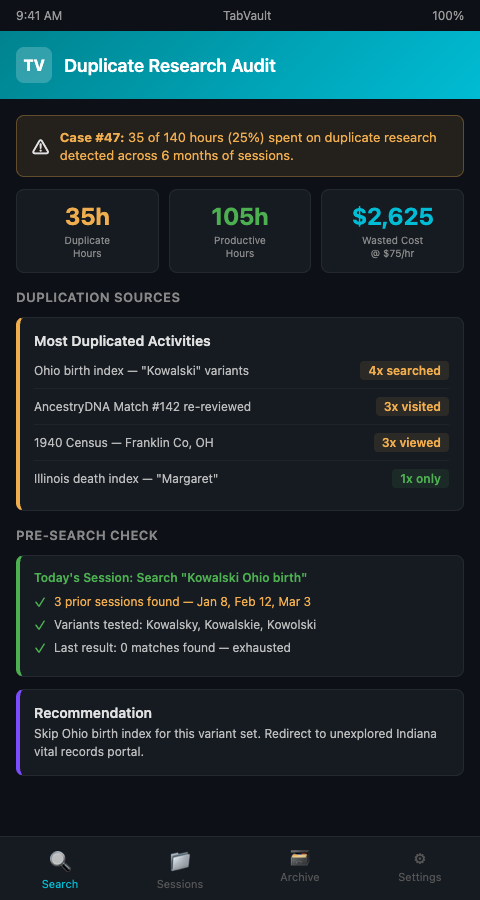
A professional genetic genealogist working a complex unknown parentage case logged 140 hours over three months. When she audited her research notes afterward, she found that she had searched the Ohio birth index for the same surname variant on four separate occasions, reviewed the same AncestryDNA match profile at least twice, and re-read the same 1940 census page three times. She estimated that 35 of her 140 hours -- a full quarter of the case -- were spent redoing work she had already completed.
The Occasional Genealogist documents that following a structured genealogy research process makes research faster and more efficient. But even experienced researchers who follow structured processes fall into duplicate work because the process depends on memory and manual logs. You remember to log the birth certificate you found. You do not remember to log the five searches that found nothing.
The problem is structural, not personal. Parentage investigations generate enormous volumes of browser-based research. Fifty DNA match profiles reviewed. Twelve state vital records portals searched. Eight newspaper archives queried. Hundreds of individual pages visited. No manual logging system can capture all of that activity with the fidelity needed to prevent duplicates. The researcher who searched Ohio births four times did not forget to check her notes -- her notes simply did not include every negative search she ran.
Family History Daily warns that duplicate entries in family trees waste time and can prevent researchers from furthering their research if vital information ends up under the duplicate entry instead of the primary one. The same logic applies to duplicate research sessions: if the evidence from your first Ohio search ended up in a tab you closed, your second Ohio search cannot build on it.
Turning Browser History Into a Duplicate Prevention System
TabVault addresses genealogy research time waste by turning chaotic browser sessions into a searchable private database. Every page you visit during a research session gets indexed. When you sit down to start a new research session, you search your archive before you search the database.
The workflow change is small but transformative. Before opening the Ohio birth index, you search your TabVault archive for "Ohio birth" and see every page you have previously visited on that portal. You see the search parameters you used, the results you got, and the name variants you tested. In thirty seconds, you know exactly where you left off. The repeated vital records searches that consumed 25 percent of the case above simply do not happen.
This is not just about saving time. Redundant DNA research elimination has a direct impact on parentage investigation efficiency because every hour spent redoing old work is an hour not spent pursuing new leads. A case that takes 140 hours with 25 percent duplication could take 105 hours without it. For professional genealogists billing hourly, that is 35 hours of client savings. For volunteer search angels donating their time, that is 35 hours they could spend on another family's case.
Researchers who have already experienced how browser chaos derails unknown parentage investigations will recognize that duplicate research is one of the primary mechanisms of that derailment. The chaos does not just lose information -- it causes you to regenerate information you already had.
Where Duplicate Research Hides
Duplicate research is not always obvious. Some forms of duplication are invisible until you have a system that reveals them.
Match re-reviews. On AncestryDNA alone, a complex case might involve reviewing 200 to 300 matches. Without a record of which matches you have already evaluated, you will inevitably open the same profile multiple times across different sessions. Each re-review costs five to fifteen minutes. Across 50 re-reviews, that is four to twelve hours lost.
Portal re-searches. Vital records portals, newspaper archives, and census databases all get re-searched when the researcher cannot remember whether they already checked a particular source. The National Archives lists vital records offices for all 50 states. A researcher working a case that spans five states might visit 15 to 20 different portals over the course of the investigation. Remembering which portals you searched, with which name variants, three weeks ago, is unrealistic without indexed records.
Tree re-building. Speculative family trees built to test a hypothesis about a DNA match are particularly vulnerable to duplication. You build a descendancy tree from a suspected common ancestor, find that it does not connect to your target, and close the tabs. Three weeks later, a new piece of evidence suggests the same common ancestor. You build the tree again, not realizing you already explored that line. The first tree's research -- the census lookups, the vital records checks, the city directory searches -- was not preserved.
Cross-session knowledge loss. A detail discovered in one session -- a maiden name, an alternate spelling, a migration pattern -- gets forgotten by the next session. The next session's research proceeds without that detail, producing results that are less targeted and more duplicative. Researchers working after-hours poison control cases face the same cross-session knowledge loss when rotating between shifts.
Advanced Tactics for Duplicate Genealogy Research Prevention
Run a "pre-search" check at the start of every session. Before you open any database or platform, search your TabVault archive for the key terms you plan to use in today's research. Review the results to refresh your memory of what you have already found and what gaps remain. This five-minute investment at the start of a session can save an hour of duplicate work during the session.
Track negative results explicitly. The most costly duplicates are searches that return nothing. You searched the Illinois death index for "Margaret Kowalski" and found no results. Without an indexed record of that search, you will try it again. With indexing, the search result page showing zero results is in your archive, and your pre-session check reveals that Illinois deaths have already been exhausted for that name. Researchers focused on automating research deduplication through full-text genealogy search build their deduplication system specifically around this negative-result capture.
Flag your highest-duplication sources. After a few weeks of using indexed sessions, search your archive for your most-visited URLs. If you are visiting the same AncestryDNA match profile page five times, that match either needs to be resolved or explicitly shelved. The frequency data in your indexed history reveals your duplication patterns.
Audit completed cases for duplication rates. When a case closes, search your indexed sessions for repeated visits to the same pages. Calculate the percentage of your research time that was spent on duplicate visits. This metric tells you how much efficiency you are gaining from your indexing practice -- and where your duplicate genealogy research prevention system still has gaps. Podcast producers who discover two researchers working the same lead conduct the same kind of duplication audit to prevent future overlap.
If your parentage investigations are losing 20 to 30 percent of their research time to duplicate work, the fix is not better memory or more diligent note-taking -- it is a system that captures everything automatically. TabVault indexes every page you visit so your next session always knows what your last session already covered. Join the waitlist to stop paying the hidden cost of duplicate research.