When Two Producers Research the Same Lead Without Knowing
The Invisible Duplication Tax
A Panopto workplace knowledge study found that employees waste nearly six hours per week duplicating work others have already done, with 51 percent citing unawareness that someone else had already solved the problem as the primary cause. For investigative podcast teams, where research happens independently across distributed producers, that number is not surprising -- it may even be conservative.
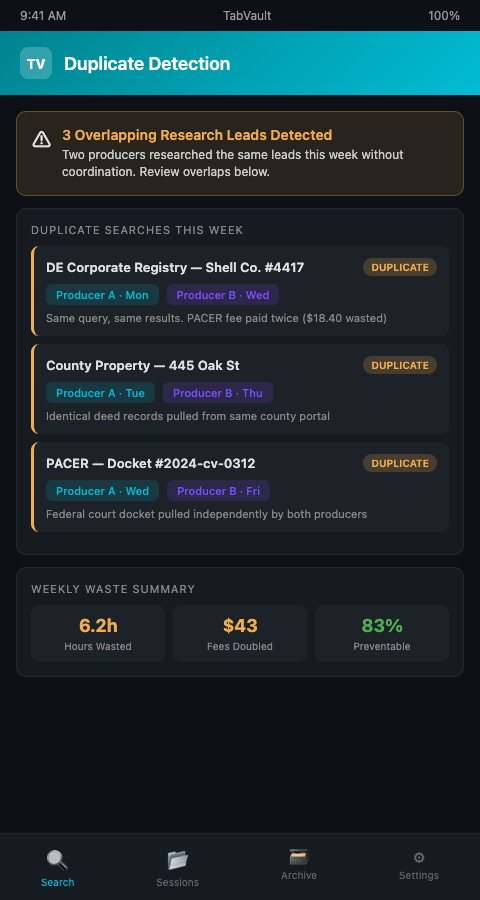
Consider a two-producer team investigating a municipal fraud case. Producer A spends Monday searching Delaware corporate filings for a shell company connected to the subject. Producer B, unaware of Monday's work, spends Wednesday searching the same Delaware corporate registry for the same company name. Both find the same filing. Both take notes. Both add it to their respective episode prep documents. The investigation does not move forward faster because two people did the same work -- it cost twice as much time.
The problem compounds when the duplicate work involves paid databases. PACER charges per page for federal court records. If both producers independently search PACER for the same defendant, the podcast pays for the same docket entries twice. State court portals with per-search fees double the cost similarly. The financial waste is concrete and measurable, but the time waste is larger. Zoom's global collaboration report found that 64 percent of workers lose at least three hours per week to poor collaboration practices including duplicated effort.
For investigative podcasts with tight budgets and tighter deadlines, overlapping investigation leads represent a structural failure that no amount of good communication can fully prevent. Producers work at different times, in different locations, on different aspects of the same story. The only reliable way to detect duplication is to make all research visible in a single shared system.
Making All Research Visible in One Archive
Duplicate research detection becomes possible when both producers' browser sessions feed into the same searchable index. This is the operational shift.
When Producer A searches Delaware corporate filings on Monday and TabVault indexes those pages, the research becomes visible. When Producer B sits down on Wednesday to begin the same search, a quick query of the shared archive for the company name or the Delaware corporate registry URL reveals that the work has already been done. Producer B sees Producer A's indexed results, reviews them, and moves on to genuinely new ground.
TabVault turns chaotic browser sessions into a searchable private database -- and when that database is shared across a production team, it becomes a duplicate research detection system by default. The detection is not a special feature or a separate step. It is a natural consequence of making all research sessions searchable by everyone on the team.
The workflow for podcast team lead coordination is simple. Before starting any new research task, search the shared archive for the key terms you plan to investigate. If the search returns indexed pages from a colleague's sessions, review those results before opening a single new tab. If the search returns nothing, proceed with your research knowing that you are covering genuinely new ground.
Producers who already maintain shared research archives will find that the duplicate detection layer is an immediate benefit of making those archives searchable instead of merely stored.
Preventing Duplication Without Slowing Research
The concern with any deduplication system is that it might create friction -- requiring producers to check in before every search, slowing down the momentum of active investigation. The key is making the check fast enough that it adds seconds, not minutes.
Pre-session archive check. At the start of each research session, run three or four broad searches for the terms you plan to investigate. The subject's name, the entity names, the geographic area. If previous indexed sessions appear, scan them to understand what has already been covered. This takes two to three minutes and can save hours.
Post-session notification. After completing a research session, send a brief message to the team noting what you covered. A shared Slack channel or project management thread works. The indexed archive provides the detail; the notification provides the alert. The ICIJ's Global I-Hub uses a similar model where journalists post about specific topics so colleagues can cross-check.
Divide by source type, not by topic. If two producers are working on the same lead, assign one to court records and the other to news archives. This prevents overlap while ensuring both source types get covered. The research deduplication happens by structure rather than by checking.
Weekly overlap audit. Once a week, search the shared archive for each active investigation's key terms and review which producers' sessions appear. If the same search terms appear in multiple producers' sessions from the same week, that is a signal that coordination needs tightening.
Advanced Team Research Deduplication Tactics
Track search queries, not only results. The most common form of co-producer duplicate work is running the same query in the same database. If your indexed archive captures the search parameter pages (the form with the query you submitted), you can detect when two producers ran identical queries. The results might differ if the database updated between searches, but the duplicated effort is visible.
Cross-reference against lead assignments. If your team uses a lead tracking system -- a spreadsheet, Airtable board, or project management tool -- cross-reference it against the indexed archive. A lead assigned to Producer A should generate indexed sessions only from Producer A. If Producer B's sessions also contain pages related to that lead, either the assignment was unclear or duplication occurred. Dealers who never clear their indexed browser archives preserve this kind of team visibility indefinitely.
Handle intentional re-verification separately. Not all overlapping investigation leads represent waste. Sometimes a producer deliberately re-searches a database to verify a colleague's findings or to check for updates. When this is intentional, tag or note the session as a verification pass. This distinguishes deliberate re-research from accidental duplication in your archive.
Use duplication patterns to improve planning. If the same types of searches get duplicated repeatedly -- both producers always run the same PACER searches, for instance -- that pattern reveals a planning gap. Address it by assigning PACER research to one producer or by establishing a protocol for research handoff when producers rotate.
Quantify the duplication cost. Track the hours saved each week through pre-session archive checks. PACER alone charges per page, and CourtListener's RECAP Archive — a free, searchable collection of millions of PACER documents gathered via browser extensions — exists precisely because those per-page fees add up fast. If two producers independently pull the same fifty-page docket, that is $6.00 in duplicate charges per document and two hours of redundant reading time. Over a six-month investigation spanning hundreds of filings, the cumulative financial and time cost of undetected duplication is substantial. The shared archive makes both the duplication and the savings measurable.
Establish a "first search" protocol for new leads. When a new name, entity, or address enters the investigation, designate one producer to conduct the initial search across all relevant databases while the other focuses on a different research thread. The designated producer's indexed sessions establish the baseline in the shared archive. Any subsequent searches for that lead by other team members benefit from knowing exactly what was already covered. The SHRM analysis of knowledge transfer emphasizes that passing on institutional know-how requires structured processes rather than informal communication -- and a shared searchable archive is the most structured process available for podcast team lead coordination.
If your investigative podcast team is losing hours each week to duplicate research and you only discover the overlap after the work is done, the problem is visibility. TabVault makes every producer's research sessions searchable by the entire team, so overlapping leads surface before the duplication compounds. Join the waitlist to stop paying twice for work that only needed to be done once.