Why Competitive Dealers Never Clear Their Indexed Browser Archive
The Archive You Almost Threw Away
A dealer in Detroit cleared her browser history at the end of 2024 as part of a routine digital cleanup. Three weeks into January, a restoration contractor called asking about a set of Art Deco elevator doors she had seen listed on an obscure auction site the previous October. She remembered the listing vaguely but had no way to find it again. The auction house's catalog had been updated, the listing was gone, and the contractor hired a competitor who still had the information.
That lost sale was not caused by a lack of skill or market knowledge. It was caused by treating browsing history as disposable. For salvage dealers, the indexed browser archive is not clutter — it is the cumulative record of every sourcing lead, price point, and market observation generated through months or years of daily research.
The Carnegie Mellon tab management study found that participants feared losing hard-won information. For salvage dealers, that fear is justified. Each page you view during a sourcing session represents work: the time to find the listing, the judgment to assess its relevance, the context of what you were looking for that day. Clearing the archive erases all of that labor.
The salvage market reinforces the value of keeping salvage sourcing history. Unlike commodities with standardized pricing and steady supply, reclaimed materials are one-of-a-kind. A set of 1890s transom windows appears once. If you saw the listing six months ago and your archive still contains the indexed page, you can find the seller, check whether the item sold, and potentially source comparable pieces through the same channel. Without the archive, that lead is gone.
The scale of potential loss grows with experience. A dealer who has been sourcing online for five years has viewed tens of thousands of pages — auction catalogs, permit details, supplier inventories, estate sale listings, reference articles. Each page represents a micro-decision: is this relevant now? Maybe not. But it might be relevant in six months when a client with a specific need walks through the door. The World Economic Forum's analysis of deconstruction versus demolition documents that deconstruction recovers 70-90% of building materials, meaning the volume of salvageable material flowing through the market is large and growing. Your browsing archive is your record of which slice of that flow you have personally evaluated.
Clearing that archive is the digital equivalent of shredding your rolodex, your price records, and your supplier notes simultaneously. No experienced dealer would do that with physical records. The same logic applies to digital sourcing history, where the indexed browser archive salvage data represents years of accumulated market intelligence.
The Compounding Value of a Long-Term Archive
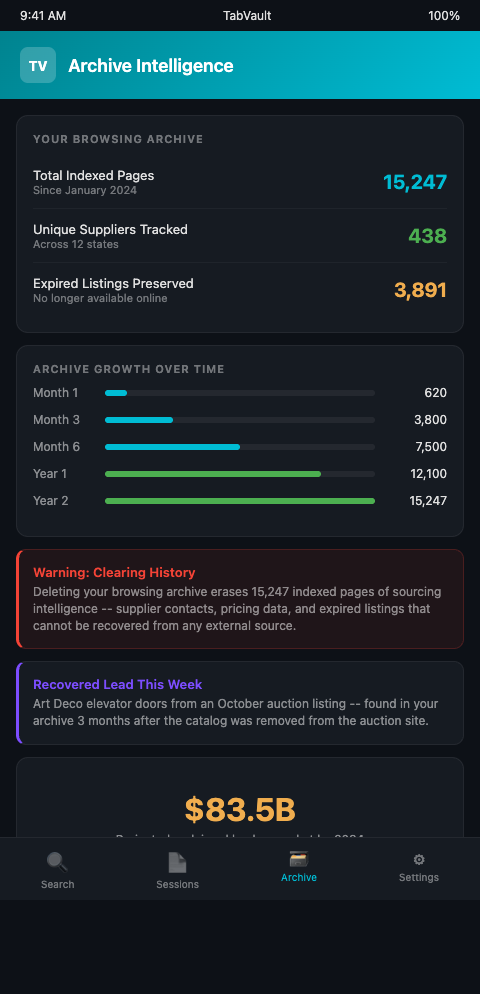
Consider what a two-year browsing archive actually contains. Two years of daily sourcing sessions, averaging thirty pages per session across five work days per week, produces roughly 15,000 indexed pages. Each of those pages carries pricing data, material descriptions, supplier information, geographic context, and timestamps. No spreadsheet, no bookmark collection, and no human memory can replicate the depth and searchability of that corpus. The salvage dealer browser history value of a mature archive is not measured in gigabytes — it is measured in the sourcing leads, pricing comparables, and market insights it makes instantly retrievable.
The reclaimed lumber market projected at $83.53 billion, and the competitive advantage salvage research provides grows as the market expands. More inventory means more listings, more price data, and more sourcing opportunities flowing through your browser every day. A long-term salvage browsing archive captures all of it.
The principle of turning chaotic browser sessions into a searchable private database makes this archival approach not just theoretical but practical. TabVault makes it frictionless. Instead of keeping hundreds of tabs open or maintaining unwieldy bookmark folders, every page you visit during sourcing sessions is indexed locally and remains searchable indefinitely. The archive grows passively as you work. After six months, your index contains thousands of pages — listings that have since been taken down, auction results that are no longer on the catalog site, permit details that have cycled off the city portal.
This historical depth matters for several reasons. First, it provides pricing baselines. A search for "reclaimed heart pine flooring" returns every listing you have seen over the past year, with prices and dates, giving you a longitudinal view of the market that no single snapshot can provide. This is the price intelligence that separates informed pricing from guesswork.
Second, it preserves supplier relationships. Your archive contains every page you visited from every supplier, auction house, and estate sale company. A search for a supplier's name reveals their full inventory history as you observed it — what they stocked, when they stocked it, and how they priced it. Over time, this creates a supplier intelligence profile that guides your sourcing priorities.
Third, it supports provenance claims. When a restoration project requires documented sourcing, your indexed archive shows the original listing, the date you found it, and the context in which it was offered. This is a lightweight provenance trail that adds credibility to your inventory descriptions.
Fourth, it provides a safety net against platform changes. Websites redesign, auction houses close, online marketplaces merge or shut down. The listing you viewed two years ago on a site that no longer exists still lives in your indexed archive. The NPR reporting on the 23andMe bankruptcy demonstrated how quickly user data can become inaccessible when a platform fails. The same risk applies to any online marketplace or listing service the salvage industry depends on. Your local archive is immune to those platform-level disruptions.
Genealogy researchers face the same archival imperative. Investigators who study the hidden cost of duplicate research in parentage cases know that clearing history means re-doing work that was already completed — a direct parallel to the salvage dealer who has to re-find a listing they already reviewed.
Advanced Tactics for Archive Preservation
Treat your archive as a business asset. Just as you would not throw away physical inventory records, do not discard your digital sourcing history. The indexed archive is a record of your competitive intelligence gathering — the pages you reviewed, the prices you observed, the leads you pursued. Its value increases with age.
Use the archive for seasonal planning. After a year of indexed browsing, you have a record of which types of salvage appeared in each season. If estate sales with Victorian content cluster in April and May, plan your spring sourcing accordingly. If commercial demolition permits spike in September, prepare warehouse space for larger hauls.
Mine the archive when new clients appear. A new client with a specific need — Art Deco light fixtures, for instance — benefits from the research you did before they existed as a client. Search your archive for their criteria and present options from listings you encountered months ago. Even if those specific items are sold, the sellers may have comparable inventory.
Back up your index. A local index is only as durable as the hardware it lives on. Maintain regular backups of your TabVault archive so that a drive failure does not destroy years of accumulated sourcing intelligence.
Share strategically. If you operate with partners or employees, a shared archive means new team members inherit the collective sourcing history of the entire operation.
Let the archive settle disputes. When a client claims they saw a lower price elsewhere, or when a partner questions whether you already checked a particular source, the archived record resolves the disagreement with evidence. You can point to the specific page, the specific date, and the specific price — not from memory, but from the index. This factual basis for decision-making is one of the underrated benefits of maintaining a long-term salvage browsing archive.
Track your own evolution as a sourcer. Reviewing your indexed browsing from a year ago reveals how your sourcing patterns have changed — which sources you have added, which you have dropped, how your search queries have become more specific. This self-awareness helps you identify blind spots in your current routine and opportunities to expand into new source types or geographic areas.
Your History Is Your Edge
The difference between a dealer with a mature indexed archive and one without is the difference between a researcher with a library and one with only their memory. The archive does not replace expertise — it amplifies it. It makes every observation, every price point, and every supplier interaction retrievable instead of relying on recall alone. Every page you have browsed during your salvage sourcing career is a data point that a competitor does not have. Clearing that history is clearing competitive advantage. TabVault preserves your indexed browser archive automatically, turning your accumulated browsing into a permanent, searchable business asset. Join the waitlist and stop throwing away the research that took you years to build.
A two-year archive contains roughly fifteen thousand indexed pages of sourcing intelligence -- pricing history from completed auctions, supplier inventory snapshots, demolition permit records, and building history research that no competitor can reconstruct. That archive survives browser crashes, platform shutdowns, and hardware upgrades because it lives on your machine as a permanent, searchable database. Clearing it would erase years of accumulated market knowledge. Keeping it means every future search gets richer and every business decision gets sharper.