Building Price Intelligence From Weeks of Indexed Browsing
The Pricing Blind Spot
A dealer in Nashville quoted a set of reclaimed heart pine flooring at $8 per square foot, based on his memory of recent sales. The buyer pushed back, citing a listing he had found at $5.50. The dealer had no way to verify whether that lower price was an outlier, a different grade of lumber, or the new market rate. He lost the sale.
The global reclaimed lumber market alone was valued at an estimated $57.28 billion in 2024, and architectural salvage price tracking across this market is almost entirely manual. Unlike new building materials, which have standardized wholesale pricing and published indexes, reclaimed materials are priced individually by condition, provenance, rarity, and local demand. A matched set of 1880s pocket door hardware in original brass commands a premium that no published index captures. The only reliable price data lives in the listings, auction results, and catalog pages that dealers encounter during their daily browsing — and most of that data disappears the moment the tab is closed.
The Grand View Research report on reclaimed lumber notes that the commercial segment held a 57.9% revenue share in 2022, indicating that commercial buyers are the largest pricing force in the market. Dealers who cannot match commercial pricing intelligence with their own data are negotiating at a disadvantage.
The absence of standardized pricing creates a knowledge asymmetry that favors the better-informed party in every transaction. Buyers — especially commercial buyers with procurement teams — research pricing systematically. They compare across suppliers, track seasonal fluctuations, and arrive at negotiations with data. Sellers who rely on instinct and spotty recall are at a structural disadvantage. The dealer who can cite specific comparable sales from the past three months, with dates and sources, negotiates from a position of authority that instinct alone cannot provide.
The challenge is that price data in the salvage market is scattered across hundreds of sources, each with its own format, its own update schedule, and its own browsing interface. Auction results live on one site. Retail listings live on another. Wholesale dealer inventories live on a third. A systematic price comparison salvage market analysis requires aggregating data across all of them — and maintaining that aggregation over time, not just on the day you happen to check.
Turning Browsing History Into a Pricing Database
The Sustainable Development Code on material reuse note that salvage and reuse markets are expanding as municipalities adopt deconstruction mandates and green building standards. As the market expands, pricing becomes more dynamic and harder to track from memory. What cost $12 per square foot in Atlanta may cost $8 in Cleveland and $18 in San Francisco. The dealer who knows these regional differentials — because they have them documented across months of indexed browsing — prices accurately in every market.
The fundamental shift is recognizing that every price you encounter during your normal sourcing is a data point worth preserving. When your browsing sessions are indexed, every listing price, auction result, and catalog entry becomes a searchable record — not just today, but across weeks and months of accumulated sessions. This is the principle behind TabVault's approach: turning chaotic browser sessions into a searchable private database that builds pricing intelligence as a byproduct of your normal work.
Here is how salvage price intelligence browsing works in practice. Over three weeks, you browse estate sale listings, auction catalogs, online salvage marketplaces, and competitor inventories as part of your regular sourcing routine. TabVault indexes the full text of every page you view. At the end of week three, a client asks for a quote on reclaimed clawfoot tubs. You search your archive for "clawfoot tub" and pull up every listing, auction result, and catalog page containing that phrase — with prices, descriptions, conditions, and dates all visible.
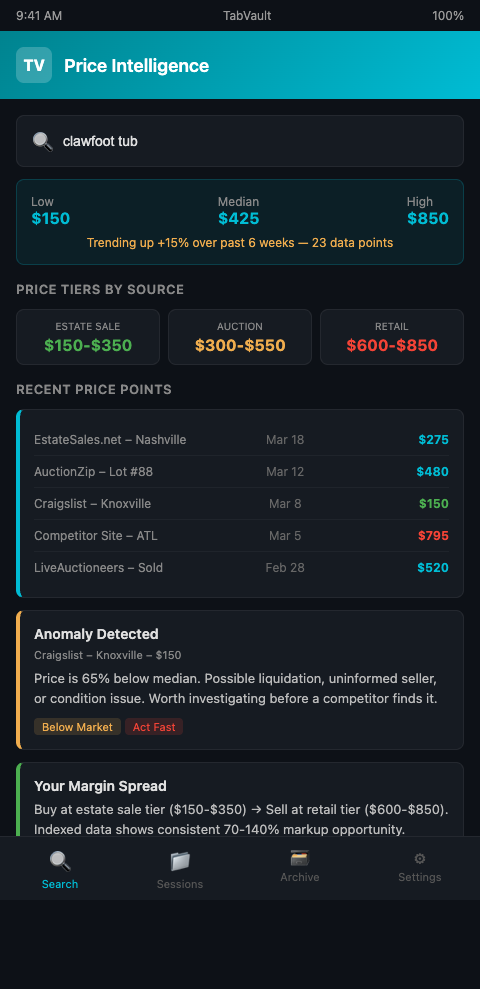
That search result is a price comparison salvage market analysis built from real market data. You can see the range of prices, identify outliers, note which sellers are pricing aggressively, and spot trends. If tub prices have risen 15% over the past month based on indexed listings, you quote accordingly. If one seller consistently prices below market, you know where to source.
The value of indexed pricing data reclamation increases with time. A single week of browsing might capture twenty or thirty price points for a common material. Six months of browsing captures hundreds. At that scale, your archive becomes genuine market intelligence — not a formal database with structured fields, but a full-text searchable corpus of real-world pricing data that no competitor has access to unless they built the same archive.
TabVault preserves this pricing data locally and privately. Your pricing intelligence is not shared with any platform or competitor. It exists only on your machine, queryable by you alone. This is the same competitive advantage that investigative producers build when constructing episode timelines from indexed sessions — the accumulated data becomes a strategic asset precisely because it is private and comprehensive.
The architectural salvage price tracking capability also applies to your own sales history. If you maintain an online storefront or list items on marketplace platforms, those pages get indexed too. Over time, your archive contains both buy-side and sell-side pricing data — what you paid for materials and what you sold them for. The margin analysis this enables is straightforward: search for a material type and see both acquisition costs from sourcing sessions and sale prices from your own listings, all in one result set.
Advanced Tactics for Pricing Intelligence
Search by material and date range to track price movement. Because each indexed page carries a timestamp, you can review how prices for a specific material have changed over weeks or months. If you indexed a reclaimed oak mantel listing at $1,200 in January and a similar one at $1,500 in March, you have documented a price trend. Multiply that across dozens of listings and you have a directional indicator for the broader market.
Compare across source types. Estate sale prices, auction hammer prices, and retail catalog prices represent three different market tiers for the same material. Your indexed archive lets you see all three in one search, revealing the spread between wholesale and retail. That spread is your margin, and understanding it precisely is the difference between profitable pricing and leaving money on the table.
Build a pricing playbook for your most-requested items. Identify the ten materials clients ask about most frequently. Run periodic searches for each one and note the current price range. Update these ranges monthly. After a few months, you have a living price guide that is more current and more specific to your market than any published resource.
Flag anomalies. If a listing appears at a price far below or above your indexed range, investigate. Below-market prices may signal a liquidation, an uninformed seller, or damaged goods. Above-market prices may indicate a rare variant or a seller targeting the collector market. Either way, the anomaly is only visible when you have a baseline — and your indexed archive provides that baseline. According to Allied Market Research, over 30% of custom home builders in the United States now incorporate reclaimed wood into their projects, which means pricing anomalies increasingly reflect genuine demand shifts rather than random fluctuations.
Use pricing data to justify your quotes. When a client questions your price, you can reference the range of prices you have documented across multiple sources and dates. This is not a formal appraisal, but it is evidence-based pricing that demonstrates market awareness. The principle parallels how genealogy researchers use indexed archives to justify evidence preservation decisions — the accumulated record gives credibility.
Identify emerging pricing categories. The salvage market evolves. Materials that were low-value five years ago — mid-century modern fixtures, for instance — may be commanding premiums today as design trends shift. Your indexed pricing archive captures this evolution. A search for a material type that shows prices rising over consecutive months signals a trend worth pursuing. A search that shows prices declining signals a category to deprioritize. This trend detection capability is impossible without a longitudinal data set, and your indexed browsing history is exactly that.
Build seasonal pricing calendars. The Rubicon analysis of C&D waste notes that construction and demolition debris constitutes nearly one-quarter of the national waste stream, with demolition activity fluctuating seasonally. After a year of indexed browsing, you have enough data to identify seasonal price patterns. If reclaimed brick prices drop in winter when construction slows and rise in spring when demand picks up, your archive documents that cycle. Use it to time your purchases — buy in the low season, sell in the high season — with data rather than intuition backing the decision.
Price With Confidence, Not Guesswork
The salvage market price analysis you need to make informed business decisions already exists in the pages you browse every day. The data is there — you are viewing it, evaluating it, forming opinions based on it. The only missing piece is a system that preserves it beyond the current browser session. Every listing you browse is a price data point that vanishes when you close the tab. TabVault captures those data points automatically, building a searchable pricing archive that grows with every sourcing session. Stop relying on memory and start pricing from data. Join the waitlist and turn your daily browsing into the salvage market price analysis your business needs.
Every listing price, auction hammer result, and catalog entry you view becomes a data point in your private pricing archive. After sixty days, a search for "clawfoot tub" returns dozens of price points spanning estate sales, auctions, and retail catalogs -- enough to establish a defensible market range. After a full year, your archive contains thousands of pricing observations that no published index covers. Quote with the confidence of someone who has data, not the uncertainty of someone relying on last month's memory.