Understanding Private Indexing for Competitive Salvage Intelligence
Your Competitors Cannot Search Your Browsing History
Two salvage dealers in the same metro area browse the same sites: the same county demolition portals, the same EstateSales.net listings, the same Craigslist boards, the same auction previews. Both see the same raw information. The difference between them is what happens after the browsing session ends. One closes tabs and starts fresh the next day. The other has a private, searchable archive of every page visited over the past six months -- a local database of pricing history, material availability, demolition patterns, and competitor inventory that no one else can access.
That archive is competitive salvage intelligence, and it exists only because the data stays local.
The U.S. Small Business Administration defines competitive analysis as identifying your competition by product line and market segment. For salvage dealers, competitive analysis happens organically during sourcing: you browse a competitor's website and see their pricing; you check an auction result and see what a lot sold for; you monitor demolition permits and notice which contractors another dealer works with. The problem is that this analysis is trapped in ephemeral browser sessions rather than accumulated in a searchable system.
A Carnegie Mellon University study on browser behavior found that about 25 percent of participants had experienced browser or computer crashes from having too many tabs open (Carnegie Mellon University, 2021). When those tabs contain six months of competitive intelligence, a crash does not just close pages -- it erases market knowledge.
How Private Browser Indexing Salvage Data Works
Private browser indexing means that the full text of every page you visit is indexed and stored locally on your machine. No data leaves your computer. No cloud service processes your browsing. No third party can see what you have searched for or what pages you have indexed.
TabVault implements local-only salvage data indexing as its default architecture. When you browse a competitor's inventory page, an auction result, or a demolition permit filing, the page content is indexed in a local database on your hard drive. The index lives on your machine, encrypted and inaccessible to anyone who does not have physical access to your computer.
This matters for three reasons specific to the salvage trade. Cloud-based note-taking tools, browser sync services, and online bookmark managers all store your data on servers you do not control. That data could be accessed by the service provider, exposed in a breach, or discontinued if the service shuts down. Local-only indexing eliminates all three risks.
Sourcing intelligence is competitive advantage. If your research into available materials, pricing trends, and demolition activity were visible to competitors, they could replicate your sourcing strategy. Local-only indexing ensures your archive is private. The demolition permits you track, the estate sales you monitor, the auction catalogs you review -- all of this browsing generates intelligence that is valuable precisely because it is yours alone.
Pricing data is sensitive. When you index competitor pricing pages over time, you build a historical pricing database. That database reveals competitor pricing strategies, seasonal adjustments, and markup patterns. Sharing that data -- even inadvertently through a cloud-synced service -- could undermine your pricing advantage.
Demolition lead pipelines are time-sensitive. If your demolition monitoring data were accessible to others, the head start you gain from systematic permit tracking would disappear. Private indexing preserves the exclusivity of your lead pipeline.
This principle of turning chaotic browser sessions into a searchable private database applies the word "private" literally. Your database is yours alone.
Building Architectural Salvage Market Intelligence
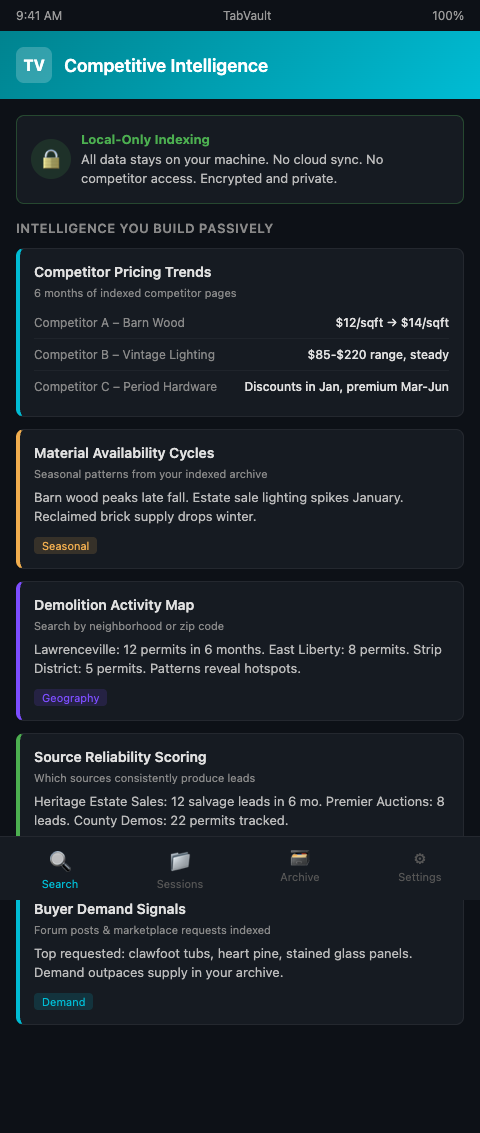
With a private index accumulating data over months, you can run analyses that would be impossible from memory or from a folder of bookmarks.
Competitor pricing trends. Search your archive for a competitor's name and review every product page you indexed from their site. Compare prices for similar materials across different dates. Over six months, patterns emerge: when they discount, what they overprice, which categories they do not carry. This is architectural salvage market intelligence built from your own browsing -- not from an expensive market report.
Material availability cycles. Search your archive by material type and review results by date. You may discover that reclaimed barn wood listings peak in late fall when barn demolitions complete before winter, or that estate sale listings for vintage lighting spike in January after holiday season cleanouts. These cycles are invisible without historical data, and your private index is the only place that data exists.
Demolition activity mapping. Search your archive by neighborhood or zip code and retrieve every demolition permit you indexed for that area. Over a year, you build a map of demolition hotspots -- neighborhoods where buildings are coming down consistently, creating recurring sourcing opportunities. This aligns with the approach genealogy researchers use for private indexing of sensitive local data, where keeping research local is a matter of both privacy and practicality.
Buyer demand signals. If you use online forums, Facebook groups, or classified platforms to monitor what buyers are requesting, those pages get indexed too. Over time, your archive reveals demand patterns: which materials buyers request most often, what sizes and styles are in short supply, where geographic demand clusters. Your sourcing strategy shifts from reactive to predictive.
Source reliability scoring. Search your archive by estate sale company, auction house, or demolition contractor name. The results show you the history of what each source has offered. After a year, you know which estate sale companies consistently feature architectural elements, which auction houses handle high-quality salvage lots, and which contractors are willing to negotiate pre-demolition access.
Geographic sourcing heat maps. Search your archive by city, zip code, or neighborhood name and review the density of results. Areas with frequent demolition permits, estate sales, and salvage listings represent high-opportunity zones worth monitoring closely. Areas with sparse results may not justify regular sourcing trips. Your indexed browsing data becomes a geographic guide to where your time is best spent. The EstateSales.net 2024 Industry Survey shows over 9,000 estate sale companies operating nationwide, but their geographic distribution is uneven -- your indexed archive reveals where the concentration is highest in your market.
Advanced Competitive Intelligence Tactics
Index auction results, not just previews. When an auction closes and results are posted, visit the results page so TabVault indexes the sold prices. Over time, this builds a private database of realized prices for salvage materials -- data that auction houses charge subscribers to access, but that you accumulate for free through regular browsing and indexing.
Track new competitor entries. When a new salvage dealer opens in your market, their website gets indexed the first time you visit. Periodic revisits keep your index updated with their growing inventory. You know what they carry and what they charge without maintaining a manual tracking spreadsheet.
Cross-reference sourcing tabs with demolition data. When you index both demolition permits and salvage listings, your archive lets you connect the two. Search an address from a demolition permit and find that an auction house is already marketing materials from that site -- intelligence that tells you the salvage opportunity may already be spoken for, saving you a wasted trip.
Build a private indexed browser archive over years. Unlike cloud-based tools that may change pricing, terms, or ownership, a local index remains under your control indefinitely. Your competitive intelligence archive is not subject to a third party's business decisions. The data you indexed three years ago is still there, still searchable, still private.
Use intelligence for strategic inventory decisions. When your archive reveals that a particular material category -- say, reclaimed subway tile -- has appeared in 40 listings over six months with rising prices, that is a market signal to stock more of it. When another category shows declining availability, you know to source aggressively before supply tightens further. These insights emerge from data, not intuition, and they are available only to the dealer who has been systematically indexing their browsing history.
The EPA's data on C&D material recovery shows the scale of the demolition economy, but individual market intelligence -- what is available in your region, at what price, from which sources -- is something only systematic, private indexing can provide.
The distinction between a dealer with private browser indexing and one without is the distinction between operating with six months of searchable market data and operating from memory alone. Both browse the same sites. Both see the same listings. The difference is that one retains and can search everything they have encountered, while the other starts fresh each session. Over time, that gap becomes a structural advantage that no amount of browsing speed or market experience can close.
Your Intelligence, Your Machine, Your Advantage
Competitive advantage in the salvage trade comes from knowing more than the next dealer about what is available, where, and at what price. TabVault builds that knowledge base automatically from your daily browsing, keeps it private on your machine, and makes it searchable whenever you need it. Join the waitlist and start building the competitive intelligence archive that only you can access.
Two dealers browse the same sites. One starts fresh each morning. The other searches a private archive containing six months of indexed competitor pricing, demolition patterns, and supplier inventory snapshots -- all stored locally on hardware only they control. After a year, that archive holds over ten thousand pages of competitive intelligence invisible to everyone else. The gap between these two dealers widens with every browsing session, and no amount of market experience can substitute for searchable data.