When Salvage Sourcing Lives in 50 Open Tabs: A Better Approach
The Morning Everything Disappeared
A dealer outside Pittsburgh had 53 tabs open on a Thursday afternoon last spring. Fourteen were estate sale listings on EstateSales.net, eight were demolition permit notices from two different county portals, a dozen were eBay and Craigslist posts for period door hardware, and the rest were auction house catalogs and supplier pages. Chrome froze, force-quit was the only option, and session restore recovered exactly nine tabs. The rest were gone -- along with three days of sourcing work.
That scenario is ordinary in the architectural salvage trade. Sourcing reclaimed materials means monitoring a scattered constellation of websites: municipal demolition portals, estate sale aggregators, online auction platforms, Facebook Marketplace groups, and regional Craigslist boards. A Carnegie Mellon University study on browser tab behavior found that about 25 percent of participants reported their browser or computer had crashed because they had too many tabs open, and that people felt psychologically invested in their open tabs even as the count became unmanageable (Carnegie Mellon University, 2021).
For salvage dealers, tab overload is not just an inconvenience. It is a business problem. Every forgotten tab is a potential lead -- a Victorian-era mantel about to sell at an estate sale, a demolition notice for a 1920s schoolhouse with intact terrazzo flooring, an auction lot of reclaimed heart pine that closes in 48 hours. The EPA estimates 600 million tons of C&D debris, and salvage dealers compete for the small fraction of that material worth reclaiming before it reaches the landfill. Losing track of leads in a sea of open tabs salvage dealers rely on means losing inventory and revenue.
The problem compounds because salvage sourcing is inherently time-sensitive. Estate sales last two or three days. Auction lots close on fixed dates. Demolition permits trigger work that starts within weeks. A lead that sits in an open tab for five days without action may already be dead by the time the dealer remembers it. The combination of high lead volume, multiple source platforms, and tight timelines makes tab-based sourcing fundamentally unreliable.
From Salvage Sourcing Browser Tabs to a Searchable Lead Archive
The fundamental shift is treating your browser not as a workspace you will return to, but as a collection point whose contents flow into a permanent, searchable index. This is the principle behind turning chaotic browser sessions into a searchable private database -- every page you visit during a sourcing session gets captured, indexed, and made available for full-text search long after the tab is closed.
TabVault applies this principle to the architectural salvage sourcing workflow. When you open a demolition permit page on a county portal, an estate sale listing with photos of stained glass transoms, or an auction catalog featuring reclaimed barn beams, TabVault indexes the full text of that page locally on your machine. Close the tab whenever you need to. The content persists in your private archive, and you can query it later by keyword, address, material type, or any text that appeared on the original page.
Consider what this means for organizing salvage leads online. Instead of keeping 50 tabs open as fragile bookmarks, you browse normally through your morning sourcing routine -- scanning EstateSales.net, checking county permit portals, scrolling through auction previews -- and every page is silently added to your local index. Two days later, you remember seeing a listing for cast iron radiators but cannot recall where. You type "cast iron radiator" into TabVault and every indexed page containing that phrase appears, whether it was an eBay listing, an estate sale description, or a forum post mentioning a demolition site.
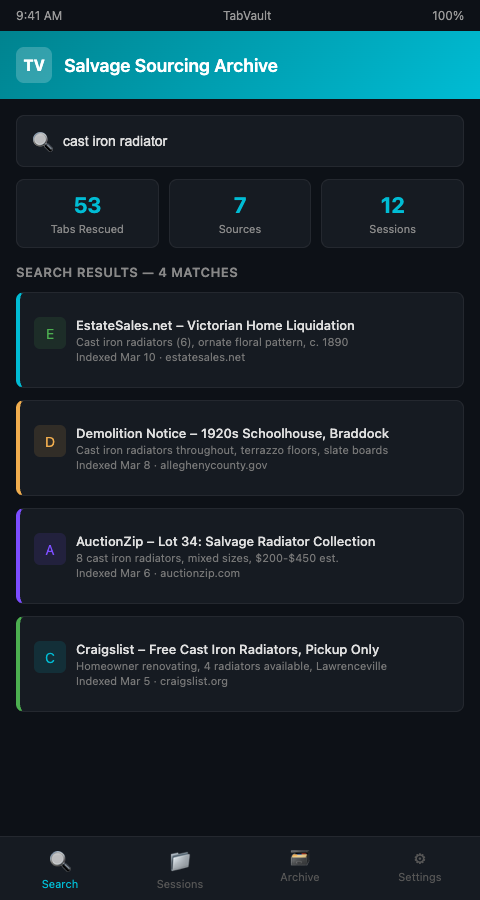
This approach also solves the architectural salvage lead management problem that spreadsheets and bookmark folders create. Spreadsheets require manual data entry -- copying URLs, typing descriptions, noting prices -- which few dealers maintain consistently during fast-paced sourcing sessions. Bookmark folders preserve URLs but not content; if the listing is taken down or the page changes, the bookmark points to nothing useful. A full-text index captures the entire page as it existed when you viewed it, preserving listing details, prices, photos descriptions, contact information, and location data without any manual effort.
The value compounds over time. After three months of indexed sourcing sessions, you have a searchable archive of every estate sale listing, demolition notice, auction catalog, and marketplace post you encountered. When a client asks for reclaimed heart pine flooring, you search your archive and find six listings you viewed over the past quarter -- including two that are still active and one from a demolition site you had forgotten about entirely. That kind of lead capture from browsing history is impossible with tabs alone.
TabVault stores everything locally, which matters for competitive sourcing. Your indexed leads are not shared with any cloud service or visible to competitors. The archive is yours, on your machine, searchable only by you.
The architectural salvage lead management advantages extend beyond simple retrieval. Because every page is full-text indexed, you can search across listing types. A search for "walnut" returns estate sale pages describing walnut mantels, auction lots featuring walnut doors, demolition notices for buildings known to contain walnut trim, and Craigslist posts offering walnut flooring. You are not searching one platform at a time -- you are searching your entire sourcing history as a single corpus. This cross-platform retrieval is what transforms tab overload reclamation sourcing from a daily grind into a compounding asset.
The National Trust for Historic Preservation has galvanized support for more than 350 endangered sites since 1988, but the majority of buildings with salvageable materials never make any watchlist. Salvage dealers are the last opportunity for those materials to avoid the landfill, and a systematic sourcing archive is the tool that makes that possible at scale.
Advanced Tactics for Tab-Based Sourcing
Build sourcing sessions around material categories. Dedicate Monday mornings to door and window sourcing, Tuesday to hardware and fixtures, Wednesday to structural lumber and flooring. When you search your archive later, the session dates help you narrow results to the material type you were focused on that day. This pairs naturally with building a searchable salvage inventory pipeline from your browsing habits.
Set up recurring searches for high-value keywords. Terms like "pre-war demolition," "Victorian estate sale," or "reclaimed chestnut" should be part of your weekly search routine inside your TabVault archive. New results appear as you index fresh pages each week, and older results stay available for comparison. Over time your archive becomes the most comprehensive record of salvage availability in your region.
Cross-reference demolition notices with sourcing leads. When a county portal lists a demolition permit for a 1940s commercial building, search your archive for the address or neighborhood. You may find that you previously indexed an auction listing, a historical society page, or a real estate listing for the same property -- context that helps you assess whether the site is worth a trip. Dealers who use tab search across sourcing sessions find connections that a single browsing session would never reveal.
Use date ranges to track lead freshness. Not every indexed page stays relevant. Estate sales end, auction lots close, demolition timelines shift. Searching your archive by date range lets you focus on leads from the past two weeks while still having access to older data when you need historical context -- such as what a similar lot of reclaimed materials sold for six months ago.
Index reference material alongside leads. Architectural style guides, period hardware catalogs from companies like Olde Good Things with its 4,500-plus vintage hardware pieces, and restoration forum discussions all contribute context that improves your sourcing decisions. When these pages enter your index, a search for "Eastlake hinge" returns both the reference identification guide and the estate sale listing where you spotted one for sale. Your sourcing archive doubles as a reference library.
Track pricing trends across months. After three months of indexed sessions, search your archive for a commonly sourced material -- say, reclaimed barn wood -- and review the prices listed across the dozens of pages you indexed. You now have a pricing trendline built from real listing data, not from memory or guesswork. This data helps you bid smarter at auctions and negotiate better with sellers.
The EstateSales.net 2024 Industry Survey reports that over 9,000 estate sale companies list on the platform nationwide, generating a constant flow of new listings. No dealer can monitor all of them manually. An indexed archive turns that firehose into a searchable database you can query on your own schedule.
Stop Losing Leads to Browser Crashes
Your browser was built to display web pages, not to manage a salvage sourcing operation. Every open tab is one crash, one accidental close, one forced restart away from disappearing. TabVault turns your sourcing sessions into a permanent, searchable archive -- a private database of every lead, listing, and notice you encounter online. If you are tired of rebuilding your lead pipeline after every browser crash, join the waitlist and start building the archive your business depends on.
Picture this: you install TabVault on a Monday, and by Friday your archive already contains every demolition notice, estate sale listing, and Craigslist post you reviewed that week. Within ninety days, you have a searchable database of over a thousand pages -- complete with addresses, material descriptions, and pricing data. A year from now, when a client asks for reclaimed chestnut flooring, you will search an archive spanning every source you have touched in twelve months and surface leads that competitors lost to closed tabs weeks ago.