The Salvage Dealer's Guide to Capturing Every Online Lead
Three Leads Lost Before Lunch
On a Wednesday morning in March, a salvage dealer in Columbus, Ohio, found three high-value leads during a 90-minute sourcing session. The first was a demolition permit filing for a 1935 Art Deco theater on the city's east side. The second was an estate sale listing in Granville featuring original Craftsman-era built-in cabinetry and period lighting. The third was an AuctionZip preview for 800 board feet of reclaimed white oak from a barn disassembly in Licking County. He bookmarked none of them. By Friday, the demolition permit page had been updated with a new address, the estate sale listing had scrolled off the first page of EstateSales.net, and the auction preview link returned a 404 error.
This pattern repeats daily across the salvage trade. The EPA estimates 600 million tons of C&D debris, and the salvageable fraction of that material appears briefly on municipal portals, auction sites, and marketplace platforms before vanishing. Salvage dealer online lead capture is fundamentally a race against time and against the ephemerality of web content.
The challenge is not finding leads. Most experienced dealers know where to look. The challenge is retaining what you find during the browsing session so it remains accessible when you need it -- hours, days, or weeks later. Bookmarks save URLs but not content. Spreadsheets require manual data entry that interrupts the flow of sourcing. Screenshots capture images but produce unsearchable files. None of these approaches scale to the volume of pages a salvage dealer browses in a typical week.
The National Trust for Historic Preservation has galvanized support for more than 350 endangered sites since 1988, but the materials inside most demolished buildings never receive that level of attention. Salvage dealers are the front line for material preservation, and their sourcing effectiveness depends directly on their ability to capture and retrieve online leads.
Building a Lead Capture System From Your Browser
The most reliable architectural salvage sourcing guide begins with a simple principle: every page you view during a sourcing session should be automatically captured, indexed, and made searchable. This is the practice of turning chaotic browser sessions into a searchable private database, and it is what separates professional salvage marketplace lead tracking from the ad hoc approach of open tabs and scattered bookmarks.
TabVault implements this principle by indexing the full text of every page you visit. The mechanics are passive: you browse your usual sources, and TabVault captures the content in the background. No copying URLs into spreadsheets. No screenshot folders. No manual tagging. The content flows into a local, private index that you query like a database.
Here is what a captured-lead workflow looks like in practice.
Morning sourcing session. You open your county's demolition permit portal and scan new filings. You browse EstateSales.net for sales within a 60-mile radius. You check AuctionZip for upcoming deconstruction and salvage auctions. You scan Craigslist for "architectural salvage" and "reclaimed wood" in your region. TabVault indexes every page as you view it.
Midweek client request. A restoration contractor calls asking for six matching five-panel interior doors from the 1920s or 1930s. You open TabVault and search "five-panel door" or "interior door 1920" or "Craftsman door." Every indexed page containing those terms appears -- the estate sale listing from Monday, the auction preview from last week, the Craigslist post from two weeks ago. You have a lead pipeline assembled from your own browsing history.
End-of-week review. On Friday afternoon, you search your archive by date range for the current week. Every page you viewed surfaces, organized chronologically. You scan for leads you intended to follow up on but forgot -- the demolition notice you meant to call about, the estate sale you planned to attend, the auction lot you wanted to bid on.
Monthly pipeline assessment. At the end of each month, search your archive by material categories your clients request most often. The results show the total volume of leads you encountered for each material type -- and how many you acted on versus how many slipped away. This data reveals gaps in your follow-through and helps you focus reclamation yard online sourcing efforts where they produce the most revenue.
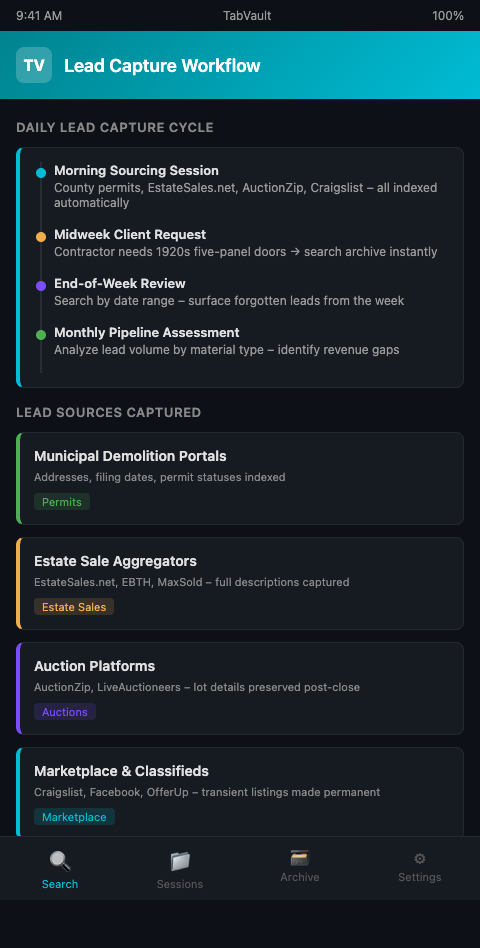
This workflow turns capturing demolition leads online from a manual, error-prone process into an automatic byproduct of normal browsing. The U.S. Small Business Administration recommends that small businesses systematize their market research and competitive analysis. For salvage dealers, the "market" is the constantly shifting landscape of available materials, and systematizing lead capture is how you stop losing inventory to forgetfulness.
Where Leads Come From and How to Capture Each Type
Municipal demolition portals. Cities like Chicago publish building permit data through open data portals, including demolition permits. These pages contain addresses, filing dates, and permit statuses. Full-text indexing captures all of this data, making it searchable by address, neighborhood, or date. When you build a habit of browsing demolition notices regularly, your archive becomes a longitudinal record of demolition activity in your area.
Estate sale aggregators. EstateSales.net, EBTH, MaxSold, and local platforms list sales with descriptions, photos, and dates. The text descriptions often contain material details that photo-only browsing misses. Indexing captures those descriptions so a future search for "marble mantel" or "stained glass" returns estate sale pages you viewed weeks ago.
Online auction platforms. AuctionZip, LiveAuctioneers, and regional auction houses post preview catalogs with lot descriptions. These catalogs are rich in material details but ephemeral -- they disappear after the auction closes. Indexing preserves the catalog content in your archive, creating a historical record of what was available and at what estimated price.
Marketplace and classified platforms. Craigslist, Facebook Marketplace, and OfferUp feature individual sellers posting salvage materials. These listings are highly transient -- a Craigslist post may be deleted within days. Indexing captures the listing content before it disappears.
Specialized dealer websites. Companies like Olde Good Things and Historic Houseparts maintain online inventories with detailed descriptions. Indexing their product pages creates a searchable reference of available inventory that you can cross-reference against client requests.
Advanced Lead Capture Tactics
Capture competitor pricing. When you browse a competitor's website, their product pages with prices get indexed. Over time, this builds a pricing database that helps you set competitive rates for similar materials. Your archive becomes a market intelligence tool similar to how podcast producers build searchable case files from public record browsing.
Index historical society and preservation pages. Local historical societies often publish information about significant buildings in your area. When a building appears on a demolition list, searching your archive for its address might surface historical context that increases the salvage value of its materials -- or helps you pitch to preservation-minded buyers.
Build source profiles. After six months of indexing, search your archive by estate sale company name or auction house. The results show you which sources consistently offer architectural salvage worth pursuing, helping you prioritize your time during future sourcing sessions. A source that produced 12 leads with salvage-relevant materials over six months deserves a weekly check. One that produced two may not be worth the time.
Document your sourcing for business planning. When you assess your business at year-end, your indexed archive provides concrete data: how many leads you encountered, which material categories appeared most frequently, which geographic areas produced the most opportunities. This data supports decisions about whether to expand your sourcing radius, hire a buyer for a new region, or invest in a particular material category. The archive transforms gut instinct into evidence-based planning.
Track seasonal patterns. Reclaimed material pricing shifts seasonally, with outdoor items peaking in spring and interior elements rising in fall. Your indexed archive, searchable by date, lets you compare what was available and at what price across different seasons, informing your buying strategy.
Create a lead-response protocol. Establish a weekly rhythm: browse Monday through Thursday, search and follow up on Friday. The archive makes this protocol possible because Friday's search retrieves everything from the week, not just what you remember. A salvage dealer who responds to every lead within one business week wins more deals than one who rediscovers leads weeks later -- or never rediscovers them at all. The EstateSales.net 2024 Industry Survey shows that the majority of estate sale companies conduct 10 to 20 sales annually per company, meaning new listings appear continuously and a consistent follow-up rhythm is the only way to keep pace.
Index forum and community posts. Restoration forums, Facebook groups for salvage dealers, and community boards where buyers post material requests all contain actionable intelligence. Indexing these pages captures demand signals -- what materials people are actively seeking, at what price points, in which regions. When you find matching materials during a sourcing session, your archive connects supply to demand without relying on your memory to bridge the gap.
Capture Leads Now, Act on Them Later
The salvage business rewards dealers who can act on the right lead at the right moment. TabVault ensures that moment does not pass just because you closed a browser tab. Every page you visit becomes a permanent, searchable entry in your private lead database. Join the waitlist and start capturing every lead your browsing produces.
Every demolition permit you check, every AuctionZip preview you scan, every marketplace post you evaluate adds another entry to your private lead database. One month in, you have captured hundreds of leads without copying a single URL into a spreadsheet. By quarter's end, your archive holds a searchable record of every material opportunity you encountered -- retrievable by address, material type, price, or seller name. The salvage dealer who captures leads automatically outpaces the one who relies on memory every single week.