5 Estate Sale Leads Every Salvage Dealer Loses to Forgotten Tabs
5 Estate Sale Leads Every Salvage Dealer Loses to Forgotten Tabs
The Listing That Sold Before You Remembered It
A salvage dealer in Richmond, Virginia, spotted a three-day estate sale listing on EstateSales.net featuring photos of an intact 1890s walnut staircase, original pocket doors, and a set of porcelain doorknobs. She opened the tab alongside 30 others during a Friday morning sourcing session, intending to return to it after lunch. By Monday, the tab was buried under new research. By Wednesday, the sale had ended. The staircase went to a competitor who showed up on day one.
The EstateSales.net 2024 Industry Survey reports that over 9,000 estate sale companies list on the platform, with a constant churn of new sales appearing weekly. For salvage dealers, each listing is a time-sensitive lead. Estate sale architectural elements -- mantels, hardware, light fixtures, built-in cabinetry, stained glass -- sell quickly to the first buyer who arrives prepared. A Carnegie Mellon University study found that people keep tabs open because they fear losing information that took significant effort to gather, yet the sheer volume of open tabs makes individual pages harder to relocate (Carnegie Mellon University, 2021).
The problem is structural, not behavioral. Dealers do not forget because they are careless. They forget because the volume of listings exceeds what any person can track manually. A dealer who opens 30 estate sale tabs per week encounters 1,500 listings per year. Without a system that captures and indexes those pages automatically, the vast majority of that sourcing intelligence disappears within days.
Here are five specific categories of estate sale listing salvage leads that dealers lose to forgotten browser tabs.
1. Period Hardware Collections
Estate sales in pre-war homes often include drawers or boxes of original hardware: crystal doorknobs, brass bin pulls, cast iron hinges, skeleton keys. These items rarely appear in the headline listing photos. They show up in supplemental gallery images or in the text description as "misc. hardware" or "vintage door hardware included." A dealer who scans the listing quickly may open the tab to review later, but by the time they return, the tab is lost among dozens of others. The hardware collection -- potentially worth hundreds of dollars to a restoration client -- goes unnoticed. Companies like Olde Good Things maintain inventories of over 4,500 vintage hardware pieces, demonstrating the market depth for period hardware. A single estate sale drawer of original Eastlake hinges could supply a restoration project that a dealer would otherwise source piecemeal from specialty catalogs at premium prices.
Full-text indexing captures those buried descriptions. When TabVault indexes the estate sale page, the phrase "vintage door hardware" or "crystal doorknobs" becomes searchable text in your local archive. Days later, when a client requests period hardware for an 1890s Queen Anne restoration, you search your archive and find the listing you had forgotten. This is the difference between a forgotten salvage leads browser workflow and a system that retains every detail you encountered.
2. Intact Architectural Woodwork
Original crown molding, wainscoting, built-in bookcases, and fireplace surrounds appear regularly at estate sales in older neighborhoods. These items are difficult to photograph well and often underrepresented in listing previews. A dealer might open the listing, note the potential, and plan to call the estate sale company for dimensions -- then lose the tab before making the call.
The National Trust for Historic Preservation has documented more than 350 endangered historic sites since 1988, and the materials inside those structures represent a fraction of what passes through estate sales every year without preservation-minded buyers. Every forgotten listing is a salvage dealer missed opportunity that benefits no one.
With TabVault indexing each listing page, the description text that mentions "original built-in china cabinet" or "quarter-sawn oak wainscoting" becomes permanently searchable. When a restoration client needs period woodwork six weeks later, your archive surfaces listings you browsed and forgot -- recovering leads that would otherwise be permanently lost to the forgotten salvage leads browser problem.
3. Lighting Fixtures and Electrical Salvage
Art Deco sconces, schoolhouse pendants, porcelain pull-chain fixtures, and brass chandeliers appear at estate sales with regularity, but they are often listed generically as "vintage lighting" or "old fixtures." A dealer scanning EstateSales.net might open several listings that mention lighting, intending to compare them later. When 15 lighting-related tabs blend into a sea of 40 open pages, the comparison never happens.
TabVault solves this by making every indexed listing searchable by its actual content. Search "Art Deco sconce" and retrieve every estate sale page that used those words -- even if you viewed the listing three weeks ago and closed the tab the same day. Reclamation dealer lead tracking becomes a search query rather than a memory exercise. The distinction between "I think I saw something about lighting last week" and "here are the four estate sale listings that mentioned sconces, with addresses and dates" is the distinction between guessing and knowing.
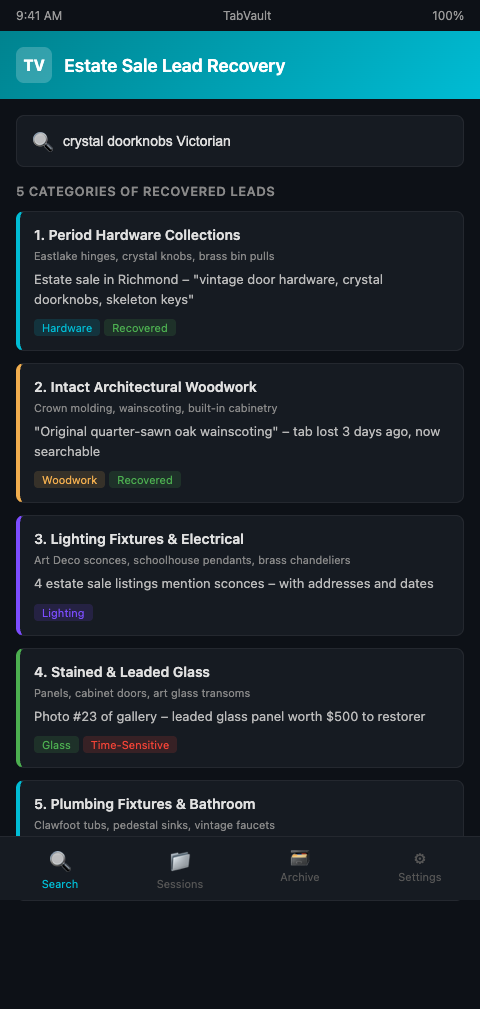
4. Stained and Leaded Glass
Original stained glass panels, leaded glass cabinet doors, and art glass transoms are high-value salvage items that estate sale companies sometimes do not highlight in their marketing. They appear in background photos or are mentioned in passing. A dealer who notices a leaded glass panel in photo number 23 of a 40-photo gallery might open the tab with the intention of contacting the sale company -- then forget about it as the sourcing session continues.
The loss compounds because stained glass buyers are specialists. A panel that sells for $50 at a general estate sale might be worth $500 to a restoration contractor working on a historic church or Victorian home. The EPA's data on construction and demolition debris shows that 600 million tons of C&D material were generated in the US in 2018. Architectural glass that ends up in a dumpster rather than a salvage dealer's inventory is part of that waste stream.
5. Plumbing Fixtures and Bathroom Salvage
Claw-foot tubs, pedestal sinks, original tile work, and vintage faucet hardware are staples of estate sale architectural salvage. These items are heavy, difficult to ship, and therefore undervalued by estate sale companies focused on jewelry, furniture, and collectibles. A dealer who recognizes the value may open the listing tab as a reminder to attend the sale in person -- and then lose track of it before the sale date arrives.
Indexing the listing page captures the sale dates, address, and item descriptions in your searchable archive. When you review your week's indexed pages on Sunday evening, the plumbing fixture listing surfaces alongside every other estate sale lead you browsed that week.
The EPA best practices for C&D reuse specifically cite material reuse as a priority strategy. Vintage plumbing fixtures that end up in estate sale dumpsters after nobody claims them represent exactly the kind of reusable material the EPA's guidance targets. A dealer who captures these leads consistently diverts more material from the waste stream and captures more revenue in the process.
Building a System That Does Not Forget
The pattern across all five categories is the same: a dealer spots a lead, opens a tab, and loses it before acting. The fix is not better tab management or more disciplined bookmarking. It is removing the tab from the equation entirely as a storage mechanism and turning chaotic browser sessions into a searchable private database.
TabVault indexes every page you visit during your sourcing sessions, building a local archive that you search the way you would search a database. Estate sale listings that you viewed on Tuesday are still findable on Friday -- by keyword, by address, by material type, by any text that appeared on the page. The leads that currently fall through the cracks of your online sourcing workflow instead become permanent entries in your private index.
The approach scales with your sourcing volume. A dealer who browses 30 estate sale listings per week indexes 1,500 listings over a year. That archive becomes the most comprehensive record of estate sale architectural elements available in your market -- a private database of materials, pricing, and availability data that compounds with every sourcing session. No bookmark folder or screenshot collection approaches that level of searchable, structured information.
The principle extends beyond estate sales. Every online lead source that salvage dealers use -- auctions, Craigslist, Facebook Marketplace, demolition portals -- shares the same vulnerability: the information exists only as long as the tab stays open. A system that indexes every page removes that vulnerability permanently.
Researchers in other fields face the same structural problem. Genetic genealogists, for instance, lose critical DNA matches between browser sessions for the same reason salvage dealers lose estate sale leads -- tabs are ephemeral, but the information they contain is not.
Stop Letting Estate Sales Slip Away
Every week, estate sales across the country feature architectural elements that salvage dealers need -- and every week, leads vanish into forgotten tabs. TabVault turns your browsing history into a searchable archive where no listing gets lost. If your sourcing depends on estate sales, auctions, and online marketplaces, join the waitlist and build the lead-tracking system your business has been missing.
Think about the estate sale listings you browsed last week. How many can you still find? With TabVault, every listing page -- the walnut staircase in Richmond, the porcelain doorknobs in Savannah, the stained glass transoms in Chicago -- stays indexed and searchable by any word that appeared on it. After three months, your archive contains a quarter's worth of estate sale intelligence that no bookmark folder could preserve. The dealer who can search six months of accumulated listings answers client requests in minutes, not days.