Handing Off Research Context When Podcast Producers Rotate
The Knowledge That Walks Out the Door
Research published in The Learning Organization journal analyzed 91 empirical studies on knowledge loss from staff turnover and found that departing employees take with them not only explicit knowledge -- documented facts and files -- but tacit knowledge: the context, judgment, and decision-making frameworks that informed their work. For investigative podcast producers, that tacit knowledge includes which leads seemed promising but were set aside for later, which database results looked suspicious and warranted follow-up, and which source names appeared in surprising places.
A production company working on a wrongful conviction podcast described losing a lead producer six episodes into a twelve-episode season. The departing producer conducted a two-hour handoff meeting, shared their research folder, and left detailed notes. The incoming producer still spent four weeks reconstructing the investigation's research state. The notes described what was found but not what was searched. The folder contained saved documents but not the dozens of database searches that returned nothing. The handoff meeting covered the narrative arc but not the ninety browser tabs the departing producer had open the day they decided to pursue a specific angle.
The Reworked analysis of institutional knowledge loss documents how high turnover creates "brain drain" that degrades organizational performance. In a podcast production context, the brain drain is immediate and specific: every un-transferred research insight means the new producer either re-discovers it through duplicate work or never discovers it at all.
Making Research Context Transferable
The core problem with traditional handoffs is that they rely on the departing producer's ability to summarize their own research -- and summaries necessarily lose detail. No one can accurately recall every page they visited, every search they ran, and every result they reviewed across weeks of investigation.
TabVault solves this by turning chaotic browser sessions into a searchable private database that belongs to the investigation, not the individual producer. When the lead producer's browser sessions are indexed throughout their tenure, the incoming producer inherits a complete, searchable record of every page visited, every search conducted, and every result reviewed. The handoff does not depend on the departing producer's memory or note-taking discipline.
The research context transfer for the team becomes concrete rather than narrative. Instead of the departing producer saying "I searched the Florida corporate registry for the subject's name," the incoming producer can search the indexed archive, find the actual Florida corporate registry pages, review the search parameters used, and see the results returned. Instead of the departing producer summarizing which FOIA portals were checked, the incoming producer searches the archive and sees every FOIA portal page that was visited.
This transforms the podcast producer research handoff from a lossy compression of weeks of work into a lossless transfer of the complete research trail. The incoming producer does not need to trust the departing producer's summary because they can see the original sources.
Producers who already manage duplicate research detection through shared archives will recognize that the same shared archive that prevents duplication also enables handoffs. The archive is already shared; the incoming producer simply needs to learn how to search it.
Structuring the Handoff Around the Archive
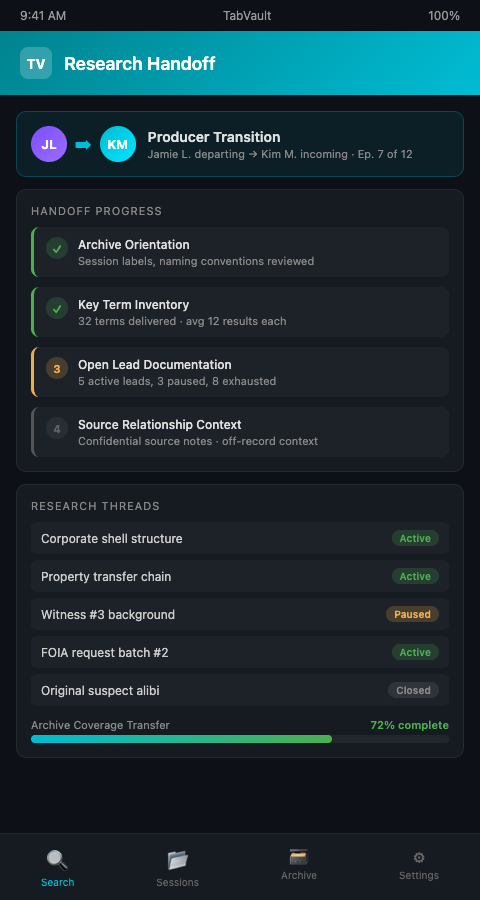
Step one: Archive orientation. Before the departing producer leaves, they walk the incoming producer through the archive's structure. How sessions are labeled, what naming conventions were used, which investigation key terms produce the most relevant results. This orientation takes an hour and gives the incoming producer the search vocabulary they need.
Step two: Key term inventory. The departing producer provides a list of every name, entity, jurisdiction, and topic they investigated. This list is not the research itself -- it is the set of search queries the incoming producer should run against the archive to understand the research landscape. A list of thirty key terms, each producing five to twenty indexed page results, gives the incoming producer a structured path through months of research.
Step three: Open lead documentation. The departing producer flags which leads are still active, which were deliberately set aside, and which were exhausted. For each active lead, the incoming producer searches the archive to see the current state of research. This documentation layer sits on top of the indexed archive -- it tells the incoming producer where to look, while the archive itself shows what was found.
Step four: Source relationship context. Some handoff context is genuinely personal and cannot be indexed: the rapport built with a particular source, the tone of a specific interview, the off-the-record conversation that shaped a line of inquiry. The departing producer transfers this through conversation and notes. Everything else -- the publicly accessible web pages, the database searches, the document reviews -- lives in the searchable archive.
Producers managing co-producer workflows can use the same structure for planned rotations, not only unexpected departures.
Advanced Tactics for Team Research Knowledge Transfer
Incoming producer verification protocol. During the first two weeks, the incoming producer should search the archive for each key investigation term and compare the results against the departing producer's notes. Discrepancies -- terms that produce indexed results not mentioned in the notes, or notes referencing research that does not appear in the archive -- flag gaps that need attention before the investigation proceeds.
Staged assumption of research responsibility. Rather than taking over the entire investigation at once, the incoming producer assumes one research thread at a time. They search the archive for that thread's key terms, review the indexed sessions, conduct any needed follow-up research, and confirm continuity before moving to the next thread. This staged approach prevents the overwhelm of inheriting months of work in a single day.
Preserve the departing producer's search patterns. The way a producer searched -- which databases they prioritized, which name variants they used, which jurisdictions they checked first -- reflects investigative judgment that the indexed archive captures implicitly. The incoming producer can study these patterns by reviewing the chronological sequence of indexed sessions. Architectural salvage teams onboarding new staff with searchable sourcing history use the same approach to transfer institutional knowledge about sourcing patterns and supplier preferences.
Plan for your own eventual departure. The best time to prepare for a producer rotation is before it happens. Maintain clean session labeling, consistent key term usage, and periodic archive audits throughout your tenure. The producer who maintains their archive with handoff in mind ensures that their handing off case research will be smooth regardless of whether the departure is planned or sudden.
Measure handoff completeness with archive metrics. A successful research context transfer for the team can be measured objectively. Count the number of indexed sessions in the archive, the number of distinct search domains represented, and the number of unique entity names that appear across indexed pages. When the incoming producer's own research sessions begin generating results that overlap with the departed producer's archive -- the same names appearing in new contexts, the same court dockets showing updated filings -- the handoff has succeeded. When the incoming producer's searches consistently return zero results from prior sessions, either the archive is thin or the incoming producer is not using the right search terms.
The Harvard Business Review documented that a structured approach to knowledge sharing within organizations -- instead of relying on informal channels -- produces measurably better outcomes, and the same principle applies to podcast production teams navigating producer rotation investigation continuity.
If your investigative podcast has experienced the slow-motion disaster of a producer departure mid-investigation, you know the cost of lost research context. TabVault keeps every research session searchable and transferable, so the investigation's knowledge belongs to the project instead of the person. Join the waitlist to make your next producer rotation a handoff instead of a restart.