Onboarding New Salvage Staff With Searchable Sourcing History
The Knowledge That Walks Out the Door
A salvage operation in Pittsburgh lost its lead buyer to retirement after twenty-three years. Within two months, the remaining team realized how much sourcing knowledge had left with him. He knew which demolition contractors were open to salvage agreements. He knew which neighborhoods had concentrations of pre-1920 housing stock. He knew which online auction houses specialized in architectural hardware and which estate sale companies flagged properties with original woodwork. None of this knowledge was documented anywhere — it lived in his memory and in a browser history that was wiped when the company reformatted his laptop.
The AIHR onboarding research found that only 12% of employees believe their employer does a good job at onboarding, while effective onboarding programs can improve retention by 82% and productivity by over 70%. In the construction and trades sectors, the problem is acute: Code of Talent's research shows that one in three new hires leave within the first 90 days, and the construction industry faces turnover that can exceed 400% annually in some firms.
For salvage businesses, the stakes are particularly high because sourcing knowledge is the core competitive asset. A new employee salvage knowledge transfer that fails means the new hire spends months rediscovering suppliers, neighborhoods, and pricing patterns that the departing employee knew by heart. Every week of that ramp-up period is a week of missed leads and suboptimal purchasing decisions.
The traditional fix — shadowing, written guides, training sessions — captures only a fraction of what an experienced buyer knows. WorkBright's research on knowledge transfer confirms that once established, a structured knowledge transfer process can significantly affect a company's bottom line by increasing employee productivity, yet most trades businesses lack any systematic approach. The specific listing they saw on an auction site in March, the demolition notice that led to a productive neighborhood, the estate sale company that consistently handles properties with original Craftsman features — these micro-observations accumulate over years and resist compression into a training manual.
The CITB and Digital Construction Week analysis of knowledge transfer in construction-adjacent industries found that over a third of workers are aged over 50, and capturing their expertise requires formats that fit naturally into the working day rather than demanding separate documentation effort. For salvage operations, where the most valuable knowledge is embedded in daily browsing patterns rather than formal procedures, the documentation problem is especially severe. Nobody writes down "I check this specific auction house every Thursday because they get consignments from estate liquidators in Germantown" — but that is exactly the type of sourcing intelligence that makes an experienced buyer irreplaceable.
The AIHR onboarding research reports that new hires typically take three to eight months to reach full productivity, and during the first month in a new role, productivity fluctuates around 25%. For salvage operations, where sourcing knowledge is the core differentiator, that ramp-up period represents months of missed leads and suboptimal purchasing. The cost of losing this knowledge is not limited to the ramp-up time for a replacement hire. It is the specific leads, supplier relationships, and market insights that disappear completely. A new hire cannot search for knowledge that was never recorded. They start from scratch, repeating months of sourcing exploration that the departing employee had already completed.
A Searchable Archive as the Institutional Memory
The structural solution is to make the experienced buyer's research visible and searchable before they leave. The principle of turning chaotic browser sessions into a searchable private database applies directly to knowledge retention. When sourcing sessions are indexed by TabVault, every page the buyer views during their daily work enters a local archive — listings, permits, catalogs, supplier pages, pricing references, and neighborhood research. That archive persists independently of the individual. When a new hire joins, they inherit not a training binder but a searchable database built from years of real sourcing activity.
The onboarding experience transforms. Instead of asking "Where do you find Art Deco fixtures?" the new employee searches the archive for "Art Deco" and sees every listing, supplier page, and auction catalog the previous buyer viewed when sourcing that category. The search results are a map of the experienced buyer's sourcing network — which sites they visited, which suppliers they checked, which neighborhoods they researched.
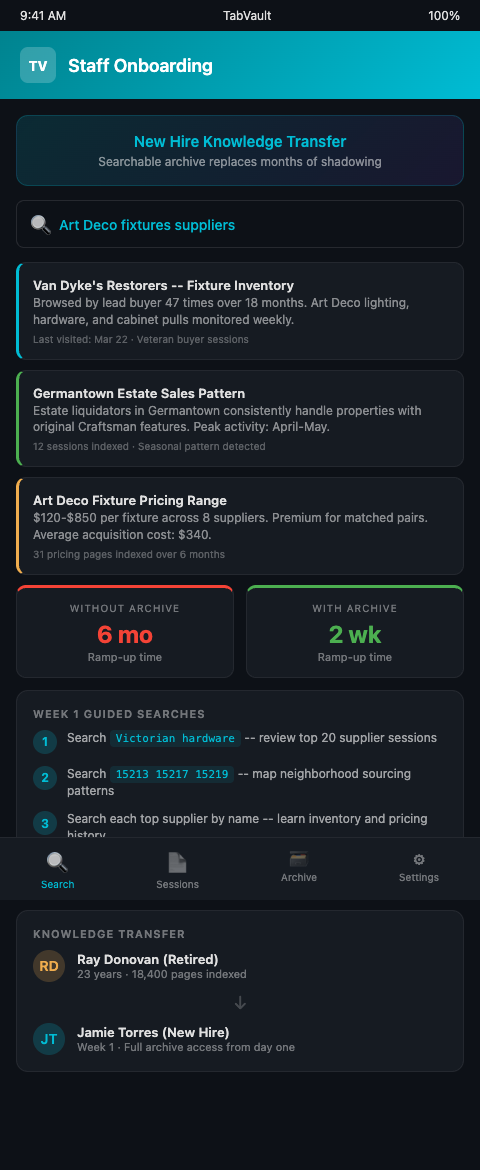
This searchable sourcing history training approach works because salvage knowledge is contextual. A new hire needs more than knowing that Van Dyke's Restorers exists — they need to know which specific product pages the lead buyer was monitoring, what price range was considered competitive, and how frequently inventory turned over. The indexed archive captures all of this context in the form of the actual pages the buyer browsed, timestamped and full-text searchable.
The reclamation team onboarding tool also preserves market intelligence that predates the new hire's arrival. Price trends from the past year, seasonal patterns in estate sale listings, contractor relationships documented across permit pages — all of it remains in the archive. The new employee does not start from zero; they start from the accumulated browsing archive of the entire team's sourcing history.
TabVault makes this institutional knowledge searchable and private. The archive stays on the company's hardware, not on a cloud platform accessible to competitors. Shared salvage sourcing knowledge flows to new team members through the same search interface everyone uses for daily sourcing — there is no separate training system to learn.
The new employee salvage knowledge transfer becomes self-directed rather than spoon-fed. Instead of waiting for a manager to schedule training sessions or pair them with a mentor, the new hire explores the archive at their own pace, guided by their own questions. Wondering which neighborhoods produce the best Victorian salvage? Search the archive. Curious which auction houses the team has purchased from? Search the archive. Each query teaches the new employee something concrete about the business based on actual sourcing activity, not theoretical training materials.
The salvage staff onboarding sourcing improvement is measurable. Track how long it takes a new hire to complete their first independent sourcing acquisition — from identifying the lead to negotiating the purchase. With access to a searchable archive of past sourcing activity, that timeline should compress significantly compared to hiring into an operation with no institutional research history.
Genealogy research firms face the identical challenge when experienced investigators leave. The approach to packaging indexed sessions as shareable evidence mirrors the salvage industry's need to transfer research context between team members.
Advanced Tactics for Staff Onboarding
Structure the first week around guided searches. Instead of lecturing a new hire about sourcing strategy, give them a list of search queries to run against the archive. "Search for 'Victorian hardware' and review the top twenty results." "Search for your metro area's zip codes and see which neighborhoods appear most frequently." Each search teaches the new employee about the business through the accumulated evidence of real sourcing activity.
Assign supplier research using the archive. Ask the new hire to search for each of your top ten suppliers by name. The results show every product page, catalog entry, and correspondence page the team has viewed from that supplier. The new employee learns the supplier's inventory, pricing, and relationship history from the indexed record — faster and more completely than any verbal briefing could accomplish.
Build a sourcing routine from day one. Pair the new hire's daily browsing routine with the existing archive. Their morning sourcing sessions add new pages to the same index, and they can search both their own discoveries and the team's historical data simultaneously. Within weeks, their contributions are indistinguishable from the veteran's — both are indexed, both are searchable, both enrich the collective knowledge base.
Document tribal knowledge through browsing, not writing. Instead of asking the retiring buyer to write a knowledge transfer document, ask them to spend their final weeks browsing their key sources and favorite research paths. Each page they visit gets indexed, creating a navigable record of their sourcing instincts without requiring them to articulate tacit knowledge in writing.
Use the archive for performance benchmarking. After a month, compare the new hire's search queries and browsing patterns against the experienced buyer's indexed history. If the new hire is not visiting certain source types or neighborhoods that the veteran frequented, that gap highlights areas for additional training. Research from BambooHR found that prompt onboarding boosts retention in an employee's first year by 60%, making this early benchmarking and course-correction critical for keeping new hires engaged before they become part of the industry's high turnover statistics.
Reduce the cost of turnover. The Bridge LMS construction onboarding analysis found that 38% of construction-adjacent workers quit within their first year. In salvage operations, each departure represents both a recruitment cost and a sourcing intelligence loss. When the institutional knowledge lives in a searchable archive rather than an individual's memory, turnover hurts less. The next hire inherits the same archive and can reach productive sourcing capacity faster.
Create role-specific search guides. Different roles within a salvage operation need different slices of the archive. A field buyer needs to search for demolition notices and site-visit notes. A pricing specialist needs to search for comparable sales and market data. A sales representative needs to search for inventory sourced from specific eras or styles. Create short guides for each role, listing the most useful search queries for their daily work, and pair each guide with the shared archive.
Keep the Knowledge When the Person Leaves
Your best buyer's sourcing intelligence should not depend on their continued employment. TabVault turns individual expertise into a searchable institutional asset that survives turnover, retirement, and role changes. Join the waitlist and build the salvage staff onboarding sourcing system that keeps your competitive edge intact regardless of who is on the team.
When your lead buyer retires next year, will their sourcing knowledge leave with them? With TabVault, every page they browse during their final months -- favorite auction sites, trusted supplier catalogs, productive demolition portals -- enters a searchable archive the next hire inherits on day one. A new employee who can search two years of accumulated sourcing sessions ramps up in weeks instead of months. The institutional knowledge that once existed only in one person's memory becomes a permanent, queryable asset that outlasts any individual tenure.