Packaging Indexed Sessions as Shareable Evidence for Collaborators
The Handoff Problem in Collaborative Genealogy
DNAngels, the nonprofit that helps people discover their biological parentage through genetic genealogy, has solved more than 7,500 cases since its founding in 2019 with a team of nearly one hundred volunteers, according to their website. Each case requires a handoff: the client provides DNA data, a search angel picks up the case, and if that angel gets stuck, the case may pass to a second or third volunteer. Every handoff is a potential information loss event.
The problem is not a lack of expertise. The problem is that research context lives in the browser. The first search angel spent four hours reviewing AncestryDNA matches, building speculative trees, and checking vital records. She found twenty promising leads and ruled out fifteen dead ends. When she hands the case to the next volunteer, she writes a paragraph summary from memory. The summary mentions the three most promising leads but says nothing about the fifteen dead ends. The second search angel, working without that context, re-investigates five of those dead ends before discovering they were already exhausted.
MyHeritage's DNA collaborator feature demonstrates that the genealogy industry recognizes this problem. Their feature lets you share DNA results with one collaborator at a time, giving them read access to matches and ethnicity estimates. But sharing the DNA data is only half the solution. The other half is sharing the research -- the hundreds of pages visited, the searches run, the connections drawn, and the dead ends documented.
Building Shareable Evidence Packages From Indexed Sessions
The concept of shareable genealogy evidence packages starts with a simple premise: if every page you visit during research gets indexed, your research history itself becomes a transferable artifact. TabVault turns chaotic browser sessions into a searchable private database, and that database -- or a curated subset of it -- becomes the evidence package.
A well-constructed indexed session export for genealogy contains several layers of information. First, the raw indexed pages: every DNA match profile, every census record, every vital records portal result, every newspaper clipping visited during the case. Second, the search history: every query run against the archive, showing what the researcher was looking for and when. Third, the negative evidence: portals visited that returned no results, matches reviewed that led nowhere, name variants tested that produced no hits.
This three-layer package gives the receiving researcher something no written summary can provide -- the ability to search the departing researcher's entire body of work. Instead of reading a paragraph about "promising leads in the Ohio cluster," the new researcher can search the indexed sessions for "Ohio" and see every page the previous researcher viewed that mentioned Ohio. Instead of wondering whether the previous researcher checked FamilyTreeDNA, the new researcher can search for "familytreedna.com" and see exactly which pages were visited.
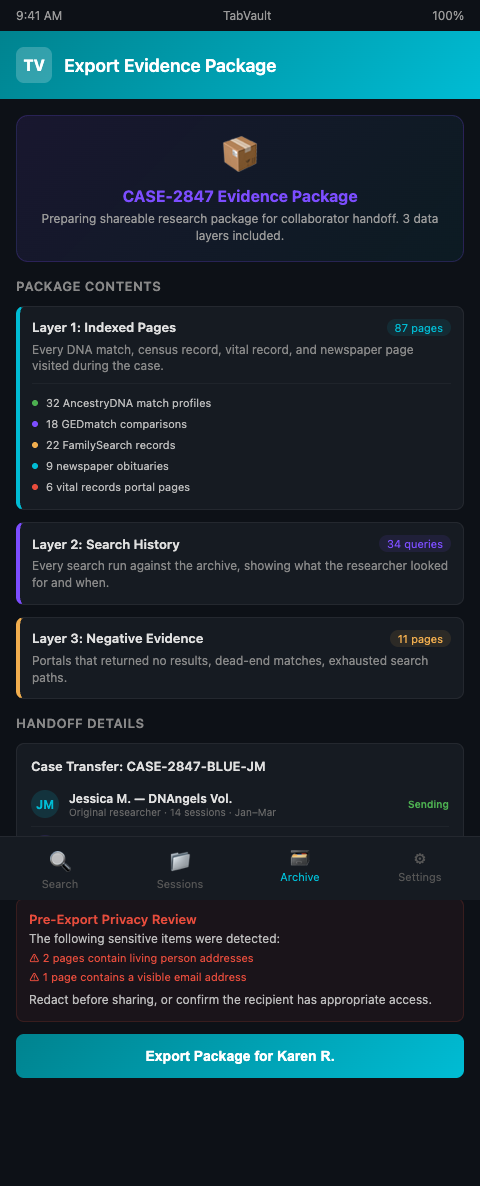
The Board for Certification of Genealogists requires that genealogical conclusions be supported by thorough research and complete source citations. An indexed session export provides both: the sources are the indexed pages, and the thoroughness is demonstrated by the breadth of pages visited. Researchers who maintain evidence logs from indexed browser sessions are already halfway to building exportable evidence packages.
A Workflow for Evidence Sharing in Collaborative Research
The genealogy evidence sharing workflow works best when both the departing and receiving researchers follow the same structure.
Before the handoff: curate and annotate. The departing researcher reviews their indexed sessions and identifies the key research threads. If the case involved three DNA clusters and two geographic regions, the researcher should be able to point to specific indexed sessions covering each. A brief annotation layer -- "This session covers the maternal blue cluster, focusing on matches in Cuyahoga County" -- makes the package navigable. The raw indexed pages provide the depth; the annotations provide the map.
During the handoff: transfer the archive, not just the summary. The receiving researcher gets access to the full indexed archive for the case. They begin by searching for the client's name to see every page that references it. Then they search for the key surnames, locations, and cM values that define the case. Within an hour, they have a working understanding of what has been done and where the gaps are.
After the handoff: build on the existing archive. The receiving researcher's new sessions get indexed into the same archive, extending rather than replacing the previous work. When the case resolves, the archive contains the complete research history from all contributors -- a permanent record that documents how the answer was found.
This cumulative approach works for research collaboration between search angels, between professional genealogists, and between family members working a case together. Investigative podcast co-producers who shared research archives for co-producers use the same principle: the archive belongs to the project, not to any individual contributor.
Advanced Tactics for Research Collaboration With Search Angels
Establish naming conventions before research begins. If multiple researchers will contribute to the same indexed archive, agree on how sessions will be labeled. Use the client's case ID, the cluster color, and the researcher's initials. A session labeled "CASE-2847-BLUE-JM" is instantly identifiable months later.
Redact sensitive information before sharing. Genetic genealogy research frequently involves living people's personal information. Before exporting an indexed session package, review it for content that should not be shared -- Social Security numbers visible in records, addresses of living individuals, private messages from DNA matches. The privacy-first approach to local indexing that protects client data during research also applies during handoffs.
Use the archive to resolve researcher disagreements. When two search angels have different theories about a case, the indexed sessions provide an objective record. Each researcher's evidence trail is searchable. Reviewing both trails side by side often reveals where the theories diverge and which one has stronger documentary support. This evidence-based approach to disagreement resolution is more productive than debating from memory.
Document the handoff itself. Create a brief indexed session that captures the state of the case at the moment of handoff: which clusters are resolved, which are still open, which matches are the highest priority, and what specific questions need answering. This "handoff session" becomes a searchable snapshot that the receiving researcher can reference throughout their work. Researchers involved in sharing indexed research with reunion registries build similar snapshot documents when they submit findings.
Version your evidence packages when cases reopen. Cases that appear resolved sometimes reopen when new DNA matches surface or when previously unresponsive contacts reply months later. When you return to a case, create a new indexed session rather than modifying the original evidence package. The original package documents the research as it stood at the time of the initial conclusion. The new session documents the additional investigation. Keeping both versions intact preserves the integrity of each conclusion and shows the receiving researcher or registry exactly what changed between the original findings and the updated ones. This versioning discipline is especially valuable when multiple search angels contribute over the life of a case, because each version captures a distinct phase of the investigation with its own evidence base.
If you collaborate with search angels, professional genealogists, or family members on genetic genealogy cases, the handoff should not mean starting over. TabVault preserves every contributor's research in a single searchable archive. Join the waitlist to make your collaborative genetic genealogy research truly cumulative.