What Co-Producers Need to Know About Shared Research Archives
Two Producers, Two Laptops, Zero Shared Research
A co-producer on a true crime podcast described the moment she realized the team's research workflow was broken: she spent an entire morning searching for a county property record that her co-producer had found, read, and discussed in a planning meeting two weeks earlier. He had the record in an open browser tab on his laptop. She did not. He was traveling and unreachable by phone. The record was not bookmarked, not shared in their Google Drive, and not mentioned in their Slack channel. The production deadline was that afternoon.
This scenario recurs across collaborative investigation research because the default tools — browser tabs, bookmarks, browser history — are inherently single-user. Your tabs live on your machine. Your bookmarks sync to your account. Your browser history is yours alone. When a two-person team divides research responsibilities, each producer builds a private, unsearchable collection of pages that the other cannot access without explicit, manual sharing.
The ICIJ's collaborative journalism model demonstrates what effective research sharing looks like at scale: their Datashare platform lets teams of hundreds of journalists search across millions of shared documents. But most podcast teams operate with two to five people and no dedicated technology infrastructure. The Global Investigative Journalism Network notes that collaborative investigations require tools for communicating, sharing documents, and managing the project — and that the document-sharing layer is typically the weakest.
Edison Research estimates approximately 42 percent of U.S. adults have listened to a true crime podcast, representing an audience of roughly 119 million people. The investigations behind those shows increasingly involve collaborative teams, and those teams need co-producer workflow tools that match the collaborative nature of the work.
Building a Shared Tab Search Database
A co-producer shared research archive starts with each team member indexing their own research using TabVault — the same local, full-text indexing that turns chaotic browser sessions into a searchable private database. The difference is that selected portions of each producer's archive can be shared with the team, creating a shared tab search database that every co-producer can search.
The workflow operates on a controlled-sharing model. Each producer indexes their research locally. Sensitive material — source-identifying information, off-the-record communications, preliminary leads that are not yet verified — stays in the producer's private index. Substantive research — court filings, news articles, public records, FOIA responses — gets shared to the team archive. This separation is critical because podcast team research sharing must respect the boundaries between what the team needs and what individual producers must keep confidential. The Society of Professional Journalists Code of Ethics requires journalists to identify sources clearly while reserving anonymity for those who face danger or retribution — the shared archive's controlled-sharing model operationalizes that principle at the research-management level.
TabVault's shared archive means that when Producer A indexes a PACER docket page on Monday, Producer B can search for a party name on Wednesday and find that page in the shared index. No manual URL sharing. No copying links into a spreadsheet. No "can you send me that thing you found?" messages in Slack. The research enters the shared archive as it is indexed, and any team member can retrieve it through full-text search.
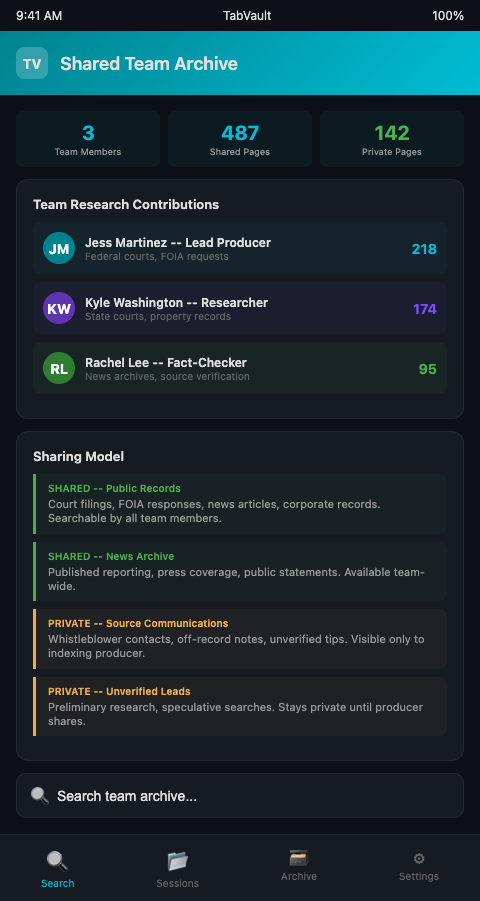
For collaborative investigation research involving divided responsibilities, the shared archive eliminates duplication. If Producer A has already indexed all the PACER filings for a case, Producer B does not need to re-visit those pages. She searches the shared archive, finds the filings, reads the indexed text, and moves on to her own research focus. The team's total coverage expands because each member is adding to a shared pool rather than independently building overlapping private collections.
The shared archive also creates a team-wide research timeline. Every indexed page carries a timestamp and a producer attribution. During editorial meetings, the team can search the shared archive for recent additions to see what each person has been researching. This visibility prevents both duplication and gaps — if nobody has indexed any state court records for a particular jurisdiction, that gap is immediately apparent.
This approach to source protection within a shared system is deliberate. Sensitive material stays in individual private indexes. Only public-record research and other non-sensitive material enters the shared archive. The decision about what to share rests with each producer, not with the platform.
As the team and the archive grow, practices for team deduplication become important. When two producers independently index the same page, the archive should recognize the duplication and surface both versions rather than creating confusion about which is the "real" entry.
The shared archive also addresses the onboarding problem that plagues long-running investigative podcasts. When a new researcher or fact-checker joins the team mid-investigation, the shared tab search database gives them immediate access to every public-record page the team has indexed. Instead of a two-week ramp-up period spent being briefed verbally and reading through disorganized Google Drive folders, the new team member searches the archive for the key names and topics and builds context in hours. The IRE resource center recommends that investigative teams maintain thorough documentation for exactly this reason — a searchable archive is that documentation generated automatically.
The controlled-sharing model also protects against the accidental exposure of sensitive material through casual file sharing. When producers share research by forwarding links in Slack or copying files into shared folders, there is no systematic control over what gets shared and what does not. The private-by-default, share-by-choice model means that a source's identity cannot leak into the shared archive unless a producer explicitly decides to share that specific material.
Advanced Tactics for Team Research Archives
Establish sharing norms before the investigation starts. Before the first research session, agree on what goes into the shared archive and what stays private. A clear rule — "all public records and published news go to shared; source communications and unverified leads stay private" — prevents confusion and builds trust within the team.
Use the shared archive for handoffs. When a producer takes over a research thread from a colleague, the shared archive provides full context. Search for the topic and read every page the previous producer indexed. This is faster and more complete than any verbal handoff or written summary.
Assign portal responsibilities to avoid overlap. If one producer covers federal court records and another covers state courts, each person's indexing contributes unique material to the shared archive. Divide by portal type, by jurisdiction, or by topic area to maximize coverage and minimize redundant work.
Run shared-archive searches during editorial meetings. When a question arises in a planning session — "Do we have anything on this person's campaign donations?" — search the shared archive on the spot. The answer arrives in seconds rather than requiring a follow-up email and a multi-day wait.
Review the shared archive for completeness before recording. Before producing a final episode, search the shared archive for every major claim, name, and date in the script. Verify that the indexed source material supports each factual statement. This team-wide verification step catches errors that individual producers might miss. The Society of Professional Journalists Code of Ethics requires accuracy and verification — a shared searchable archive makes that standard achievable in practice.
Maintain the archive after publication. Investigations do not end when episodes air. Follow-up stories, corrections, listener tips, and legal challenges all require access to the original research. Keep the shared archive intact and searchable so that any team member can retrieve source material months or years after publication. Collaborative teams in other fields have developed practices for packaging indexed sessions into shareable evidence that maintain provenance while enabling long-term team access — the same principle applies to preserving podcast research archives after publication.
Use the shared archive for cross-season research. When planning a new season, search the shared archive from previous seasons for relevant names, topics, and locations. Research completed for an earlier investigation might contain leads, background material, or source documents relevant to the new project. The archive's persistence across seasons turns historical research into a strategic asset rather than a forgotten collection of files.
Track individual research contributions for credit and accountability. Because each indexed page carries a producer attribution, the shared archive provides a clear record of who researched what. This transparency supports fair credit in show notes and helps the team assess whether research responsibilities are being distributed equitably.
Your Team's Research Should Be Bigger Than Any One Producer's Browser
A co-producer shared research archive multiplies the investigative capacity of every team member. Instead of each producer working from their own incomplete collection of tabs and bookmarks, the entire team searches one unified, full-text archive of every public record and article anyone has indexed. TabVault makes this shared archive possible while keeping sensitive material private. Join the waitlist and give your team the collaborative research layer your investigations demand.
When Producer A indexes a PACER docket on Monday and Producer B needs that filing on Wednesday, the shared archive delivers it without a Slack message, a forwarded link, or a "can you send me that thing you found?" conversation. A three-person team investigating municipal corruption used TabVault's shared archive to eliminate an estimated four hours per week of redundant record-sharing and duplicate research. Within two months, their shared archive contained 620 indexed pages from federal courts, county property records, and campaign finance databases -- all searchable by any team member. Join the waitlist and give your co-production team the shared research layer your investigations demand.