Sharing Indexed Research With Reunion Registries and Search Angels
The Evidence That Never Reaches the Registry
The International Soundex Reunion Registry (ISRR), the oldest and largest adoption reunion registry in the United States, has facilitated matches for over 12,000 families since its founding in 1975. The registry maintains approximately 225,000 active registrations at any given time. Each registration contains basic identifying information -- birth year, state, and known details about the biological family. But the genetic genealogy research that frequently leads to these registrations generates far more information than the registration form captures.
A typical search angel case produces weeks of browser-based research: DNA match reviews across AncestryDNA and FamilyTreeDNA, speculative tree building on FamilySearch and Ancestry, vital records searches across multiple state portals, newspaper archive searches on Newspapers.com and GenealogyBank, and cross-referencing sessions that connect all of these sources. DNAngels, which has solved more than 7,500 cases since 2019 with a team of nearly one hundred volunteers, reports that most cases resolve within 24 hours to a week. The research intensity during that period is enormous.
When the case resolves and findings need to be shared -- with the client, with a reunion registry, or with another search angel -- the researcher faces a documentation problem. The research happened in browser tabs that are now closed. The evidence trail exists only in the researcher's memory and whatever notes they took along the way. The submission to the reunion registry includes the conclusion ("We believe your biological father is John Kowalski, born 1952 in Cleveland") but not the chain of evidence that supports it.
Turning Research Sessions Into Transferable Documentation
TabVault addresses this gap by turning chaotic browser sessions into a searchable private database. Every page visited during the research -- every DNA match profile, every census record, every obituary, every vital records search result -- gets indexed. When the case concludes, the indexed sessions constitute the reunion registry documentation: a complete, searchable record of how the conclusion was reached.
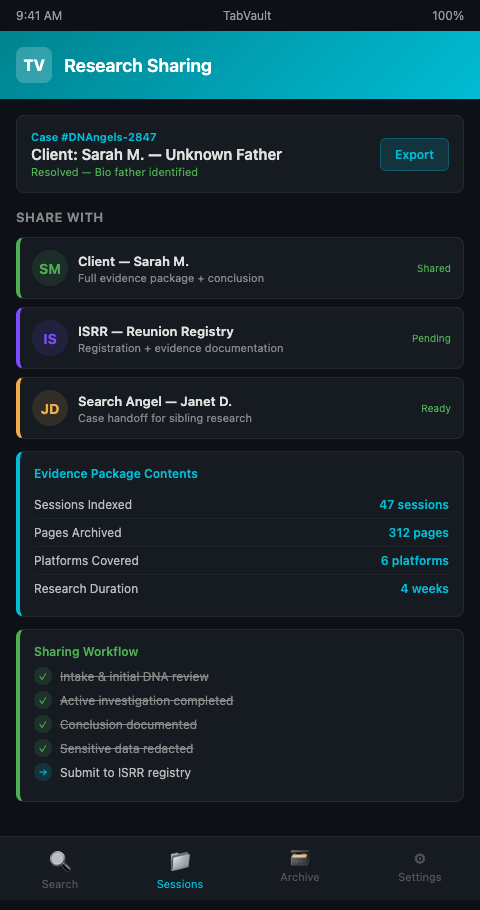
This indexed research sharing genealogy approach serves three distinct audiences.
The client. The person searching for their biological family receives not just the answer but the evidence. They can search the indexed sessions by name, location, or date to understand how each piece of the puzzle was identified. This transparency builds trust and gives the client the ability to continue the research independently if they choose.
The reunion registry. When submitting findings to ISRR, Search Angels, or other registries, the researcher can provide a comprehensive evidence package alongside the registration. If the registry later needs to verify the submission or cross-reference it with other registrations, the indexed research provides the supporting documentation.
Other search angels. When a case passes between volunteers -- because the first angel gets stuck, because the case requires a specialist, or because the case reopens months later -- the indexed sessions transfer the complete research context. The receiving search angel does not start from zero. Researchers who package indexed sessions as shareable evidence build exactly this kind of transferable case file.
The Adoption Reunion Registry Workflow With Indexed Sessions
The adoption reunion registry workflow has specific stages where indexed research sharing adds the most value.
Intake and initial DNA review. The client provides DNA test results, typically from AncestryDNA. The search angel reviews the match list, identifies the highest-cM matches, checks for shared matches, and evaluates any linked trees. All of this browsing gets indexed. The intake phase produces a searchable baseline of the case's starting conditions.
Active investigation. The search angel builds speculative trees, cross-references vital records, searches newspaper archives, and tests hypotheses about biological family connections. This is the most tab-intensive phase, often involving dozens of pages per session across multiple research sessions. The indexed sessions capture the entire investigative process, including dead ends and negative results. The Board for Certification of Genealogists' evidence standards emphasize that DNA evidence should be combined with documentary evidence to support conclusions about genetic relationships. Indexed sessions provide that documentary trail.
Conclusion and documentation. When the research identifies the likely biological parent or family, the search angel documents the conclusion. With indexed sessions, the documentation includes not just the final answer but the full chain of evidence: the DNA match that started the investigation, the newspaper obituary that provided the connecting surnames, the vital records that confirmed the relationships, and the family tree that ties it all together.
Registry submission. The search angel submits findings to the appropriate reunion registry. The indexed research package supports the submission with verifiable evidence. If the Find My Family registry, which has over 90,000 registrations, later receives a matching submission from the other side of the reunion, the indexed research from both sides can be compared.
Post-reunion follow-up. Some cases require additional research after initial contact. The client may want to identify siblings, aunts, uncles, or other biological relatives beyond the immediate parents. The indexed sessions from the original case provide the foundation for this extended research. Researchers who focus on privacy-first indexing for sensitive adoption searches ensure that the archived sessions remain secure throughout this extended timeline.
Advanced Tactics for Search Angel Collaboration Tools
Standardize session labeling across your search angel team. If your organization handles multiple cases simultaneously, establish a naming convention for indexed sessions: client case number, research phase, and researcher initials. Consistent labeling makes it possible to search across cases for pattern matches -- a surname that appears in two unrelated cases might indicate an overlooked family connection.
Redact before sharing. Indexed sessions capture everything on the pages you visit, which may include personal information about living individuals who are not part of the reunion. Before sharing indexed sessions with clients or registries, review for and redact sensitive information: Social Security numbers, current addresses, private messages, and financial details. The privacy protections for genetic data that apply during research apply doubly during sharing.
Use indexed sessions to train new search angels. A resolved case with thorough indexed sessions becomes a training resource. New volunteers can search the sessions to understand how an experienced angel approached the case: which platforms they searched first, how they built the connecting tree, where they encountered dead ends, and how they ultimately reached the conclusion. Investigative podcast producers who research handoff during producer rotations use the same indexed-session approach for onboarding.
Build a pattern library from resolved cases. Across dozens of resolved cases, indexed sessions reveal recurring patterns: common database combinations that yield results, typical research sequences for different case types, and frequent pitfalls. This institutional knowledge benefits the entire search angel community.
Prepare registry-ready summaries alongside full archives. While the full indexed archive contains every page you visited during the investigation, reunion registries often need a condensed summary that highlights the key evidence chain. Create a brief document that lists the critical DNA matches, the connecting tree structure, the confirming vital records, and the conclusion. Link each item in the summary to the specific indexed session where the supporting evidence was found. This two-layer approach gives the registry a navigable overview while preserving the full evidence base for anyone who needs to verify the chain of proof. The summary also serves as a template for communicating findings to clients who may not have the technical background to navigate a raw session archive.
If you are a search angel, a reunion registry contributor, or a researcher working adoption cases, your evidence should outlast your browser session. TabVault preserves the full research trail so every submission to a registry, every handoff to a colleague, and every package delivered to a client includes not just the answer but the proof. Join the waitlist to make your indexed research sharing as thorough as your research itself.