Best Practices for Tracking Period Hardware Across Online Catalogs
The Matching Problem
A restoration contractor in Savannah needed twelve matching sets of Eastlake-pattern door hardware for a historic hotel rehabilitation. She found the mortise locks at one supplier, compatible rosettes at another, and period-appropriate hinges at a third. Three weeks later, when the project budget was approved, she could not relocate two of the three listings. One supplier had updated their catalog and reorganized their inventory pages. The other had sold the lot to someone faster.
Period hardware catalog tracking is uniquely difficult because the market is fragmented across dozens of specialized suppliers. House of Antique Hardware carries period-inspired reproductions spanning Colonial to mid-century styles. Van Dyke's Restorers stocks over 100,000 products across Victorian, Arts and Crafts, and Art Deco categories. Historic Houseparts offers both genuine antiques and reproduction elements. Each catalog has its own organizational scheme, its own search interface, and its own pricing structure.
The Secretary of the Interior's Standards for Rehabilitation require that replacement features match the original in design, color, texture, and material wherever possible. For dealers and contractors meeting these standards, finding hardware that passes muster means browsing extensively, comparing across catalogs, and documenting what is available at what price — a process that generates enormous tab sprawl and leaves no durable record once the browser closes.
The pricing dimension adds another layer of complexity. Antique Hardware Supply notes that the value of antique hardware varies widely based on age, condition, rarity, and provenance, with pieces linked to specific makers or historical periods commanding substantial premiums. A dealer quoting a restoration project needs to know current market rates across multiple suppliers and auction results — data that requires browsing dozens of catalog pages, comparing pricing, and retaining the information long enough to produce an accurate bid. When those catalog pages are scattered across bookmarks or lost to closed tabs, the period hardware price comparison becomes an exercise in imprecise recall.
The temporal challenge is equally pressing. Vintage hardware online catalogs update their inventory continuously. A set of matching Eastlake bin pulls available on Tuesday may be sold by Friday. The dealer who saw the listing needs to act within days, and acting requires remembering where the listing was, what it cost, and whether it matched the project specifications — details that evaporate once the browser session ends.
From Catalog Sprawl to a Searchable Hardware Archive
The market for period hardware is also growing more competitive. As restoration and historic preservation projects increase — driven in part by federal and state historic tax credits governed by the Secretary of the Interior's treatment standards — the demand for period-appropriate hardware pushes dealers to source faster, compare more thoroughly, and track inventory across more suppliers than ever before. The dealers who compile the most complete picture of available inventory win the project bids.
The core problem is that online catalogs are designed for shopping, not for research. They do not let you search across competitors or compare items you viewed on different sites during different sessions. TabVault fills that gap by turning chaotic browser sessions into a searchable private database, indexing every catalog page you visit into a single searchable archive. Browse House of Antique Hardware on Monday, Van Dyke's on Tuesday, and Historic Houseparts on Wednesday — then search for "Eastlake mortise" and see matching results from all three, complete with the descriptions and pricing you viewed on each site.
This turns your browser into a working database for architectural hardware sourcing. Instead of maintaining parallel bookmark folders for each supplier and hoping the URLs still point to the right pages weeks later, you have a full-text archive that preserves the actual page content. The vintage hardware online catalogs you browse become a cumulative reference library instead of a set of disposable tabs. Each page carries its full text — product names, pattern descriptions, dimensions, materials, prices, availability notes — all indexed and queryable.
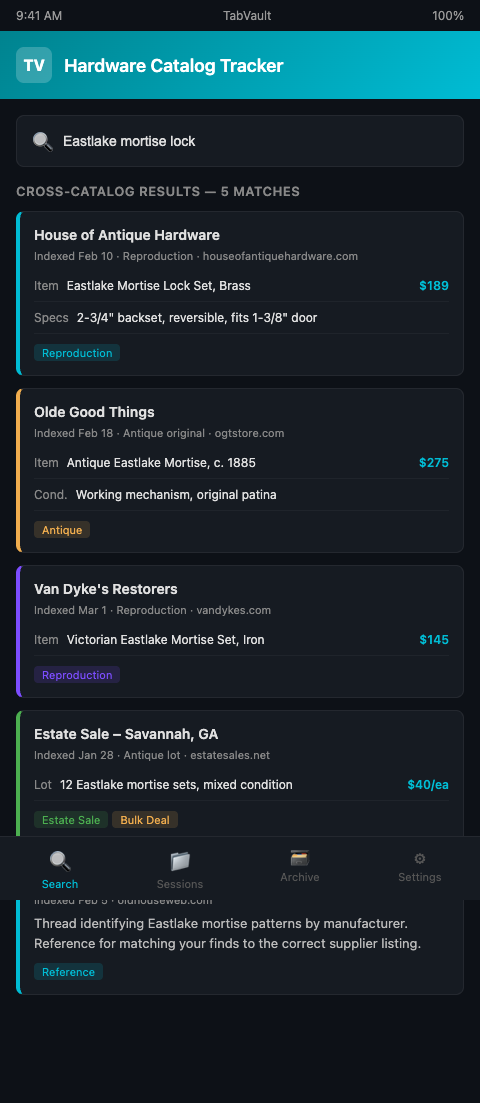
The period hardware price comparison benefit emerges naturally. After browsing multiple catalogs over several weeks, a search for a specific hardware pattern returns every listing you have viewed, with the prices visible in the indexed text. You can compare without re-visiting each site, and you have a timestamped record of what each supplier was charging on a specific date — useful for quoting restoration projects and for tracking whether prices are rising or falling over time.
This approach extends the catalog indexing fundamentals to a specialized material category where precision matters most. Period hardware requires exact matching in ways that structural lumber or plumbing fixtures typically do not, making the full-text search capability particularly valuable.
TabVault's indexing captures details that bookmark folders cannot. A bookmarked URL tells you that you visited a page. An indexed page tells you what was on that page — the pattern name, the metal type, the dimensions, the era attribution. When a client asks whether you have seen any Aesthetic Movement bin pulls in the past month, you can answer with a search, not a guess.
The tracking hardware across salvage catalogs workflow also benefits from indexing secondary sources. Restoration forums, historical reference articles, and museum collection pages all appear in your browsing during hardware research. When these pages are indexed alongside catalog listings, a search for a specific pattern or maker returns both commercial availability and historical context — the kind of integrated view that makes you an authoritative resource for restoration professionals, not just a parts supplier.
The same cross-referencing logic applies to other evidence-heavy fields. Genealogy researchers face a similar challenge when cross-referencing obituaries with birth records across different databases — the principle of unifying fragmented sources under one search layer transfers directly.
Advanced Tactics for Hardware Tracking
Index reproduction and antique catalogs separately in your mental model. Both types of hardware appear in your search results, but they serve different markets. Reproductions are for restoration projects that prioritize visual accuracy. Genuine antiques are for collectors and high-end restorations where provenance matters. Train yourself to note which supplier is which so search results do not blur the distinction.
Search by material, not just pattern. Period hardware came in brass, bronze, iron, nickel, and porcelain, among other materials. A search for "cast iron" across your indexed catalogs reveals every cast-iron item you have browsed, regardless of the pattern or era. This material-first search is useful when a client specifies a metal type but is flexible on the pattern.
Track price changes by re-visiting key pages quarterly. When you re-visit a catalog page, TabVault indexes the updated version. You now have two records of the same item at different dates, giving you a price history. Over a year, this produces genuine salvage market intelligence — a topic covered in depth in the guide to matching architectural styles to salvage inventory.
Build supplier profiles from your index. Search for a supplier's name to see every product page you have viewed from their catalog. This aggregated view reveals their inventory strengths — maybe one supplier dominates in Victorian brass while another specializes in Colonial iron. Those profiles inform where you look first for specific requests.
Document availability windows. As LookInTheAttic's guide to identifying genuine hardware notes, authentic antique pieces show hand-worked irregularities that reproductions lack, making verified originals especially scarce. Period hardware — especially genuine antiques — sells in a first-come, first-served market. The timestamp on each indexed page tells you when the item was available. If you notice that a supplier's antique inventory turns over within two weeks, you know to act fast when you spot something relevant.
Aggregate catalog data for client presentations. When a restoration architect asks you to source a complete hardware package for a project, your indexed archive becomes a presentation tool. Search for the target style and era, compile the matching results, and present the client with options across multiple suppliers — complete with pricing, availability notes, and source details. This consultative approach positions you as a research partner, not just a parts supplier, and justifies the premium that expertise commands in the period hardware market.
Track discontinued patterns and reproductions. Some hardware patterns that were once available as reproductions get discontinued by manufacturers. Your indexed archive preserves the product pages from before the discontinuation, documenting what was available and at what price. When a client needs a pattern that is no longer in production, your archive may be the only record of which supplier carried it and what alternatives existed — information that guides the search for remaining stock or acceptable substitutes.
Your Hardware Research Should Outlast Your Browser Session
Every catalog page you browse during a hardware sourcing session is a data point that contributes to your market knowledge — the available patterns, the prevailing prices, the inventory depth of each supplier. Losing that data when you close the browser means repeating the research next time a similar request arrives. The period hardware market rewards the dealer who can locate, compare, and act on catalog listings faster than the competition. TabVault turns your catalog browsing into a permanent tracking system — no spreadsheets, no bookmark folders, no lost leads. Join the waitlist and make every catalog page you view a searchable asset for your next restoration project.
Browse House of Antique Hardware on Monday, Van Dyke's on Tuesday, and Historic Houseparts on Wednesday. By Thursday, a single search for "Eastlake mortise" shows matching listings from all three catalogs with prices and availability side by side. After three months of indexed catalog browsing, you own a private hardware reference spanning hundreds of product pages -- searchable by pattern name, metal type, era, or dimension. That reference turns a restoration contractor's urgent matching request from a multi-day research project into a confident same-day response.