Flagging Drug Interactions Hidden Across Past Emergency Sessions
The Interaction That Was Already Researched
On a Thursday evening in 2024, an emergency veterinarian in San Antonio treated a border collie for ivermectin toxicity after the dog ingested a livestock deworming paste. The clinician researched treatment protocols and found a VIN discussion thread noting that dogs with the MDR1 gene mutation — common in collies, Australian shepherds, and related breeds — are hypersensitive to ivermectin and also at increased risk for adverse reactions to certain P-glycoprotein substrates including loperamide and cyclosporine. She bookmarked the thread and moved on.
Three weeks later, a different clinician at the same practice treated an Australian shepherd for acute vomiting from an unknown ingestion. During supportive care, the clinician considered administering loperamide to control diarrhea. The MDR1 interaction risk with loperamide was documented in the very thread the first clinician had read — but that bookmark was buried in the first clinician's private browser, unshared and unsearchable by anyone else.
Drug interaction veterinary toxicology is a domain where information fragmentation creates real clinical risk. The Plumb's Veterinary Drug Handbook, the most widely used veterinary pharmacology reference, lists hundreds of interactions for commonly used emergency medications. The FDA's Center for Veterinary Medicine regularly publishes safety communications about newly identified drug interactions in veterinary species. A single emergency visit can involve multiple drugs with multiple potential interactions — antidotes, sedatives, antiemetics, fluid additives, and analgesics — each carrying its own interaction profile.
The problem is not that interaction data does not exist. It does, spread across Plumb's, VIN threads, PubMed case reports, and FDA alerts. The problem is that clinicians research these interactions in isolation, during individual emergencies, and the research disappears when the browser closes. When a different clinician faces the same interaction risk weeks later, they start from scratch — if they catch the risk at all.
The Washington State University College of Veterinary Medicine maintains the Veterinary Clinical Pharmacology Laboratory, which specifically tracks breed-specific drug sensitivities including the MDR1 mutation. Their published data on P-glycoprotein substrate drugs represents the kind of specialized reference that clinicians find once during an emergency and then lose to browser history.
Cross-Referencing Past Sessions for Hidden Interactions
An indexed archive of past emergency research sessions changes the dynamics of veterinary drug interaction detection. Instead of each clinician discovering interactions independently, the practice's accumulated research becomes a searchable interaction reference that grows with every case.
TabVault captures the full text of every page a clinician visits during an emergency research session. When the first clinician reads the VIN thread about MDR1 sensitivity and loperamide, that page is indexed — not bookmarked, not summarized, but fully captured with every word of the discussion thread preserved. Three weeks later, when the second clinician is considering loperamide for the Australian shepherd, a search for "loperamide Australian shepherd" or "MDR1 loperamide" in the practice's TabVault archive would surface that exact thread, flagging the interaction risk before the drug is administered.
This is antidote contraindication cross-reference built from the practice's own research history. The indexed archive turns chaotic browser sessions into a searchable private database where past research directly informs current clinical decisions. The interaction flag is not generated by an algorithm — it comes from the actual clinical literature that a colleague already found and reviewed.
The emergency medication conflict search capability extends to every drug class used in toxicology emergencies. Consider the common combinations:
Atropine and pralidoxime for organophosphate toxicosis — but pralidoxime should be administered within a specific time window and can be ineffective or harmful if the organophosphate has undergone aging. A clinician who researched this timing issue last month has indexed pages that warn about the age-dependent efficacy window.
N-acetylcysteine for acetaminophen toxicosis in cats — but concurrent administration of certain antiemetics can alter NAC bioavailability. A protocol retrieval search that surfaces both the NAC dosing page and the antiemetic interaction page provides a more complete picture than either page alone.
Vitamin K1 for anticoagulant rodenticide toxicosis — but IV administration carries anaphylaxis risk, and concurrent use of hepatotoxic drugs can compromise the vitamin K-dependent clotting factor synthesis the treatment depends on. Flagging drug interactions past emergency sessions means a clinician who once researched the IV vitamin K anaphylaxis risk has contributed that knowledge to every future rodenticide case the practice handles.
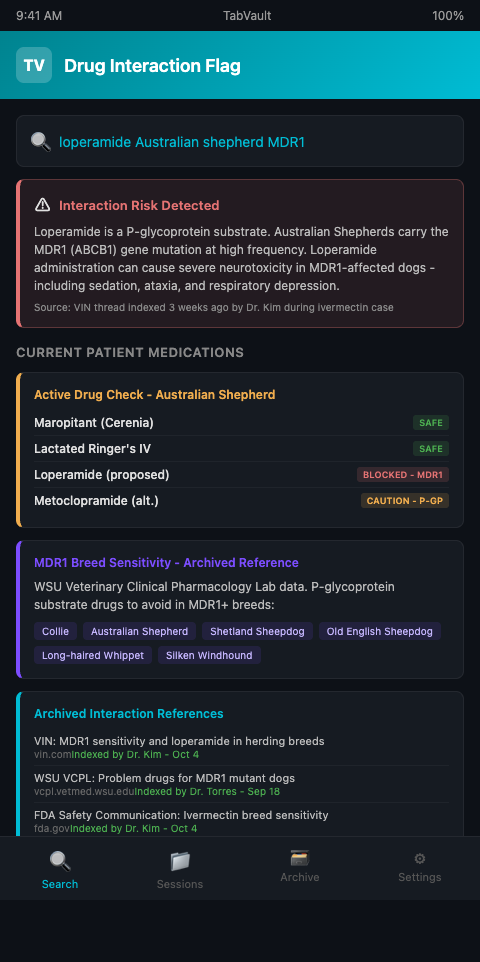
The value of drug interaction veterinary toxicology detection from indexed sessions compounds with the size and tenure of the team. A practice with eight veterinarians accumulating indexed research over two years builds a cross-reference library that no individual clinician could assemble alone. The archive captures interactions encountered across hundreds of cases, including rare combinations that any single clinician might encounter only once in a career.
TabVault's full-text indexing is particularly strong for interaction detection because interactions are often described in discussion threads, case reports, and editorial comments — not in structured drug interaction databases. A PubMed case report describing an adverse outcome from a specific drug combination might not appear in a formal interaction checker but will appear in a full-text search of the practice's indexed archive if any clinician has ever read it.
Advanced Interaction Detection Strategies
Build a pre-administration search habit. Before administering any antidote or adjunctive medication, search the practice's archive for the drug name combined with the patient's current medications. A ten-second search for "pralidoxime diazepam interaction" is a trivial time investment that can prevent a serious adverse event. Make this search step as routine as checking the drug's dosing chart.
Create interaction watchlists for common protocols. Identify the ten most common multi-drug protocols your practice uses in toxicology emergencies. For each protocol, search the archive for known interactions between the drugs in that protocol. Compile the results into a quick-reference list that clinicians can consult before initiating treatment. The indexed archive provides the source material; the watchlist provides the clinical shortcut.
Cross-reference across species and breed. Drug interactions can be species-specific (cats metabolize drugs differently than dogs) and breed-specific (MDR1 mutation carriers). The Cornell University College of Veterinary Medicine notes that the MDR1 variant is most commonly found in herding breeds, with 70% of tested Collies carrying the mutation, and that severe consequences can occur when at-risk dogs are exposed to P-glycoprotein substrate drugs. When searching for interactions, include species and breed terms in the query to surface the most relevant indexed content. The cross-referencing approach used in other investigative fields applies directly to pharmacological cross-referencing in veterinary practice.
Flag newly indexed interaction data for team review. When a clinician's research session indexes a page describing a drug interaction the practice has not previously encountered, flag that page for discussion at the next team meeting. Proactive dissemination of new interaction data prevents the scenario where critical information sits in the archive but no one thinks to search for it until after an adverse event.
Review interaction near-misses. When a clinician discovers an interaction risk during a case — they searched the archive, found the risk, and avoided the drug — document the near-miss. Tracking near-misses quantifies the clinical value of the indexed archive and identifies which interaction risks appear most frequently in your practice's caseload.
The Interaction Data Is Already in Your Archive
Drug interactions in veterinary emergency toxicology are documented across thousands of pages that your clinicians have already read and researched. The question is whether that research is preserved and searchable when the next critical interaction risk arises. TabVault indexes every page, preserves it locally, and makes it searchable across every clinician and every past session. Join the waitlist to turn your practice's accumulated research into a drug interaction safety net.
One clinician reads a VIN thread about MDR1 loperamide sensitivity in collies. Three weeks later, a different clinician considers prescribing loperamide to an Australian shepherd. With TabVault, a ten-second search for "MDR1 loperamide" before administering the drug surfaces the exact thread — flagging the interaction risk before it becomes an adverse event. Your practice's accumulated research on drug interactions, contraindications, and breed-specific sensitivities transforms from isolated browser sessions into a shared pharmacological safety net that catches risks no individual clinician's memory could reliably retain across hundreds of cases and dozens of drug combinations.