Combining PubMed Case Reports With AnTox Database Results
Two Databases, Zero Integration
A veterinary toxicologist managing a permethrin toxicosis case in a cat wants two types of information. First, she wants peer-reviewed case reports from PubMed that describe treatment protocols and outcomes for feline permethrin exposure. Second, she wants aggregate case data from the AnTox database — how many feline permethrin cases were reported last year, what percentage required hospitalization, what the mortality rate was. These are complementary data sources that together provide a complete clinical picture: published evidence for treatment decisions and population-level outcome data for prognosis.
The problem is that PubMed and the AnTox database are entirely separate systems with no cross-referencing capability. PubMed, maintained by the National Library of Medicine, indexes biomedical literature from over 37 million citations across thousands of journals (PubMed). The AnTox database, maintained by the American Association of Poison Control Centers, collects veterinary poisoning case data reported by poison control centers and veterinary toxicologists (AAPCC). Searching one tells you nothing about what exists in the other. The clinician must run separate searches on each platform, then manually compare the results.
This manual correlation is time-consuming and error-prone. A search for "permethrin feline" on PubMed might return 60 results, many of which are tangentially relevant — review articles, basic science studies, non-clinical research. The same search on the AnTox database returns case-level data organized by outcome, severity, and treatment modality. Identifying where the PubMed case reports align with the AnTox aggregate data — for example, whether the mortality rate reported in a PubMed case series matches the population-level mortality in AnTox — requires the clinician to hold both result sets in memory simultaneously.
A study on evidence-based veterinary medicine found that time constraints, difficulty accessing evidence, and the effort required to appraise and synthesize results from multiple databases were the most significant barriers preventing clinicians from utilizing available resources during clinical decision-making (Sherwin et al., Veterinary Evidence). The databases exist. The evidence exists. The integration does not.
One Search Across Both Platforms
The indexed browser session approach solves this integration problem at the point of retrieval rather than at the point of data storage — turning chaotic browser sessions into a searchable private database where PubMed and AnTox coexist in one index. When you search PubMed for feline permethrin case reports during a clinical case, those result pages are indexed. When you then search the AnTox database for aggregate permethrin data, those pages are indexed too. Both sets of results now live in the same full-text searchable archive. The next time a permethrin case arrives, a single search in TabVault retrieves both the PubMed case reports and the AnTox data in one result set.
TabVault makes this PubMed AnTox database combined search a natural byproduct of clinical browsing. You do not need to build a custom integration between two databases. You do not need to export data from either platform. You simply use both platforms during your normal research workflow, and the index captures everything you view. The veterinary case report cross-reference that previously required manual mental effort becomes a search operation.
This approach is especially valuable for evidence-based veterinary toxicology research, where treatment decisions should be informed by both published evidence and real-world outcome data. A PubMed case series might report that intravenous lipid emulsion therapy improved outcomes in feline permethrin toxicosis. The AnTox database might show that the overall survival rate for feline permethrin cases has increased over the past decade, possibly reflecting adoption of that very therapy. With both sources indexed, searching "permethrin feline lipid emulsion outcomes" retrieves the published evidence and the population data side by side.
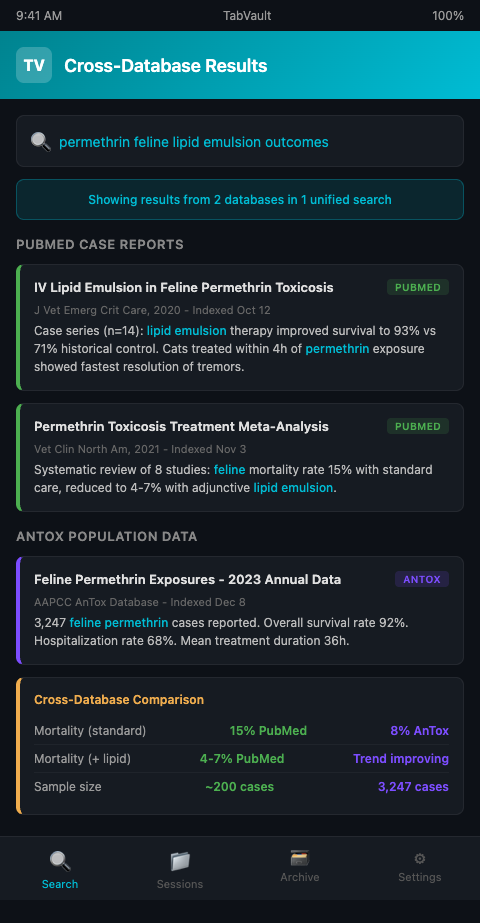
The PubMed veterinary toxicology case reports you index today become more valuable as you add AnTox data over subsequent cases. A search for "metaldehyde canine seizure" might initially return only the PubMed case report you indexed during your first metaldehyde case. After you search the AnTox database during a second metaldehyde case, the same TabVault query now returns both the PubMed evidence and the AnTox population data. The archive deepens with each case.
The AnTox database search integration extends to rare toxins where published evidence is scarce. For an uncommon exposure — say, a dog ingesting a hand warmer containing iron powder — PubMed might yield only one or two relevant case reports. The AnTox database might have ten additional case records with treatment details and outcomes. Separately, either source is thin. Together, indexed in the same searchable archive, they provide a clinically meaningful evidence base.
This cross-source correlation pattern is the same one that connects your searchable poisoning case archive with your MSDS-to-decontamination protocol correlations. Each source type adds a layer. The index connects them.
Investigative researchers in other fields face the same multi-source synthesis challenge. Podcast producers who combine social media findings with court record analysis rely on the identical principle: index both sources during research, and the cross-reference becomes a search operation rather than a memory exercise.
Strategies for Cross-Database Research
Develop parallel search habits. When you search PubMed for a specific toxin, immediately run the same search on the AnTox database. Index both result sets during the same session. This parallel approach ensures that your archive always contains both evidence types for every toxin you research, and a future search returns a complete picture.
Use PubMed MeSH terms as AnTox search anchors. PubMed uses Medical Subject Headings (MeSH) to categorize articles. When you find a useful MeSH term — "Pyrethrins/toxicity" or "Rodenticides/poisoning" — use that same terminology when searching the AnTox database. This consistency means your indexed pages from both platforms share vocabulary, making cross-platform retrieval more precise.
Compare published outcomes to AnTox aggregates. After indexing case reports and AnTox data for the same toxin, compare the outcomes. If a PubMed case series reports a 15% mortality rate for a specific toxin exposure but the AnTox aggregate data shows 8%, that discrepancy is clinically interesting — it might reflect publication bias toward severe cases, or it might indicate that the published series used a different population. Your indexed archive provides the raw material for this comparison. The Veterinary Information Network hosts discussion threads where board-certified toxicologists compare published case outcomes to their own clinical experience, offering practical context for narrowing results by outcome measure.
Index systematic reviews alongside primary case reports. PubMed systematic reviews summarize evidence across multiple studies. When you index a systematic review on a toxin, your archive gains a pre-synthesized evidence summary that complements both the primary case reports and the AnTox aggregate data. Searching your archive later retrieves all three levels of evidence — primary reports, systematic reviews, and population data — in one operation.
Track evidence evolution over time. The same cross-source correlation that helps investigators combine social media and court records applies to clinical evidence tracking. When you index PubMed and AnTox results across multiple cases over months or years, your archive captures how the evidence base for a specific toxin evolves. A treatment that was experimental when you first indexed it may now be standard of care. The historical and current pages in your archive make this evolution visible.
Two Databases Are Better Than One — If You Can Search Both
PubMed and the AnTox database provide fundamentally different but complementary evidence for veterinary toxicology decisions. TabVault makes the PubMed AnTox database combined search a single operation by indexing both platforms during normal clinical research. If you want your evidence-based veterinary toxicology research to draw on every source you have consulted, join the waitlist and start building a cross-database archive that grows with every case.
Search PubMed for a feline permethrin case series during one emergency, then query the AnTox database for aggregate permethrin outcome data during another — TabVault indexes both sessions automatically. The next time a permethrin-exposed cat arrives, a single archive search for "permethrin feline lipid emulsion" retrieves the peer-reviewed treatment evidence and the population-level survival data in one result set. No toggling between platforms, no manual correlation, no trying to remember which database had which number. Your archive does the cross-referencing that PubMed and AnTox were never designed to do on their own.