Building a Searchable Archive of Past Poisoning Case Research
The Case You Already Solved — Six Months Ago
A two-year-old Golden Retriever presents with acute kidney injury after confirmed grape ingestion. The attending veterinarian remembers treating an almost identical case last spring. She remembers researching the toxic dose, the expected timeline for renal biomarker changes, and the aggressive fluid therapy protocol she used. She remembers finding a particularly useful PubMed case series. But she cannot find any of it. The browser history from six months ago is gone. The bookmarks she thought she saved do not include the case series. She starts the research from scratch.
This is not a rare scenario. Veterinary emergency clinicians treat recurring toxin exposures regularly. The ASPCA Animal Poison Control Center's data shows that the same toxin categories — chocolate, rodenticides, NSAIDs, grapes and raisins, lilies — appear year after year in nearly identical proportions (ASPCA). A busy emergency hospital may see the same type of poisoning case multiple times per month. Yet each presentation often triggers a fresh round of research because the clinician's previous research is inaccessible.
The problem compounds across a career. A veterinarian with ten years of emergency experience has researched hundreds of poisoning cases. The cumulative research hours are staggering. A study of physician information-seeking behavior found that clinicians spend an average of 15 to 30 minutes per clinical question that sends them to external references (Ely et al., 2005). Veterinary toxicology questions are often more complex than average because they require cross-referencing species-specific data with chemical-specific data. If even a fraction of those research sessions could be retrieved rather than repeated, the time savings would be measured in hours per week.
The AnTox database, maintained by the American Association of Poison Control Centers for veterinary cases, contains thousands of case records (AAPCC). PubMed indexes veterinary toxicology case reports across hundreds of journals. The Merck Veterinary Manual provides species-specific protocols. Each of these sources is valuable, but none of them remembers what you specifically researched during a particular case. Your browser was the only system that tied your research to your clinical questions, and browser history is designed to be ephemeral.
From Ephemeral Browsing to a Permanent Case Archive
Building a searchable poisoning case research archive requires one change: index every browser session where you research a toxicology case. The principle is turning chaotic browser sessions into a searchable private database. The research process stays the same — you open the same sources, read the same references, follow the same clinical questions. The difference is that every page you visit is captured in a full-text index that persists indefinitely.
TabVault makes this past poisoning case retrieval practical. During the grape toxicosis case last spring, you opened a PubMed case series, an ASPCA dosing threshold page, a Merck Manual entry on acute kidney injury, and a VIN discussion thread about fluid therapy rates. TabVault indexed all of them. Today, when the identical case arrives, you type "grape canine renal" and every one of those pages appears. The PubMed case series you could not find is right there, alongside the dosing threshold and the fluid therapy discussion. Your research from six months ago is instantly accessible.
This is what a veterinary case report database built from your own browsing looks like. It is not a generic database — it is an archive of every reference you personally consulted for every case you personally treated. The pages you found most useful are the ones you spent the most time on, and they are all indexed.
The AnTox database case archive connection is particularly powerful. When you query the AnTox database during a case and review the results, those result pages get indexed. Six months later, searching your TabVault archive for a specific toxin retrieves both the AnTox query results from your previous case and the PubMed case reports you read alongside them. The toxicology case history search becomes a single operation that spans every source.
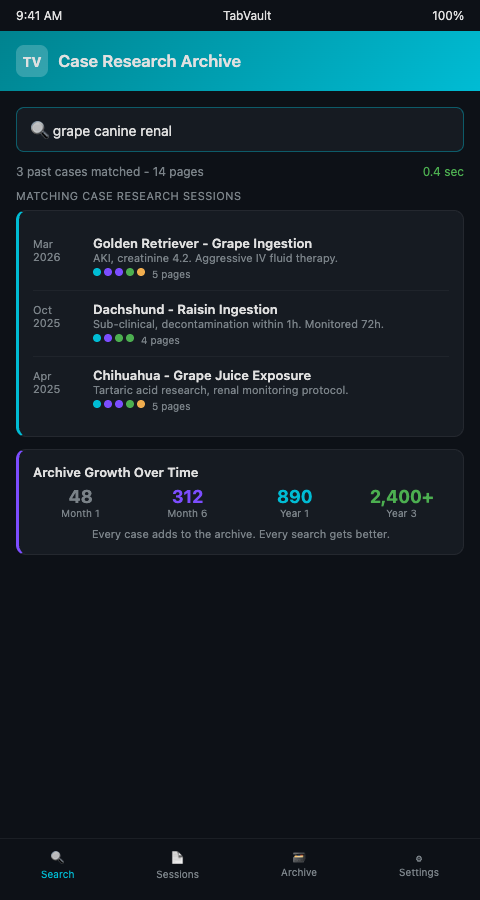
TabVault's value grows nonlinearly with time. After one month, your archive covers the cases from four or five shifts. After a year, it covers hundreds of cases spanning every toxin category your hospital encounters. After three years, it represents a comprehensive personal reference library shaped entirely by real clinical experience. The archive becomes more valuable the longer you use it because the probability that a new case matches something you have already researched increases steadily.
This connects directly to the work of retrieving past ASPCA lookups from any previous session. The ASPCA lookup is one component of a broader case research session. The archive captures not just the ASPCA page but everything you viewed in the context of that case — the PubMed abstracts, the formulary entries, the clinical calculators.
The pattern of building research archives from indexed sessions exists across disciplines. Investigative producers who build episode timelines from indexed sessions face the same structural challenge: research conducted over months needs to be retrievable as a coherent whole. The domain is different, but the archival principle is the same.
For clinicians who later want to combine PubMed case reports with AnTox database results, the searchable archive is the prerequisite. You cannot cross-reference sources you cannot find.
Strategies for a Clinical Case Archive
Search by clinical presentation, not just toxin name. Sometimes you remember the clinical signs but not the toxin. Search your archive for "acute kidney injury oliguria canine" and retrieve every case where those terms appeared in your indexed pages — grape toxicosis, ethylene glycol toxicosis, NSAID nephrotoxicity, lily ingestion in the cat that was misidentified initially. The search surfaces patterns across cases that memory alone cannot reconstruct.
Use timestamps to isolate single-case research. Each indexed page carries a timestamp. If you remember approximately when you treated a case, search by date range to retrieve every page you indexed during that shift. This isolates the research for one case from the rest of your archive, giving you a focused view of exactly what sources informed your treatment decisions.
Index discharge instructions and owner resources too. The pages you pull up for client education — "what to watch for after rodenticide ingestion" or "follow-up care for ethylene glycol treatment" — are also worth indexing. When a similar case arrives, searching your archive retrieves not just the clinical protocols but also the client-facing resources, saving you from hunting for owner education materials you have already found.
Periodically review your archive for outdated protocols. Clinical guidelines change. A dosing recommendation you indexed two years ago may have been superseded. The AVMA and specialty boards update treatment guidelines regularly. Compare your oldest indexed pages against current sources annually, and re-index updated pages so your archive reflects the latest evidence alongside the historical record.
Build case series from your own archive. The same approach that lets investigators build timelines from indexed sessions works for clinical case series. After a year of indexing, search for a specific toxin and review every case you researched. You may discover patterns in your own practice — seasonal spikes, breed predispositions, treatment approach evolution — that would be invisible without a searchable archive. This is the beginning of practice-based evidence.
Your Past Research Is Your Best Future Reference
Every poisoning case you research adds to an archive that makes the next similar case faster to manage. TabVault turns past poisoning case retrieval from a frustrating memory exercise into a reliable search operation. If you want a searchable poisoning case research archive built from your actual clinical experience, join the waitlist and let every shift you work make the next one better.
Six months of indexed emergency shifts transforms your browsing history into a structured poisoning case archive. The Golden Retriever grape toxicosis case from March, the antifreeze ingestion from January, the sago palm hepatotoxicity case from last October — each one preserved with every ASPCA page, AnTox query result, and PubMed abstract you consulted during treatment. When the next grape case walks in, you search "grape canine renal biomarker" and instantly retrieve your own curated research trail from the previous case, complete with the specific fluid therapy rates and monitoring intervals that led to a successful outcome.