Building a Personal Toxin Reference Library From Browser Sessions
The Reference You Actually Need Does Not Exist in Print
A board-certified veterinary toxicologist at a Midwestern teaching hospital estimated that she consults online resources for 80 percent of her clinical cases — not because she lacks textbook knowledge, but because the specific details she needs at the point of care are more current, more species-specific, and more granular than any printed reference provides. The ASPCA Animal Poison Control Center database, which handled over 401,000 cases in 2024, is updated continuously as new toxin data emerges. The Merck Veterinary Manual's online edition receives regular revisions that its print counterpart cannot match. PubMed adds thousands of veterinary toxicology articles annually.
The result is that the most current and relevant toxicology reference material exists in browser tabs, not on bookshelves. But browser tabs are ephemeral by design. Each case generates a research session — five, ten, fifteen pages consulted across multiple databases — and when the case resolves, that curated collection of relevant pages scatters back into the undifferentiated mass of browser history. The clinician's personal expertise grows, but the reference library that supported that expertise vanishes.
The American Veterinary Medical Association maintains directories of toxic plants and household hazards, but these are starting points, not comprehensive clinical references. The species-specific toxin data archive a clinician needs — which compounds affect which species at which doses with which clinical signs and which treatment protocols — can only be assembled through clinical experience. Every browser research session contributes to that assembly. The question is whether any of it persists.
Building a personal toxin reference library from browser sessions requires a system that captures content automatically, indexes it for full-text search, and retains it indefinitely. Manual approaches — bookmarking, note-taking, copying text into documents — fail at scale because they require deliberate effort during emergency situations when cognitive bandwidth is already exhausted.
From Case Research to a Permanent Poison Control Reference Collection
The conceptual shift is from disposable research sessions to cumulative knowledge building. Every time you open an ASPCA toxin page, a PubMed article, or a Merck Veterinary Manual entry during a case, you are selecting the specific information relevant to your clinical question. That selection process represents expertise. Browser session archiving toxins means preserving not just the pages but the implicit curation your clinical judgment applied in choosing them.
TabVault implements this approach by turning chaotic browser sessions into a searchable private database, indexing the full text of every page you visit during a research session. No copying, no bookmarking, no manual filing. You research a case the way you always have — opening pages, reading content, cross-referencing sources — and the indexer captures everything in the background. When the case resolves and the tabs close, the content persists in your local archive as part of your growing poison control reference collection.
The veterinary toxicology database building process happens automatically from that point. After your first month, your archive contains every toxicology page you consulted across all cases. After six months, you have a substantial species-specific toxin data archive built entirely from your own clinical research — not a generic textbook's selection, but the exact information you needed for the exact cases you treated.
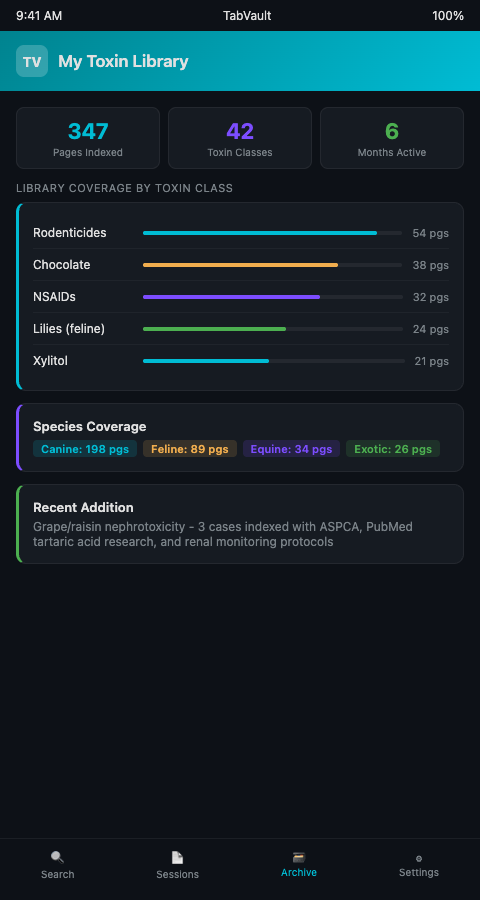
Consider how this changes the workflow for a common scenario. A dog presents with suspected grape or raisin ingestion. The toxic dose is poorly defined — the Pet Poison Helpline notes that toxicity can occur at any amount in some individuals, making clinical judgment critical. You have treated three previous grape ingestion cases over the past year. With a personal toxin reference library, you search "grape raisin canine nephrotoxicity" and retrieve every page you consulted during those three cases: the ASPCA page with current decontamination guidance, the two PubMed articles on tartaric acid as the suspected toxic component, the case report describing delayed-onset renal failure. Your library gives you not just current reference material but your own research history for this specific toxin.
TabVault's archive also captures the peripheral research that standard reference-building misses. During a chocolate toxicity case, you may have opened a page on theobromine pharmacokinetics, another on activated charcoal dosing, and a third on cardiac monitoring for tachyarrhythmias. A bookmark folder might capture the main toxin page. The indexed archive captures all three — and makes each one retrievable by any term it contains.
The approach parallels how architectural salvage dealers capture every online lead through passive indexing of their browsing sessions. The domain differs, but the structural problem is identical: valuable information appears during normal browsing, and without automatic capture, it disappears.
Your growing archive also functions as a reference setup for new practitioners — when a new resident joins your service, your indexed collection provides a case-based orientation to the toxins most commonly seen in your practice, far more relevant than a textbook's alphabetical listing.
The species-specific toxin data archive capability is especially valuable for practices that treat multiple animal types. A mixed-practice veterinarian who sees dogs, cats, horses, and livestock encounters the same toxins presenting differently across species. Permethrin, for instance, is relatively safe in dogs but causes severe neurotoxicity in cats. Monensin is a routine feed additive for cattle but lethal to horses at standard cattle doses. The indexed archive captures these species-specific research sessions separately, and a search for a specific compound returns all species-related pages together, making cross-species comparison immediate without relying on memory to connect separate research sessions conducted weeks or months apart.
The dosing references that accumulate in your archive also serve as a check against prescribing errors. When a dosing protocol retrieved from the archive differs from what a colleague has recommended verbally, the indexed page provides a citable source for discussion — the archive functions as an evidence base that supports clinical decision-making under pressure.
Strategies for Structuring Your Toxin Library
A personal toxin reference library grows most useful with intentional organization layered on top of automatic indexing.
Let case frequency determine depth. Your archive will naturally contain more material on toxins you see frequently. This is a feature, not a limitation. The toxins with the deepest coverage in your archive are the ones your practice encounters most often — exactly the ones where comprehensive reference material has the highest clinical value. Do not try to index everything preemptively. Let clinical necessity drive the collection.
Cross-reference species across cases. The same toxin often affects different species differently. Ibuprofen toxicity in dogs involves renal and gastrointestinal damage; in cats, the renal threshold is lower and clinical signs develop faster. Your archive captures these species-specific differences because you researched them in different clinical contexts. Searching "ibuprofen" retrieves both your canine and feline research, making cross-species comparison immediate.
Index dosing references alongside clinical resources. Your dosing reference pages — antidote calculations, decontamination agent volumes, fluid rate tables — are as important as the toxicology pages themselves. Index them during use so they become part of the same searchable archive. When you search for a toxin, the treatment parameters appear alongside the clinical description.
Track emerging toxins through indexed case reports. The same passive capture approach that lets architectural salvage dealers capture every online lead applies to emerging toxin tracking. New toxic substances enter veterinary practice regularly — novel synthetic cannabinoids, new rodenticide formulations, emerging mycotoxins. When you research an unfamiliar compound, the indexed pages become the seed of a new entry in your personal reference library. Over time, additional cases and new literature add depth.
Audit your archive annually. Browse your oldest indexed pages once a year. Some will contain outdated dosing or superseded guidelines. Re-index the current versions from those same sources so your archive reflects both the historical protocol and the updated one. The Merck Veterinary Manual updates its toxicology entries regularly, and your archive should track those updates.
Use the archive to identify your practice's toxin profile. After twelve months of browser session archiving toxins encountered during clinical work, your archive reveals which compounds dominate your caseload. A practice near agricultural land may see disproportionate organophosphate and herbicide cases. An urban practice may see more NSAID, chocolate, and xylitol presentations. This caseload profile, emergent from your indexed research rather than manually tracked, informs stocking decisions for antidotes, staff training priorities, and client education materials specific to your practice environment.
Start Building the Library Your Textbooks Cannot Provide
A personal toxin reference library built from browser sessions captures the specific intersection of compounds, species, and clinical scenarios that define your practice. No textbook, no generic database, and no bookmark folder replicates this. TabVault indexes every page you consult during every case, building a searchable poison control reference collection that grows with your clinical experience. Join the waitlist and start turning your case research into a permanent resource.
Your personal toxin library starts building itself the first time you research a case with TabVault active. A grape ingestion case adds the ASPCA tartaric acid threshold page and two PubMed renal outcome studies to your archive. A permethrin exposure in a cat adds the Merck feline neurotoxicity entry and the VIN discussion on lipid emulsion rescue therapy. Each case contributes its own set of curated references, and after several months the collection reflects the exact species mix, compound frequency, and clinical scenarios that define your practice. The next unfamiliar toxin that walks through the door enters a clinic that already has months of accumulated, searchable clinical intelligence behind it.