Advanced Provenance Research Using Indexed Building History
Why Provenance Separates Commodity From Premium
The National Park Service's Preservation Brief 35 describes architectural investigation as the critical first step in planning appropriate treatment for historic properties, encompassing written, visual, and oral resources including letters, legal transactions, account books, insurance policies, maps, photographs, and personal remembrances. For salvage dealers, this same investigative process determines whether a piece carries documented history or arrives as anonymous reclaimed material.
A dealer handling a set of stained glass panels from a demolished church needs to establish when the church was built, who designed it, who fabricated the glass, and whether the panels are original to the structure. Each of those questions sends the dealer to a different online resource: county property records, historical society archives, denomination-specific church history databases, and stained glass studio registries. According to the University of North Carolina's provenance research guide, provenance is the recorded history of ownership of an object, lending historical, social, and economic context that fundamentally affects its value.
The problem is not finding these resources. Most experienced dealers know where to look. The problem is retrieval. Six weeks after the initial research session, a buyer contacts the dealer wanting verification that the panels predate 1920. The dealer remembers finding a church history page that mentioned the original glazing contract, but cannot locate it in browser history. The URL has changed, or the search terms that originally surfaced the page no longer produce the same results. Hours of re-research follow.
This retrieval failure is the central bottleneck in provenance research for architectural salvage. The research happens once. The need to reference that research recurs for months or years afterward, every time a buyer asks a provenance question or a restoration architect requests documentation.
The financial impact is direct. A dealer who cannot produce provenance documentation loses the sale or accepts commodity pricing for what should have been a premium piece. Over a year, the difference between documented and undocumented inventory can represent tens of thousands of dollars in lost margin. The Traditional Building Magazine has profiled companies that have built their entire business model around turning salvaged architecture into documented living history, demonstrating that provenance is not a luxury supplement to the salvage business. It is the value proposition itself.
Indexed Building History as a Permanent Research Layer
TabVault transforms provenance research by turning chaotic browser sessions into a searchable private database where every building history page, every property record search, every historical society archive visit becomes permanently indexed by its full-text content. When the dealer researches those stained glass panels, every page visited during that session enters the archive with its complete text, not just its URL.
Six weeks later, when the buyer asks about the panels' age, the dealer searches the archive for the church name or the street address. The original research session appears, complete with the church history page that mentioned the 1897 glazing contract. The answer takes thirty seconds instead of three hours.
The indexed building history research capability extends beyond individual pieces. Over months and years, a dealer's archive accumulates a deep record of building records and property research across their entire sourcing territory. A search for a specific architect's name returns every building associated with that architect that the dealer has ever researched. A search for a neighborhood returns the full research history for every property in that area.
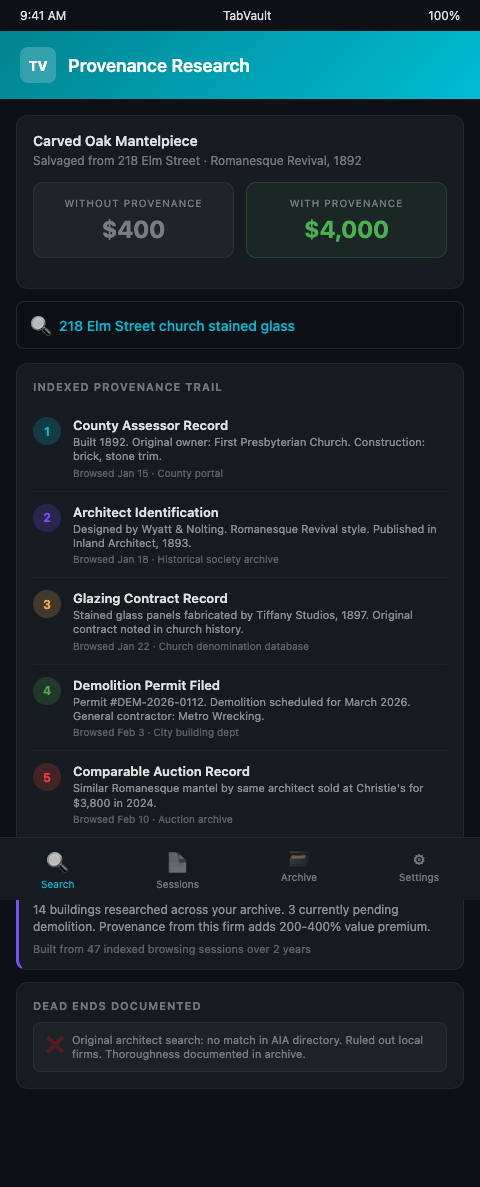
This accumulated provenance record becomes a competitive asset. When a new demolition is announced on a street the dealer researched two years ago, the archive surfaces the original research session. The dealer already knows the building's construction date, its architect, and what materials were used. That advance knowledge translates directly into faster, better-informed bids.
Building history provenance verification also benefits from the archive's ability to preserve page content at the time of the visit. Historical society websites update their databases. County record portals redesign their interfaces. A provenance claim documented through an archived session retains the evidence even if the source page later changes. This durability matters for maintaining the documentation standards that premium buyers expect.
The indexed archive supports the kind of layered research that provenance demands. One session establishes the building's construction date. Another identifies the architect. A third traces the original material suppliers through trade publications. Each session is independently searchable, but together they build a complete provenance narrative for the salvaged element.
Layered Research and Dead-End Documentation
The provenance research workflow benefits from the archive's temporal dimension. A dealer may begin researching a building when a demolition permit first appears, months before the actual deconstruction begins. By the time the materials reach the dealer's yard, the archive already contains the early research sessions that established the building's significance. Later sessions add material-specific details: condition assessments, testing results, comparable sales data. The full provenance narrative builds across multiple sessions over weeks or months, and the archive preserves each layer in chronological order.
The indexed archive also captures the dead ends that strengthen provenance claims. When a dealer researches a building and finds that the original architect is unknown, that negative finding is itself valuable documentation. It demonstrates thoroughness. A buyer or appraiser reviewing the provenance record sees not only what was confirmed but what was investigated and ruled out. This level of documentation rigor, accumulated automatically through indexed browsing, exceeds what most dealers could produce through manual record-keeping.
Advanced Provenance Research Tactics
The most effective provenance researchers work backward from the demolition permit to the original construction. Start with the county assessor's records for the construction date and original owner. Then search historical newspaper archives for construction announcements, which often name the architect and contractor. Trade publications from the construction period frequently list material suppliers. Each of these searches generates browsing sessions that TabVault indexes automatically.
Sanborn fire insurance maps, available digitally through many university libraries, provide structural details that help verify whether specific architectural elements are original to a building. The Virginia Department of Historic Resources emphasizes the importance of identifying and retaining materials that define a property's historic character. For dealers, this same identification process supports provenance claims that justify premium pricing.
Architectural element provenance tracking benefits from consistent session documentation. When researching a specific building, tag the session with the property address and the element type. Future searches for that address instantly surface every research session associated with the property, creating a provenance file that grows with each additional piece of research.
Cross-referencing between properties yields unexpected provenance connections. Two buildings on the same block, constructed in the same decade, may share an architect or a material supplier. The archive makes these connections visible because a search for the architect's name returns research sessions for both properties. These cross-property connections strengthen individual provenance claims by placing salvaged elements within a broader architectural context.
Applied Sourcing Strategies
Dealers should also index pages from architectural salvage databases and auction records that document comparable pieces. When a buyer questions a provenance claim, showing that similar elements from the same architect or period have sold at documented auctions strengthens the dealer's credibility. The archive preserves these reference sessions alongside the primary research, building a body of market evidence that supports each provenance determination.
Genealogy researchers face a parallel challenge when reconstructing multi-generational family histories from fragmentary records across multiple databases, and the same layered research approach applies to building provenance.
Consider building architect-specific provenance files within the archive. A dealer operating in a region with several notable architects can accumulate deep provenance resources for each one. Over time, a search for "Adler and Sullivan" or "Greene and Greene" returns not just one project's research but a comprehensive dossier built from years of accumulated browsing sessions. This depth transforms the dealer from a material seller into a regional architectural historian whose expertise commands premium pricing and attracts restoration professionals who need authoritative sourcing partners.
The provenance research process also generates collateral intelligence about the local demolition and renovation market. A dealer who researches a building's history inevitably encounters information about neighboring properties, about the builder's other projects, and about the broader development patterns of a neighborhood. This collateral intelligence, captured in the same archived sessions, creates unexpected sourcing leads. A building history page that mentions a sister property built by the same contractor in the same year signals a potential future sourcing opportunity if that sister property ever faces demolition.
Build Your Provenance Research Archive
Every building history page you visit today is provenance documentation you will need tomorrow. TabVault captures that research automatically, making every session permanently searchable. Join the waitlist to start building the indexed provenance archive that transforms anonymous salvage into documented architectural history.
The provenance research you do today is documentation you will reference for years. Every county assessor record, historical society page, and architectural survey you browse enters a permanent archive that turns a three-hour re-research session into a thirty-second search. After a year of indexed provenance work, your archive contains building histories for dozens of properties in your sourcing territory -- a research depth that transforms anonymous reclaimed materials into documented architectural history commanding premium prices.