Combining Historical Building Records With Demolition Schedules
Knowing What Is Behind the Walls
A salvage team in Baltimore arrived at a demolition site expecting standard 1940s residential materials — plaster, softwood framing, basic door hardware. What they found instead was a building that had been substantially remodeled in the 1940s but originally constructed in 1892. Behind the mid-century drywall were intact cypress wainscoting panels, original gas-light fixture mounts in cast brass, and a service staircase with hand-turned newel posts. They stumbled onto these materials by luck. A dealer who had checked the building's historical records before the demolition would have arrived prepared — with the right tools, the right truck, and a pre-negotiated salvage agreement.
The Library of Congress holds an estimated 700,000 Sanborn fire insurance maps covering roughly twelve thousand American cities and towns from 1867 to 1999. These maps were created to assess fire insurance liability, and they document building footprints, construction materials, wall types, roof materials, number of stories, and building uses — exactly the kind of data a salvage dealer needs when evaluating a demolition site. A Sanborn map showing "brick, slate roof, 2.5 stories, dwelling" for a property scheduled for demolition tells the dealer to expect period brick, salvageable slate, and the interior appointments typical of the era and building class.
Beyond Sanborn maps, historical building records include tax assessment records, city directories, building permits, and architectural surveys. Penn State University's library guide to Sanborn maps notes that these maps are used for historical research, urban geography, preservation, and sociological studies — all disciplines that require connecting physical structures to their documented histories. For salvage dealers, the utility is more immediate: a map that shows "frame, 2 stories, tin roof" for a property in 1905 tells you to expect balloon-frame old-growth lumber and potentially salvageable tin ceiling panels.
The National Trust for Historic Preservation has documented that the carbon payback period when replacing an existing building with a new one can stretch from 10 to 80 years, reinforcing the environmental and economic case for salvaging materials before demolition. Dealers who combine demolition schedule building history with proactive salvage planning are recovering materials that would otherwise become part of the 600 million tons of annual C&D debris the EPA tracks.
The research challenge is that historical building records and demolition schedules exist in completely different systems. Sanborn maps are accessed through library digital collections. Tax records live on county assessor websites. Demolition permits are on municipal portals. Connecting a demolition notice to the historical record of the building being demolished requires moving between these systems, comparing addresses, and synthesizing information that was never designed to be viewed together. This is a combining building records salvage research problem that manual tab management handles poorly and that a searchable index handles well.
Layering Historical Research on Top of Demolition Monitoring
The research workflow is straightforward once you adopt the habit. You already monitor demolition notices across city portals as part of your sourcing routine. The additional step is this: when a demolition notice catches your eye, open the historical records for that address. Check Sanborn maps through the Library of Congress digital collection or a local library's subscription. Pull up tax records and building permits from the county assessor's site. Browse any available architectural survey pages.
Every one of these pages — Sanborn maps, tax assessor records, architectural surveys, building permits, historical photographs — gets indexed by TabVault alongside the demolition notice itself. The result is turning chaotic browser sessions into a searchable private database that unifies demolition logistics with building history research. A search for the address later returns both the demolition permit details and the historical building records in one result set. You see the demolition timeline and the construction history side by side — combining building records salvage research into a single searchable workspace.
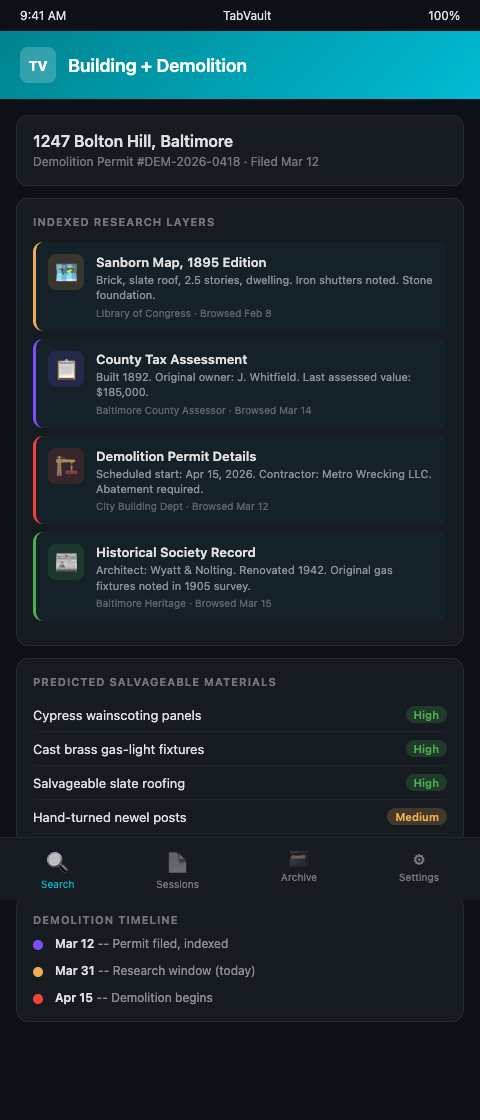
The full-text indexing captures details from Sanborn maps that are not available in summary databases. Map notes about "iron shutters," "copper cornice," or "stone foundation" become searchable text in your archive. When you are looking for a specific material across all the demolition sites you have researched, a single query surfaces every property where that material was historically documented — even if the demolition notice itself says nothing about the building's construction.
The historical preservation salvage research value deepens over time. After months of combining demolition schedules with building history, your archive contains a rich dataset linking specific addresses to specific materials, eras, and construction types. This dataset becomes a reference tool: when you encounter a new demolition notice for a building constructed in a similar era and neighborhood, your archive tells you what kinds of materials to expect based on comparable properties you have already researched.
Investigative podcast producers use a parallel approach when linking FOIA responses to news archive discoveries — combining official records with supplementary research to build a more complete picture than either source provides alone.
The building history demolition planning workflow also benefits from indexing city directory listings and historical newspaper references. City directories, available through library digital collections and sites like Ancestry, list the occupants and businesses at specific addresses over time. A directory entry showing that 442 Oak Street housed a furniture maker in 1895 suggests the presence of a workshop — and workshops often contain specialized flooring, heavy-duty hardware, and industrial fixtures with high salvage value. Newspaper archives may mention the building in the context of a fire, a renovation, or a notable event, adding provenance context that increases the value of salvaged materials. All of these pages, once browsed and indexed, become part of your research toolkit for evaluating demolition sites.
Advanced Tactics for Historical-Demolition Integration
Prioritize pre-1940 properties. According to the Delta Institute's deconstruction guide, older buildings constructed with solid wood framing and traditional joinery yield significantly higher salvage value per square foot. Buildings constructed before 1940 are far more likely to contain salvageable architectural elements — old-growth lumber, hand-crafted hardware, decorative plaster, stained glass — than post-war construction. When filtering demolition notices, use your historical records to identify the construction date and prioritize older structures for site visits.
Check for multiple construction phases. Many buildings were expanded, remodeled, or converted over their lifetimes. A Sanborn map from 1895 might show a two-story dwelling, while a 1920 edition shows the same address as a three-story with a rear addition. Each phase may contain different materials, and the earlier phases often hold the most valuable salvage. Cross-reference multiple editions of Sanborn maps for the same address to understand the full building history.
Research the building's broader history for provenance claims. Knowing that a building was designed by a notable architect, served as a prominent institution, or was associated with a historical figure adds provenance value to salvaged materials. Historical building records often contain this context, and your indexed archive preserves it alongside the physical material descriptions.
Combine with neighborhood-level demolition patterns. When multiple demolition permits cluster in one neighborhood, check the historical records for the entire block. Buildings constructed in the same era by the same developer often share construction details and materials. If one property yields high-quality heart pine, adjacent properties slated for demolition may contain the same lumber — a building history demolition planning advantage that single-property research misses.
Document everything before the site visit. Print or screenshot the key historical records before you arrive at the demolition site. Your indexed archive serves as the research repository, but having the relevant Sanborn map and permit details on your phone during the walk-through ensures you know what to look for behind walls and under floors.
Cross-reference construction dates with material availability. Different eras used different building materials, and knowing the construction date narrows the range of what to expect. Pre-1900 structures may contain old-growth timber, hand-made brick, and lime mortar. Buildings from 1900-1940 often feature early concrete, steel framing, and manufactured decorative elements. Post-1940 construction increasingly used standardized, mass-produced materials with less salvage value. Your Sanborn map research, indexed alongside the demolition schedule, creates a material prediction framework based on the building's documented history.
Build a neighborhood material profile. When you research multiple buildings in the same neighborhood, patterns emerge. If three Sanborn maps for the same block all show "frame, 2 stories, slate roof" from the same era, every future demolition on that block is likely to yield similar materials. Your indexed archive makes this pattern visible through neighborhood-name searches that aggregate historical records and demolition notices across multiple properties.
Research the Building Before It Disappears
Every demolished building is a closed book. Once the wrecking crew finishes, the opportunity to evaluate and salvage materials is gone permanently. The research window between a demolition permit filing and the start of demolition work is your opportunity to determine whether a site visit is worth the trip — and what tools and transport to bring. A demolition schedule tells you when. Historical building records tell you what. Combining both tells you whether a site visit is worth your time and what to bring when you go. TabVault indexes both data streams into one searchable archive, giving you the historical preservation salvage research edge that separates prepared dealers from those who rely on luck. Join the waitlist and start researching buildings before the wrecking crew arrives.