Linking FOIA Responses to News Archive Discoveries Across Episodes
The Gap Between Request and Response
The U.S. Government Accountability Office reported that the government-wide FOIA request backlog surpassed 200,000 requests, with agencies facing persistent challenges processing requests within the required twenty-business-day timeframe. For investigative podcast producers, this means a FOIA request filed during episode three's research might not yield documents until episode nine is in production. By then, the original context -- why you filed the request, what you expected to find, what news coverage prompted it -- has faded.
Meanwhile, the news archives you searched during episode three's production have long since been closed as browser tabs. The Columbia Journalism Review has documented how digital news archives are themselves at risk, with outlets routinely restructuring URLs, paywalling previously free content, or removing articles entirely. The newspaper database search that surfaced a critical 2014 article about your subject may not return the same result six months later.
This creates a two-sided problem. Your FOIA responses arrive disconnected from the news archive research that motivated them. And the news archive pages that would provide context may have shifted or disappeared since you last viewed them. The link between government disclosure and journalistic reporting exists only in whatever notes you happened to take -- if you took any at all.
Building the Bridge Between FOIA and News Discovery
Linking FOIA responses to news archives requires that both halves of the research exist in the same searchable system. This is where indexed browser sessions become the connective tissue.
When you first research a topic for an episode -- searching ProQuest Historical Newspapers, local newspaper archives, or digital news databases -- TabVault indexes every page you visit. The search queries, the article text, the publication dates, the source names all become part of your searchable archive. Months later, when a FOIA response arrives and you open the documents in your browser, those pages get indexed too.
Now you can search across both. Type a name, a date, or a key phrase, and your results pull from FOIA document pages and news archive pages simultaneously. The 2014 newspaper article about a city contract award appears alongside the FOIA-released emails discussing that same contract. The connection that would have required you to remember a six-month-old research session instead surfaces through a simple keyword search.
This transforms TabVault into the mechanism for turning chaotic browser sessions into a searchable private database where government disclosures and news archive discoveries coexist. Producers who already organize their FOIA findings through tab search can extend the same approach to create cross-episode research connections between FOIA materials and the journalism that first raised questions. The same indexed archive that recovers lost FOIA research also preserves the news archive context that motivated each request.
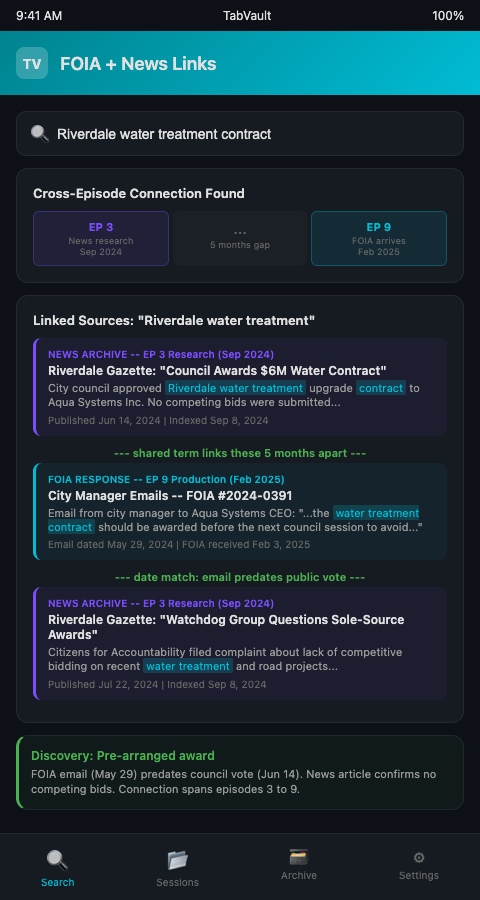
The practical impact on FOIA response organization for podcast production is immediate. Instead of treating each episode's research as isolated, your indexed sessions create a continuous, searchable record. A discovery made during episode two's news archive research can inform how you read a FOIA response that arrives during episode eight's production. The investigation continuity across episodes stops depending on human memory alone.
Workflow for Cross-Episode Research Connections
Index your news archive sessions as you research. Every time you search a newspaper database, a digital archive, or a news aggregator, ensure those sessions are being indexed. Pay special attention to the search terms you use and the specific articles you read. These become the retrieval keys when FOIA documents arrive later.
Create a FOIA tracking session when responses arrive. When you receive FOIA documents and review them in your browser, treat that review as a dedicated research session. Open each document, read through the pages, and let the indexing capture the content. Then immediately search your existing archive for key names, dates, or phrases from the FOIA documents. The news archive hits that come back are your cross-episode connections.
Build episode timelines that span both sources. The dates in FOIA documents and the publication dates in news archives create a natural chronology. Producers working on episode timeline construction from indexed sessions can layer FOIA disclosure dates onto their existing news archive timelines, revealing the sequence of events, coverage, and government response.
Search for discrepancies between government records and news coverage. When a FOIA response contains a date, a dollar amount, or a factual claim, search your indexed news archive sessions for coverage of the same event. Discrepancies between what the government documented internally and what news outlets reported publicly are among the most productive findings for investigative podcasts. An email obtained through FOIA showing a city official approved a contract on March 3 while local news coverage quotes the official saying the decision was made on March 15 raises questions that drive narrative tension.
Advanced Tactics for News Archive Discovery Tracking
The deepest value emerges when you search for patterns across multiple FOIA responses and multiple news archive sessions.
Name frequency analysis. Search your indexed archive for a specific person's name and note how many hits come from FOIA documents versus news archives. A name that appears frequently in FOIA materials but rarely in news coverage may indicate someone whose role was never publicly reported -- a potential episode focus.
Date clustering. When FOIA documents reference specific dates, search your news archives for coverage around those same dates. Clusters of activity -- government emails on the same day as a news article -- suggest moments of crisis or decision that merit deeper investigation. Researchers performing cross-reference analysis in veterinary toxicology use similar date-matching techniques across different document types.
Source credibility mapping. FOIA responses sometimes confirm, contradict, or add nuance to what news outlets reported. By searching your indexed sessions for the same event across both source types, you can build a credibility map showing where news accounts matched government records and where they diverged. This becomes powerful narrative material for your podcast.
Track which archives you have already searched. News archive discovery tracking means knowing not just what you found but which databases you queried. When a new FOIA response arrives and mentions an event from 2016, you can check whether your indexed history includes searches of the relevant local newspaper archive for that year. If it does not, you know exactly where to look next.
Build a FOIA-to-news concordance for each episode. As you prepare an episode script, search your TabVault archive for each key fact and note whether the supporting evidence comes from a FOIA document, a news article, or both. Claims supported by both government records and independent journalism carry more narrative weight than those resting on a single source type. Claims supported only by FOIA documents may need additional news archive research to establish public context. Claims supported only by news coverage may need FOIA follow-up to verify what the government knew and when. This concordance structure transforms your indexed sessions from a retrieval tool into a narrative planning instrument.
Preserve the request-to-response chain. When you file a FOIA request through a portal, index the confirmation page showing the request number, date, and agency. When the response arrives months later, the indexed confirmation page connects the response to the original request context -- why you asked, what you expected, and what news coverage prompted the inquiry. The DOJ's 2024 Annual FOIA Report Summary documented a record 1.5 million FOIA requests in fiscal year 2024 with persistent backlogs across agencies, and maintaining a timestamped record of your original request through indexed sessions strengthens any appeal or follow-up.
If your investigative podcast spans multiple episodes and your FOIA responses keep arriving disconnected from the news research that prompted them, your workflow has a structural gap. TabVault closes it by making every research session -- FOIA review and news archive search alike -- permanently searchable. Join the waitlist to stop losing the connections between what the government disclosed and what journalists already reported.