Documentation Standards for Reclaimed Architectural Elements
The Documentation Gap in Architectural Salvage
The Sustainable Development Code notes that documentation for reclaimed materials must be made available to the code official at final inspection upon request, in forms including weight tickets, tax donation letters, bills of sale, photographs, and other approved methods. Yet most salvage dealers maintain documentation practices that would not survive that inspection. The gap between what codes require and what dealers actually record costs the industry credibility, sales, and legal protection.
The International Building Code permits the use of reclaimed materials that meet code requirements for new materials, but the building official must approve them. That approval depends on documentation. A reclaimed structural beam requires engineering certification. Reclaimed electrical fixtures require safety testing records. Even decorative elements like mantels and moldings need provenance records that establish material composition, particularly for pre-1978 materials subject to lead paint regulations.
Portland's deconstruction ordinance represents the leading edge of regulatory expectations. The city requires documentation tracking materials from demolition through resale, creating a chain of custody that salvage dealers must maintain. As more cities adopt similar ordinances, following Portland's example as described by Grist, documentation standards will shift from voluntary best practice to regulatory requirement.
For dealers, the documentation problem is not willingness. Most dealers want to maintain good records. The problem is that the research supporting those records happens in browser sessions that disappear. A dealer researches a building's construction date on the county assessor's site, verifies material composition through a manufacturer's historical catalog, and checks lead paint testing requirements on the EPA portal. Each of those sessions contains documentation-grade information. None of it is captured unless the dealer manually copies and pastes it into a separate system.
The scale of the documentation challenge grows with inventory volume. A dealer handling fifty new items per month needs documentation for each one. At the commodity end, a bin of reclaimed bricks requires basic origin and material documentation. At the premium end, a carved Victorian mantel requires provenance research, condition assessment, material composition verification, and code compliance documentation. Maintaining manual records across this range of documentation depth, multiplied by fifty items per month, exceeds what most small operations can sustain without dedicated administrative staff.
The EPA guidance on C&D material reuse notes that painted materials from pre-1978 buildings must be tested for lead paint before reuse. This single requirement generates documentation obligations for a large portion of a salvage dealer's inventory. The testing results need to be recorded, associated with specific inventory items, and available on demand for buyers and inspectors. Without a systematic capture method, this documentation requirement alone creates an administrative burden that discourages thorough compliance.
Building Documentation From Indexed Research Sessions
TabVault addresses the architectural element documentation problem at its source: the browsing session where the research actually happens. By turning chaotic browser sessions into a searchable private database, every page visited during material research becomes permanently indexed and searchable. The county assessor record, the manufacturer catalog, the EPA regulation page -- all enter the archive with their full text content, tied to the session where the dealer encountered them.
When a code official or a buyer requests documentation, the dealer searches the archive for the property address or the material type. The original research sessions appear, containing the specific pages that establish construction date, material composition, and regulatory compliance. This transforms the documentation process from retrospective record-keeping into automatic capture.
The salvage inventory documentation guide that most dealers need follows a simple framework. For each element, document: source property and its construction date, material type and composition, condition assessment, any applicable testing results, and the regulatory requirements that apply to the material's intended reuse. TabVault's indexed archive captures the research supporting each of these documentation points automatically.
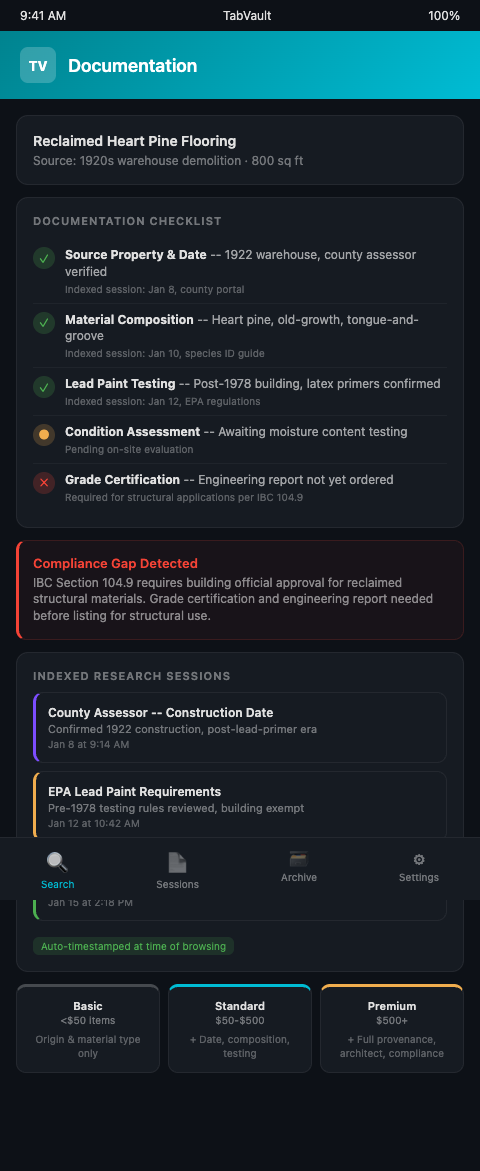
The connection between documentation and provenance tracking strengthens both practices. Provenance research establishes a piece's history. Documentation standards formalize that history into records that satisfy buyers, code officials, and insurers. When both draw from the same indexed archive, the dealer avoids duplicating research across separate systems.
Reclaimed element provenance records built from archived sessions carry an additional advantage: they preserve the source material in context. A screenshot of a county record shows only the record itself. An archived session shows the record alongside the other pages the dealer visited during the same research session, providing context that strengthens the documentation's credibility.
The archived session also provides timestamp evidence. When a code official asks when the dealer verified a material's compliance status, the archived session shows the exact date and time of the research. This temporal documentation is difficult to produce retroactively but is generated automatically when sessions are indexed at the time of browsing. For dealers operating in jurisdictions with strict chain-of-custody requirements, this timestamped research trail satisfies a documentation need that manual record-keeping struggles to address.
For dealers working toward the documentation standards used in investigative fields, the indexed archive provides an audit trail that shows when research was conducted, which sources were consulted, and how conclusions were reached. This level of documentation rigor, once reserved for legal and academic contexts, becomes practical for salvage dealers when the capture happens automatically.
Advanced Documentation Practices
Establish a documentation checklist for each material category and run through it during the initial research session. Structural lumber requires grade certification, species identification, and moisture content assessment. Plumbing fixtures require material composition verification and pressure testing. Electrical components require safety certification. Running through the checklist while browsing ensures that the archived sessions contain the specific documentation each category requires.
The building codes compliance challenge becomes manageable when code research sessions are indexed alongside the material research. A dealer researching a set of reclaimed windows can search the archive for both the window specifications and the energy code requirements that apply to window replacements in the target jurisdiction. Both sets of research live in the same searchable archive, eliminating the gap between material knowledge and regulatory knowledge.
Documentation standards for salvage dealers should also address photography. Photograph elements in situ before removal, during processing, and in final inventory condition. Store those photographs alongside the research sessions in a consistent filing system. When a buyer requests documentation, the combination of indexed research sessions and dated photographs creates a comprehensive record that no competitor relying on memory and loose files can match.
Consider implementing documentation tiers based on element value. A bin of reclaimed door hinges priced at two dollars each does not warrant the same documentation depth as a hand-carved newel post priced at two thousand. Concentrate documentation effort where it generates the most value, using the archived research sessions as the baseline record for all elements and adding formal documentation layers for premium pieces.
Build documentation templates that map to specific buyer categories. A restoration architect needs different documentation than a residential homeowner. A commercial contractor needs code compliance documentation that a retail customer does not. Having pre-built templates for each buyer category, populated with research from the indexed archive, reduces the documentation assembly time from hours to minutes per sale.
Track which documentation elements close sales most effectively. A Chicago architect's guide to reclaimed materials notes that architects increasingly require chain-of-custody documentation before specifying salvaged elements. Over time, the archive reveals patterns in which provenance details buyers respond to. Some buyers prioritize architectural significance. Others focus on material testing results. Others want construction date verification above all else. Understanding these buyer preferences, visible through the sales documentation that preceded successful transactions, allows the dealer to front-load the most impactful documentation for each buyer category.
Finally, share your documentation standards with buyers and contractors proactively. Dealers who present professional documentation at the point of sale differentiate themselves from competitors who treat documentation as an afterthought. The archive makes this proactive approach sustainable because the research behind the documentation already exists in searchable form.
Building Institutional Documentation Credibility
Use the documentation archive as a training resource for new staff. When a new employee needs to understand what thorough documentation looks like, pull up the archived research sessions from a well-documented premium piece. The sessions show the research process step by step: county assessor lookup, material verification, code compliance check, and provenance assembly. This concrete example teaches documentation standards more effectively than any written policy.
The documentation habit, once established, compounds in value over months and years. A dealer who has maintained consistent documentation standards for two years possesses an inventory archive that demonstrates professionalism to every new buyer, every code official, and every insurance adjuster who asks for records. That institutional credibility, built one archived session at a time, becomes the foundation of the dealer's reputation in the professional restoration market.
Raise Your Documentation Standard
Reclaimed materials documentation standards protect your business, satisfy regulators, and justify premium pricing. TabVault captures the research that supports those standards automatically, turning every browsing session into permanent, searchable documentation. Join the waitlist to build the documentation infrastructure your salvage business deserves.
The next time a code official asks for material documentation or a contractor requests lead paint verification records, your answer should take seconds, not hours. TabVault captures every regulatory page, county record, and material testing reference you browse, assembling timestamped documentation trails that satisfy inspectors and buyers alike. A dealer who has maintained six months of indexed documentation sessions possesses an audit-ready archive that no competitor relying on scattered files and fading memory can match.