Meeting Building Codes With Reclaimed Materials: A Research Guide
The Code Compliance Challenge for Reclaimed Materials
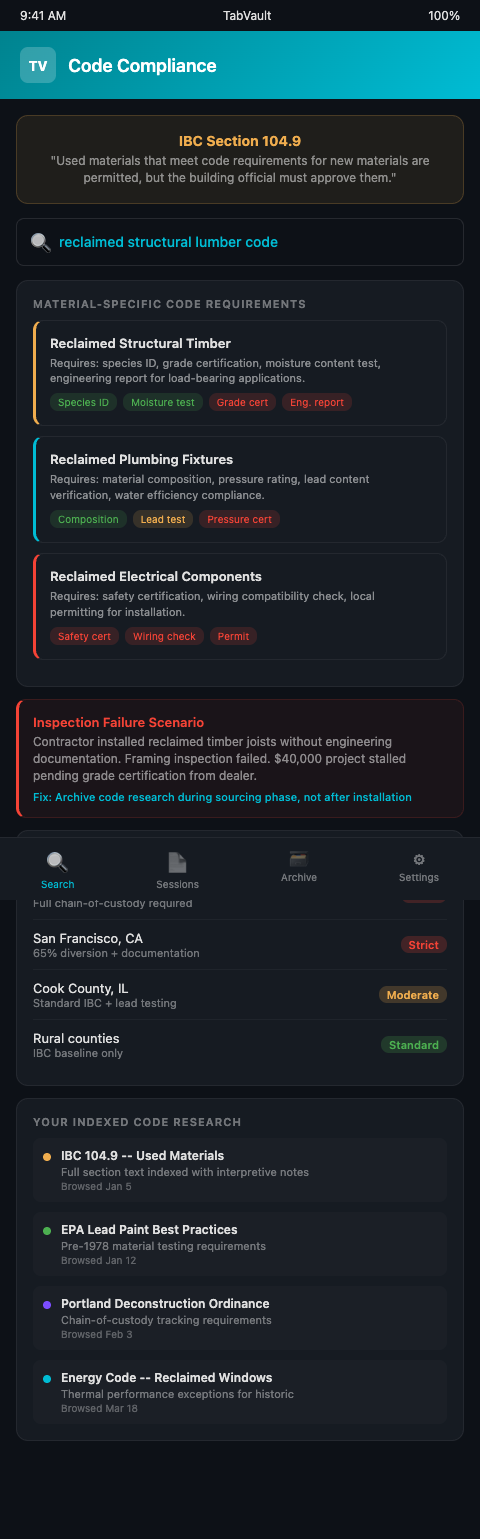
The International Building Code Section 104.9 establishes the baseline: used materials that meet code requirements for new materials are permitted, but the building official must approve them. This approval requirement places the documentation burden squarely on the party supplying the materials. For structural applications, an engineering report is required. For plumbing and electrical components, safety testing and material composition verification are mandatory. Even decorative elements may require lead paint testing for materials originating from pre-1978 structures.
The Sustainable Development Code's guidance on material reuse notes that documentation must be available to the code official at final inspection, in forms including weight tickets, bills of sale, photographs, and other approved methods. The code does not specify a single documentation format. It specifies that documentation must exist and must demonstrate compliance. This flexibility in format is an opportunity for dealers who prepare documentation proactively and a trap for dealers who treat compliance as someone else's problem.
Building code compliance for reclaimed materials becomes more complex as municipalities adopt specific reclamation requirements. Portland's deconstruction permit requirements include documentation tracking materials through the chain of custody from demolition to resale. The EPA notes that painted materials removed from buildings constructed prior to 1978 are not eligible for reuse unless tested and verified to be free of lead paint. These requirements layer onto the base building code, creating a compliance environment that varies by jurisdiction.
The salvage dealer's role in this landscape is evolving. Historically, dealers sold materials as-is and left compliance to the buyer. As the market professionalizes and municipalities tighten regulations, dealers who provide compliance-ready documentation with their materials command premium prices and attract the professional contractors who generate repeat business.
The complexity compounds when dealers sell across jurisdictions. A salvage yard in a city with no deconstruction ordinance may sell materials to a contractor working in a city that requires full chain-of-custody documentation. The dealer who cannot provide that documentation loses the sale. The dealer who maintains comprehensive records, drawing from indexed research sessions that capture both the material sourcing and the regulatory requirements, fulfills the order without delay.
Reclaimed materials building regulations also intersect with energy codes, fire codes, and accessibility standards. A set of reclaimed windows that meets structural requirements may fail energy code requirements for thermal performance. Reclaimed doors may not meet current fire rating standards. The UpCodes reference on material reuse provides guidance on how reused materials interact with broader code frameworks, but applying that guidance to specific inventory items requires research that most dealers conduct through browsing sessions they do not retain.
Systematic Code Research Through Indexed Browsing
TabVault supports the salvage code compliance research process by capturing every regulatory page, code interpretation, and jurisdiction-specific requirement the dealer encounters during browsing. When a dealer researches building code requirements for reclaimed structural lumber in a specific county, that browsing session, including the code text, the local amendments, and any interpretive guidance, enters the indexed archive with full text searchable.
The practical application works like this. A dealer sources reclaimed Douglas fir beams from a warehouse demolition. Before listing them for structural use, she researches the applicable code requirements. She browses the International Building Code section on material reuse, the state's amendments to that section, and the specific county's building department website for local interpretive guidance. TabVault indexes all three pages. Three months later, when a contractor asks whether those beams meet code for a residential floor system in a different county, the dealer searches the archive for "reclaimed structural lumber" and finds her original research alongside any subsequent sessions where she researched related requirements.
This is where turning chaotic browser sessions into a searchable private database directly affects revenue. The dealer who can answer code compliance questions quickly, with references, closes sales that competitors lose to documentation uncertainty.
The documentation standards that professional dealers maintain overlap substantially with code compliance requirements. Provenance documentation establishes material origin and age. Code compliance documentation establishes that the material meets performance requirements for its intended reuse. Both draw from the same pool of research, and both benefit from an indexed archive that preserves the research in searchable form.
Reclaimed materials building regulations also vary by material type. The code requirements for reclaimed structural timber differ from those for reclaimed brick, reclaimed plumbing fixtures, or reclaimed electrical components. A dealer handling multiple material categories needs to track compliance requirements across all of them. The indexed archive allows searching by material type, returning the relevant code research for each category regardless of when the research was conducted.
The provenance verification process feeds directly into code compliance. A piece's provenance establishes its age, which determines whether lead paint testing is required. Provenance establishes the original building's use, which may affect whether materials require asbestos testing. Provenance establishes the material's original structural application, which provides context for engineering assessments. Each provenance finding has compliance implications, and the indexed archive connects them.
The archived research sessions provide documentation of due diligence for dealers who serve the professional contractor market. The dealer can demonstrate that she researched applicable codes before listing materials for structural use, that she checked lead paint requirements for pre-1978 materials, and that she verified jurisdiction-specific amendments before selling into a particular county.
Advanced Code Compliance Research Practices
Build a code research template for each material category. For structural lumber: species identification, grade certification, moisture content, load-bearing capacity, and jurisdiction-specific requirements. For plumbing fixtures: material composition, pressure rating, lead content verification, and water efficiency standards. For electrical components: safety certification, wiring compatibility, and local permitting requirements. Run through the template during the sourcing phase, with TabVault capturing each step.
Monitor code changes across your operating jurisdictions. Building codes update on regular cycles, and local amendments can change between cycles. Add code update pages to your regular browsing routine so that the archive captures regulatory changes as they occur. A search for a specific material type should return both the current code requirements and any recent changes, giving the dealer a complete regulatory picture.
Veterinary practices face parallel requirements when maintaining compliance audit trails for controlled substance research, and the indexed archive approach serves the same evidentiary purpose for salvage code compliance.
Develop relationships with building officials in your primary jurisdictions. Each official interprets code requirements somewhat differently, particularly for unusual reclaimed materials. Document these conversations, and when a building official provides guidance via email or a departmental FAQ page, ensure those pages enter the indexed archive. The official's interpretation, archived alongside the code text, creates a compliance record specific to that jurisdiction.
Prepare material-specific compliance packets for your highest-volume products. If you sell reclaimed heart pine flooring regularly, assemble the code research, testing documentation, and engineering references into a standard packet that can be provided with every sale. The archived research sessions provide the source material for these packets, and the packets themselves reduce the compliance friction that slows sales.
Reclaimed element code requirements will continue to tighten as deconstruction ordinances spread and the reuse market grows. Dealers who build systematic code research habits now, supported by indexed archives that preserve every regulatory session, will navigate the increasingly complex regulatory terrain with confidence while competitors scramble to assemble documentation after the fact.
Maintain a jurisdiction-specific compliance file within the archive for each county and municipality where you sell materials regularly. The SE2050 guide on salvaged structural materials documents that engineering certification requirements for reclaimed timber vary significantly across jurisdictions, reinforcing the need for location-specific compliance records. Search the archive for a specific jurisdiction name to pull every code research session associated with that area. Over time, this jurisdiction-specific view reveals the local code environment in detail: which officials are strict, which requirements are unique to the area, and which types of reclaimed materials face the most scrutiny.
The code compliance research process should also capture the informal guidance that building officials provide through FAQ pages, informational bulletins, and publicly available interpretive letters. These informal sources often contain the practical guidance that the code text itself does not provide. A building official's bulletin explaining how the department evaluates reclaimed lumber for structural use contains more actionable information than the relevant code section. Archiving these informal sources alongside the formal code text creates a compliance knowledge base that reflects how codes are actually enforced, not just how they are written.
Master Building Code Compliance
Architectural salvage building codes do not need to be an obstacle to sales. They are a framework that, when mastered, separates professional dealers from casual sellers. TabVault captures your code research alongside your sourcing research, making compliance documentation as searchable as supplier inventories. Join the waitlist to build the code compliance archive your operation needs.
IBC Section 104.9 does not care whether you remember the code research you did three months ago. It cares whether you can produce documentation. TabVault captures every regulatory page, every local amendment, and every building department FAQ you browse, making code compliance answers retrievable by material type, jurisdiction, or requirement keyword. The dealer who can answer a contractor's compliance question in minutes, backed by indexed research, closes the sale. The dealer who needs a week to re-research the same requirements loses it.