Veterinary Research Compliance and Browser-Based Audit Trails
The Audit Question No One Wants to Answer
In 2022, a malpractice complaint against a small-animal emergency practice in Florida centered on a single question: what information did the attending veterinarian consult before administering fomepizole for a suspected ethylene glycol poisoning? The veterinarian knew she had reviewed the ASPCA's dosing guidelines and a PubMed case report during the emergency. But she could not produce evidence of either consultation. Her browser history had been cleared by an automatic privacy setting, and the practice had no system for documenting clinical research conducted during active cases.
This scenario is not hypothetical or rare. The American Veterinary Medical Association's Principles of Veterinary Medical Ethics require that veterinary care meet accepted standards of practice, and state veterinary licensing boards can investigate complaints about whether those standards were followed. When a treatment decision is questioned, the clinical record typically documents what was done but not what research informed the decision. The research trail — the pages consulted, the protocols reviewed, the dosing references checked — lives in browser tabs that no longer exist.
The American Animal Hospital Association (AAHA) accreditation standards include requirements for maintaining medical records that support clinical decisions. While AAHA does not explicitly mandate browser-based audit trails, the principle is clear: decisions should be traceable to their informational basis. In toxicology cases, where treatment protocols vary by species, by toxin, and by time since exposure, the informational basis is almost always web-based research conducted in real time.
Regulatory compliance in veterinary toxicology extends beyond malpractice defense. Practices that participate in clinical trials, maintain DEA-scheduled substance licenses, or submit adverse event reports to the FDA's Center for Veterinary Medicine face documentation requirements that assume research activities are traceable. A veterinary research compliance audit trail built from indexed browser sessions addresses all of these requirements simultaneously.
Building Compliance Into the Research Workflow
The fundamental problem is that veterinary clinicians conduct significant research during emergencies but have no mechanism to preserve that research as part of the clinical record. Bookmarks are incomplete. Browser history captures URLs but not content. Screenshots are impractical during a crisis. The research vanishes the moment the browser closes.
TabVault solves this by turning chaotic browser sessions into a searchable private database, indexing the full text of every page a clinician visits during a research session, automatically and in the background. The result is a timestamped, searchable archive of every toxicology resource consulted — not just the URL, but the actual content of the page at the time it was viewed. This is toxicology compliance browser documentation that requires zero additional effort from the clinician.
Consider the audit readiness implications. When a state board investigator asks what protocol informed a fomepizole dosing decision, the practice can produce a complete record: the ASPCA ethylene glycol treatment page indexed at 2:17 AM, the PubMed abstract on fomepizole efficacy indexed at 2:23 AM, the VIN dosing calculator indexed at 2:31 AM. Each entry carries a timestamp, the full page content, and the URL of the source. This is clinical research trail documentation that speaks for itself.
The veterinary practice audit readiness benefit extends to routine quality assurance. During internal case reviews, the attending clinician can pull up every page they consulted during a case, demonstrating not just what they did but why they chose that approach. This transforms case reviews from memory-dependent discussions into evidence-based evaluations grounded in the actual research that informed each decision.
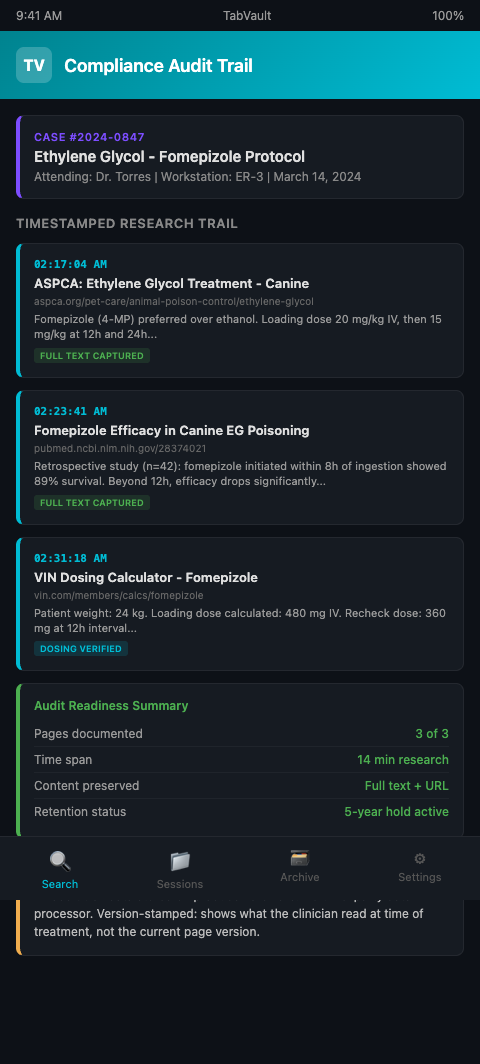
TabVault's local storage model adds a critical layer of compliance. Because all indexed content stays on the practice's own hardware, there is no third-party cloud provider with access to the research data. For practices concerned about client confidentiality, the offline audit-ready storage approach means the audit trail remains entirely within the practice's control — no external data processor agreements needed.
The distinction between a veterinary research compliance audit trail and a simple browsing log matters. A browsing log records that someone visited a URL. An indexed audit trail preserves the content of that page at the time of the visit. If a toxicology guideline is updated six months after an emergency case, the indexed version shows what the clinician actually read during the emergency, not the current version of the page. This temporal accuracy is essential for both regulatory compliance veterinary toxicology investigations and malpractice defense.
Advanced Compliance Strategies
Pair indexed research with case numbers. When a clinician begins researching a toxicosis case, tagging the session with the case or patient number creates a direct link between the research trail and the medical record. During an audit, pulling all indexed pages associated with case number 2024-0847 produces a complete bibliography of every source consulted. This linkage is what elevates browser research from informal background activity to formal clinical documentation.
Establish retention policies aligned with state requirements. The Texas Board of Veterinary Medical Examiners conducts risk-based compliance inspections that include review of patient records and documentation practices, and other state boards follow similar protocols. Regulatory retention requirements vary by state, but most veterinary medical board statutes require records to be maintained for three to seven years. Your indexed research archive should follow the same retention schedule as your medical records. TabVault's local storage makes this straightforward — the archive persists until deliberately purged, and standard backup procedures protect it against hardware failure.
Conduct quarterly compliance self-audits. Select five random cases from the previous quarter and attempt to reconstruct the research trail for each one. If the indexed archive provides a complete record of sources consulted for all five cases, your veterinary practice audit readiness is strong. If gaps exist, investigate whether certain workstations, shifts, or clinicians are not being indexed consistently.
Integrate with institutional knowledge preservation. The compliance audit trail is a subset of a broader institutional knowledge base. Research indexed for compliance purposes also contributes to the practice's collective expertise. The same archive that defends a treatment decision in an audit also helps a colleague find the right protocol for a similar case next month.
Align with emerging evidence standards. The principles of forensic evidence documentation from investigative fields are increasingly relevant to veterinary practice. Courts and licensing boards expect higher standards of documentation than they did a decade ago. An indexed, timestamped, full-text research archive positions your practice ahead of where regulatory expectations are heading.
Prepare for adverse event reporting requirements. When a patient experiences an unexpected reaction to a treatment, regulatory agencies may request documentation of the clinical reasoning behind the treatment selection. The indexed archive provides a contemporaneous record of which protocols the clinician consulted and which dosing references informed the decision. This is distinct from retrospective documentation, which relies on memory and may be viewed skeptically by investigators. The FDA's Center for Veterinary Medicine accepts voluntary adverse event reports, and practices that can demonstrate a well-documented research trail for the treatment in question strengthen the credibility of their submissions. Indexed sessions capture the decision-making process in real time, creating an evidence base that no after-the-fact summary can replicate.
Make Your Research Defensible
Every toxicology emergency generates research that informs critical treatment decisions. Without a system to capture that research, the evidence of sound clinical judgment disappears with the browser session. TabVault creates a veterinary research compliance audit trail automatically — timestamped, searchable, and stored locally under your practice's control. Join the waitlist to turn your team's clinical research into a permanent, audit-ready record.
When a state veterinary board investigator asks what informed your fomepizole dosing decision at 2 AM, TabVault provides the answer: the ASPCA ethylene glycol treatment page indexed at 2:17 AM, the PubMed abstract on fomepizole efficacy indexed at 2:23 AM, the VIN dosing calculator indexed at 2:31 AM. Every page carries a timestamp and the full rendered content from the moment your clinician consulted it. This audit trail builds itself as a byproduct of normal clinical browsing — no extra documentation steps, no post-hoc reconstruction from memory, just a permanent record of the evidence that supported every toxicology treatment decision your practice made.