Forensic Genealogy Evidence Standards and Browser-Based Logs
The Evidence Gap in Browser-Based Research
The Board for Certification of Genealogists defines a forensic genealogist as someone who applies genealogical knowledge, methods, and standards to legal problems and proceedings. When that work reaches a courtroom, it faces Rule 702 of the Federal Rules of Evidence, which requires expert testimony to be based on sufficient facts and data, produced through reliable methods, and reliably applied to the facts of the case. The genealogist must demonstrate not just the conclusion but the entire research process that produced it.
Here is where forensic genealogy evidence standards collide with reality. The research process for a genetic genealogy case unfolds across dozens or hundreds of browser sessions spanning months. The genealogist visits DNA match profiles, vital records databases, newspaper archives, cemetery indexes, and court record portals. Each visit produces information that feeds into the analysis. But the browser itself retains almost nothing. History entries show URLs and timestamps but not page content. Bookmarks capture locations but not context. Closed tabs disappear entirely.
The Genealogical Proof Standard, maintained by FamilySearch and rooted in BCG's published standards, requires five elements: reasonably exhaustive research, complete source citations, thorough analysis of evidence, resolution of conflicting evidence, and a soundly reasoned written conclusion. The first four elements depend on the researcher's ability to document what was examined and when. Browser-based research, by default, produces no such documentation.
This gap has real consequences. A forensic genealogist who solved a decades-old parentage case through months of browser research must be able to reconstruct that research trail if challenged. Without browser-based genealogy evidence logs, the reconstruction relies on memory, manual notes, and whatever screenshots the researcher thought to save at the time.
The stakes are highest in law enforcement cases. Research from PMC documents the emergence of forensic genetic genealogy as a distinct discipline, noting that no specific standards or best practices have been established for FGG case management, processing, documentary evidence, and reporting. Individual practitioners and firms set their own standards. In this environment, the genealogist who can produce comprehensive browser-based evidence logs has a significant advantage over one who cannot, both in the quality of her work and in her ability to defend it under scrutiny.
The courtroom is not the only setting where evidence standards matter. Insurance companies reviewing genealogical evidence for inheritance claims, adoption agencies evaluating parentage determinations, and family members considering the results of a search all need to trust that the research was thorough and well-documented. The evidence log serves as the bridge between the researcher's conclusion and the audience's confidence in that conclusion. Without it, even a correct conclusion lacks the documented support that transforms a claim into a finding.
Turning Browser Activity Into Auditable Evidence Logs
TabVault addresses this gap by capturing and indexing every page visited during a research session, turning chaotic browser sessions into a searchable private database with a built-in audit trail. Each session is timestamped and preserved with its full content, creating a chronological log of research activity that maps directly onto the forensic genealogy chain of custody requirements that legal proceedings demand.
The practical value for genealogy proof standard documentation is threefold. First, the indexed archive demonstrates exhaustiveness. When the genealogist testifies that she searched all available vital records databases in three states, the archive shows exactly which databases were visited, on which dates, and what content was found. Second, the archive supports source citation. Every page in the archive carries its URL, visit timestamp, and full-text content, providing the raw material for complete and accurate citations. Third, the archive captures dead ends and negative results, which are just as important to the Genealogical Proof Standard as positive findings.
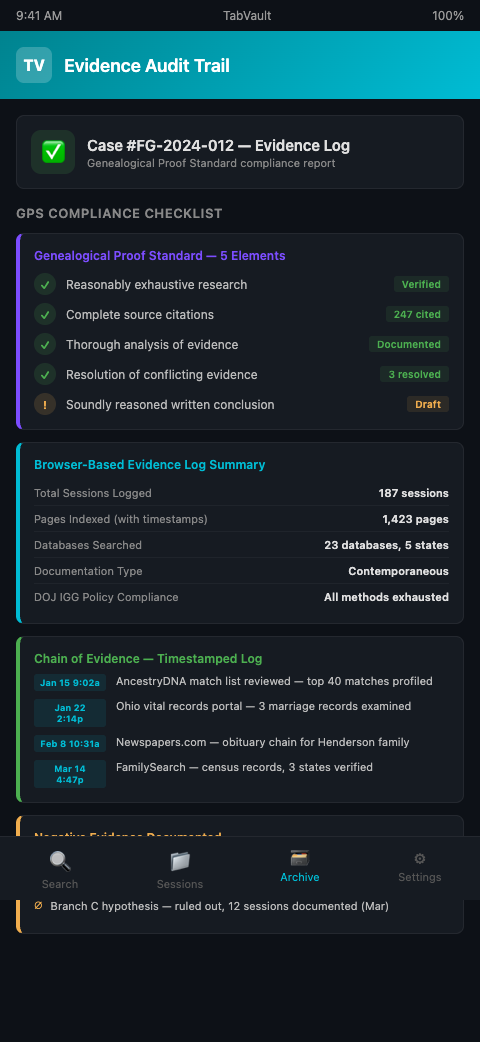
Consider the scenario where opposing counsel challenges a forensic genealogist's conclusion by arguing that the research was not exhaustive. With a traditional workflow, the genealogist must reconstruct her research path from memory and manual logs. With TabVault, she produces a searchable archive showing every session, every page visited, and the full content of each page at the time of the visit. The archive does not just show that research was conducted. It shows exactly what was examined and what was ruled out.
This distinction matters in adversarial proceedings. A forensic genealogist testifying about parentage in a custody dispute or inheritance case faces cross-examination designed to find gaps in the research. "Did you search the Ohio vital records database?" becomes a question with a verifiable answer when the session archive shows every Ohio-related session, including the specific databases queried and the pages returned. Without that archive, the genealogist's answer rests on memory, which opposing counsel will work to undermine.
The indexed archive also provides temporal documentation. The timestamp on each session shows when research was conducted, creating a chronological narrative of the investigation. This timeline demonstrates that the research was conducted methodically over time rather than hastily assembled to support a predetermined conclusion. Courts value evidence of process, and a timestamped session archive provides exactly that.
This approach aligns with the documentation requirements that professional firms follow when conducting compliance audits of their research processes. The principle is the same across fields: if the work product may face external scrutiny, the process that produced it must be documented in a way that survives that scrutiny.
Advanced Considerations for Court-Admissible Research
The first advanced consideration involves the Learned Treatise Doctrine. BCG's Genealogy Standards publication is a recognized authority in the field. A forensic genealogist who follows these standards and documents adherence through indexed session logs positions herself to invoke the Learned Treatise Doctrine during testimony. Conversely, opposing counsel can use the same standards to challenge a genealogist whose research documentation is incomplete.
The second consideration is chain of custody for digital evidence. Court-admissible genealogy research requires demonstrating that the evidence has not been altered between collection and presentation. Browser-based evidence logs that are created automatically during research, rather than reconstructed after the fact, carry stronger provenance than manually assembled documentation. The timestamp and content preservation in TabVault's indexing creates contemporaneous records rather than retrospective reconstructions.
The third consideration is negative evidence documentation. The Genealogical Proof Standard requires resolution of conflicting evidence, which means the researcher must document not just the evidence that supports the conclusion but also the evidence that was considered and set aside. A researcher who investigated and ruled out three candidate family branches needs to show the work behind those eliminations. An indexed archive of every session spent on those branches provides exactly that documentation.
The DOJ's interim policy on investigative genetic genealogy explicitly requires that all traditional investigative methods be exhausted before IGG conclusions are presented. For forensic genealogists supporting law enforcement cases, the ability to demonstrate exhaustive research through comprehensive session logs is not optional. It is a policy requirement that directly affects whether findings are admissible.
A fourth consideration involves the distinction between contemporaneous and retrospective documentation. Courts generally view contemporaneous records, those created at the time the events occurred, as more reliable than records assembled later. An indexed session archive created automatically during research is inherently contemporaneous. A research log compiled from memory after a subpoena arrives is retrospective and therefore more vulnerable to challenge. The difference in evidentiary weight is substantial.
Finally, practitioners building forensic case archives at scale should establish documentation protocols at the start of each case, not retroactively after a subpoena arrives. The strongest evidence logs are the ones that were created as a natural byproduct of the research process rather than assembled after the fact to satisfy a legal demand. A written protocol that says "all research sessions are indexed via TabVault from case inception" establishes a documentation standard that strengthens every piece of evidence the case produces.
A fifth consideration involves the practical mechanics of log maintenance. Many forensic genealogists recognize the importance of evidence documentation but find the manual process too burdensome to sustain across long cases. A researcher who diligently logs every session for the first two weeks of a case may gradually reduce her documentation effort as the case stretches into its fourth and fifth months. The sessions that are least documented are often the ones from the middle of the investigation, where the researcher was deep in analysis and least inclined to stop and write notes. TabVault's automatic indexing eliminates this documentation decay by capturing session data regardless of whether the researcher remembers to log it manually.
The convergence of forensic genealogy evidence standards with browser-based research creates an opportunity for practitioners who adopt structured session archiving early. As courts and professional bodies develop more specific standards for forensic genetic genealogy documentation, researchers who can already produce comprehensive session logs will be ahead of the compliance curve rather than scrambling to meet new requirements retroactively.
Build an Evidence Trail That Withstands Scrutiny
Forensic genealogy evidence standards exist because genealogical conclusions can change lives, determine inheritance, and identify criminal suspects. TabVault gives forensic genealogists the browser-based evidence logs that transform research activity into auditable, defensible documentation. Join the waitlist to bring your research process up to the evidentiary standard your conclusions demand.
Courtroom testimony and professional peer review demand an auditable research trail, and TabVault creates one automatically from the moment you begin a case. Every session is timestamped and preserved with its full page content, producing contemporaneous records rather than retrospective reconstructions assembled under subpoena pressure. Forensic genealogists who adopt indexed session archiving at case inception report that evidence documentation, the task most practitioners find too burdensome to sustain manually, becomes a zero-effort byproduct of their normal browser workflow. The result is a research trail that satisfies Genealogical Proof Standard requirements without adding a single minute of administrative overhead to the investigative process.