Scaling Indexed Archives for Multi-Branch Forensic Genealogy Cases
The Weight of Multi-Branch Forensic Cases
A forensic genealogist working a single unidentified remains case in 2023 told colleagues she had accumulated over 1,400 browser sessions across seven months of research. The case involved four distinct family branches, each requiring separate lines of investigation through AncestryDNA, GEDmatch, FamilyTreeDNA, newspaper archives, and state vital records portals. When the Department of Justice's Interim Policy on Forensic Genetic Genealogical DNA Analysis went into effect, it formalized what practitioners already knew: these cases demand exhaustive research across every available avenue before any conclusion is defensible.
The challenge is not the research itself. Skilled genetic genealogists know how to build family trees, interpret centimorgan values, and triangulate DNA segments. The challenge is scale. A case involving four branches of a family tree, each extending back four or five generations, produces an enormous volume of web-based research. Each branch requires its own cluster analysis, its own vital records searches, its own newspaper obituary trails. As the National Genealogical Society notes, DNA clusters represent branches of a family tree, and each cluster demands its own organized line of inquiry.
When those lines of inquiry live in browser history and scattered bookmarks, forensic genealogy evidence management breaks down. Sessions blur together. A critical obituary from Branch C gets confused with a newspaper clipping from Branch D. The researcher spends forty minutes re-finding a page she already visited in February.
The Carnegie Mellon University study on browser tab behavior found that more than half of surveyed participants felt they could not close their open tabs, fearing information loss. For forensic genealogists, this fear is well-founded. A closed tab containing a vital records result from Branch B may hold the connection that later links to Branch D, but only if the researcher can find it again. Traditional browser history, with its bare list of URLs sorted by time, offers no way to search the actual content of those pages or to see which other pages were visited during the same research session.
Turning Session Chaos Into Structured Branch Archives
The core problem with multi-branch forensic genealogy case archive scaling is that browser tabs are ephemeral, but forensic cases are not. A case that runs for six months or longer needs a research archive that grows with the investigation rather than collapsing under its own weight. TabVault addresses this by turning chaotic browser sessions into a searchable private database, where every page visited during an investigation becomes a permanently indexed, full-text-searchable record tied to the session where it was found.
The practical application for multi-branch cases is straightforward. Each family branch gets its own session grouping. When the researcher shifts from investigating the maternal line of Branch A to the paternal line of Branch B, that context switch is captured. Three months later, a search for a specific surname or location pulls up every session where that term appeared, regardless of which branch it belonged to.
This matters because forensic cases frequently produce unexpected connections between branches. A surname that appeared in Branch A's obituary research might surface again in Branch B's vital records search. Without indexed archives spanning the entire case, those connections stay invisible. The researcher working multi-generational family reconstruction across four branches needs retrieval that cuts across all of them simultaneously.
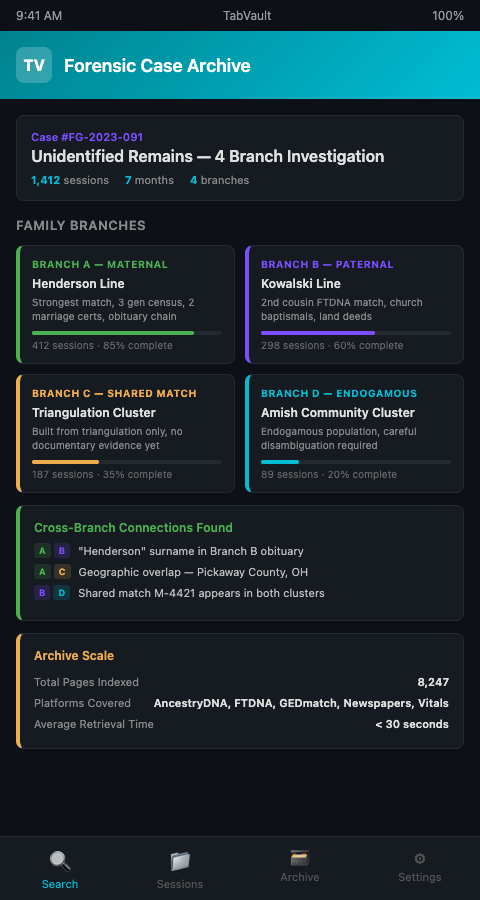
The framework for large-scale DNA case organization within TabVault follows three principles. First, sessions are tagged by branch and date, creating a two-dimensional grid of research activity. Second, full-text indexing captures page content at the time of the visit, so even if a database updates or a page goes offline, the researcher retains a searchable snapshot. Third, search results display session context, showing not only the matching page but the surrounding research activity from that same session.
For practitioners managing team knowledge bases across a firm, this structure means a case can be handed from one researcher to another without losing months of accumulated context. The incoming researcher can search the archive by branch, by surname, by date range, or by platform, reconstructing the full investigation history without relying on the previous researcher's memory.
Consider the mechanics of a four-branch case. Branch A originates from the strongest DNA match and extends through three generations of census records, two marriage certificates, and a newspaper obituary chain. Branch B starts with a second-cousin match on a different platform and runs through church baptismal records and land deeds. Branch C is built entirely from shared match triangulation with no documentary evidence yet. Branch D is an endogamous population cluster requiring careful disambiguation. Each branch generates its own stream of browser sessions, and the total volume across all four branches may exceed a thousand sessions over six months.
Without a structured indexing system, the researcher's ability to cross-reference between branches degrades as the case grows. She may remember that she found a relevant obituary two months ago but cannot recall whether it was from Branch A or Branch B research, or which newspaper archive she found it in. A full-text search that returns every session containing the deceased person's name resolves the question in seconds. This cross-branch retrieval is what separates forensic genealogy evidence management from casual family history browsing.
Advanced Tactics for Scaling Across Complex Cases
The first mistake researchers make when scaling archives is treating all sessions as equal. A quick five-minute check on a name variant does not carry the same weight as a two-hour deep session building out a branch's fifth generation. Tagging sessions by depth and significance helps prioritize retrieval later. When the case reaches the reporting phase, the researcher can filter for high-value sessions rather than sifting through hundreds of brief lookups.
The second mistake is failing to cross-reference between branches early enough. Research published in Forensic Genomics on compound unknown parentage cases demonstrates that biological parents can sometimes be identified only when multiple family branches are analyzed together. A match that seems insignificant within one branch may be the key connector when viewed alongside matches from another branch. TabVault's cross-branch search makes this type of lateral discovery possible without requiring the researcher to hold the entire case in working memory.
The third consideration is archival durability. Forensic genealogy cases, particularly those involving law enforcement, may need to produce research documentation months or years after the initial investigation. The Board for Certification of Genealogists emphasizes that forensic genealogists must be prepared to defend their work under the standards applied to expert testimony. An indexed archive that preserves the full trail of research activity, including dead ends and ruled-out hypotheses, provides exactly the type of documentation that withstands scrutiny.
Firms handling multiple active cases simultaneously face an additional scaling challenge. The architecture that works for practices managing parallel caseloads across locations applies equally to genealogy firms running five or ten forensic cases at once. Each case needs isolation to prevent cross-contamination of research, but the underlying search infrastructure needs to support firm-wide queries when a new case shares surnames or geographic regions with an older one.
A fourth consideration is version control for evolving hypotheses. In month two of a case, the researcher may believe that Branch A connects to the subject through a specific ancestral couple. By month five, new evidence may revise that hypothesis entirely. The session archive preserves both the original research that supported the first hypothesis and the later research that overturned it. This historical record is not merely useful for documentation. It prevents the researcher from accidentally revisiting and re-rejecting a hypothesis she already explored, saving hours of circular investigation.
Finally, researchers should establish a branch-naming convention at the start of each case and apply it consistently to every session. A convention as simple as "Case-47-Branch-A-Maternal" creates a filterable taxonomy within the archive. When the case report is due, the researcher can pull all sessions for a specific branch in chronological order and walk through the research narrative from first session to last. This structured retrieval converts raw session data into the documented methodology that complex genealogy case file management requires.
The scaling problem also has a temporal dimension. Multi-branch family research indexing must account for the fact that different branches progress at different speeds. Branch A might reach a fifth-generation resolution in month two, while Branch C remains stalled at the third generation in month six. The researcher needs to be able to revisit Branch A's archived sessions months later when new evidence from Branch C suggests a connection, without having to reconstruct the Branch A timeline from scratch. An indexed archive preserves each branch's full history regardless of when the research was conducted, making these retrospective connections possible.
Practitioners should also plan for case growth from the outset. A case that starts with two family branches may expand to five as DNA evidence reveals additional lines of descent. The archive architecture should accommodate this expansion without requiring reorganization of existing sessions. New branches should layer naturally onto the existing archive, with new session tags supplementing rather than replacing the established taxonomy. This forward-compatible approach prevents the disruptive reorganization that derails research momentum in the middle of an already complex investigation.
Start Building Your Forensic Case Archive
Complex genealogy case file management does not get easier as cases grow. It gets harder, unless the archive grows with the research. TabVault gives forensic genealogists the indexed, searchable, branch-aware archive that multi-branch cases demand. Join the waitlist to see how a private research database transforms the way you manage your most complex investigations.
Forensic cases that span four family branches and seven months of research cannot afford to lose a single session's context. TabVault preserves every branch's evidence trail independently, so a surname search across Branch A's obituary sessions and Branch D's vital records sessions returns results in under a second, even when those sessions occurred five months apart. Practitioners who have adopted indexed archives for multi-branch casework report that cross-branch connections, the kind that break stalled investigations, surface within the first quarter of active research. The archive scales with the case rather than collapsing under it, and every session you add strengthens the retrieval network that connects distant branches to each other.