Tab Search Architecture for Multi-Vet Emergency Practices
Five Clinicians, Five Silos
A busy 24-hour emergency veterinary hospital in the Chicago suburbs staffs five clinicians per overnight shift. On a single Saturday night in December 2024, three of those five vets independently researched xylitol toxicosis in dogs — the same toxin, the same ASPCA Animal Poison Control Center guidelines, the same published lethal dose thresholds. None of them knew the others had already found the answers. The ASPCA's Animal Poison Control Center handles more than 400,000 cases per year, and xylitol consistently ranks among the most common canine toxin exposures. According to the Veterinary Information Network (VIN), emergency clinicians spend an average of 12 minutes per case on toxicology research — time that multiplies when multiple veterinarians duplicate the same searches without knowing it.
This duplication is structural, not personal. Browser tabs are inherently private. When Dr. Patel closes her Chrome session at 6 AM, every tab she opened during her shift vanishes. Dr. Rivera, arriving for the morning shift, starts from scratch. The research each clinician performs lives and dies inside individual browser windows. In a multi-veterinarian emergency clinic setup, this means the practice's collective toxicology knowledge resets with every shift handoff.
The American Veterinary Medical Association reports that there are over 7,000 emergency and specialty veterinary practices operating in the United States. Most of these practices have multiple clinicians rotating through shifts. Yet virtually none have a system for capturing, indexing, and sharing the browser-based research their teams produce every day.
Designing a Shared Research Layer
The solution is architectural, not behavioral. Telling clinicians to save bookmarks or email links to colleagues has never worked at scale. What works is building a system where research is captured and indexed automatically as a byproduct of normal browsing — turning chaotic browser sessions into a searchable private database that every clinician on the team can query.
A tab search architecture for a multi-vet practice starts with local indexing on each clinician's workstation. TabVault runs in each browser, capturing the full text of every toxicology page visited during a shift. ASPCA toxin profiles, VIN discussion threads, Merck Veterinary Manual entries, PubMed abstracts — all indexed locally the moment they are viewed. No manual saving, no copy-pasting into shared documents.
The critical design choice is what happens next. In a shared toxicology research workflow, each clinician's index feeds into a practice-wide search layer. When Dr. Rivera types "xylitol canine hepatotoxicity" into her search bar at 7 AM, she finds not only her own past research but also the pages Dr. Patel indexed at 2 AM. The duplication problem disappears because the architecture makes prior research discoverable by default.
This is not a shared bookmark list. Full-text indexing means the search works on content, not just titles or URLs. If Dr. Patel read a VIN thread where a board-certified toxicologist described an unusual xylitol presentation in a miniature breed, Dr. Rivera can find that thread by searching for "miniature breed xylitol" even though those words never appeared in the page title. The depth of team-based veterinary tab indexing depends on capturing the entire page, not just a reference to it.
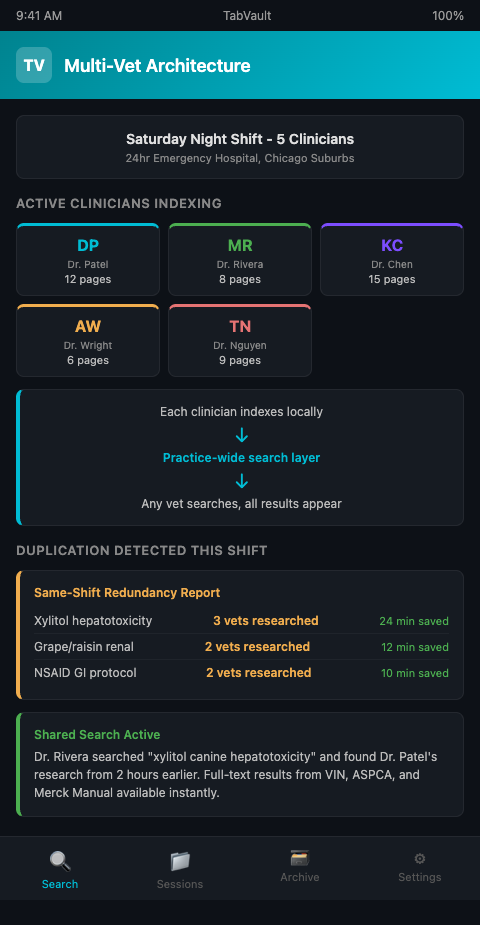
Privacy controls matter in this architecture. Client-identifying information in veterinary records requires careful handling. The indexing layer captures toxicology reference material — published protocols, dosing calculators, case reports — while excluding practice management system screens that contain client names and patient histories. TabVault's domain-level filtering lets practices specify which sites get indexed and which stay out of the shared layer entirely.
The cumulative effect is that the practice builds a permanent institutional knowledge base -- much like multi-location salvage operations unifying sourcing intelligence across yards -- without anyone changing their workflow. Every shift adds to the collective archive. After six months, the practice has a searchable corpus of thousands of toxicology pages that reflects the actual cases the team has encountered and the specific resources they found most useful.
Advanced Architecture Considerations
Role-based access tiers. Not every clinician needs the same view. A practice might restrict technician-level accounts to read-only search while giving attending veterinarians full indexing privileges. Emergency practice research infrastructure should mirror the existing clinical hierarchy without creating barriers to accessing critical information during active cases.
Session tagging by case type. When a clinician starts researching a rodenticide case, a simple tag at the session level groups all related pages together. Later searches can filter by tag, isolating all rodenticide research from all chocolate toxicosis research. This organization layer becomes especially valuable when practices need to identify research specific to a clinic's caseload.
Cross-location search for multi-site practices. Emergency veterinary groups increasingly operate across multiple locations. A tab search architecture built on local indexing with synchronized search means a clinician at the satellite location can query research generated at the flagship hospital. The principles for scaling tab search across multiple locations apply directly to multi-hospital veterinary groups, adapted for the specific privacy requirements of clinical practice.
Onboarding acceleration. New veterinarians joining a practice typically spend their first weeks rebuilding a personal reference library. With a shared index, they inherit months or years of curated toxicology research from day one. Their first shift is backed by every page every colleague has ever indexed, searchable in seconds.
Audit and review cycles. Monthly review of the most-queried terms in the shared index reveals which toxins the practice encounters most frequently. This data informs continuing education priorities, formulary decisions, and stocking levels for antidotes. The search architecture doubles as a practice analytics tool.
Disaster and surge capacity planning. When a mass exposure event occurs — a contaminated pet food recall, a neighborhood-wide pesticide application, or a toxic algae bloom — a multi-vet practice may see ten or more related cases in a single day. A shared search architecture means the first clinician who researches the exposure creates a reference trail that every subsequent clinician accesses immediately. During the 2023 FDA investigation into contaminated jerky treats, practices with shared research systems could disseminate findings across their entire team within minutes of the first case presentation.
Integration with practice management systems. The tab search architecture gains additional value when indexed sessions can be loosely correlated with case records in the practice management system. While TabVault indexes reference material rather than patient data, the temporal alignment between indexed research sessions and case timestamps provides a natural linkage. A clinician reviewing a case outcome can search the archive for research conducted during the same timeframe, reconstructing the full decision-making context without requiring a formal integration between systems.
Bandwidth and infrastructure requirements. Local indexing places minimal demands on network infrastructure. Because TabVault stores indexed content on workstation-level storage, the practice does not need to provision cloud storage or maintain high-bandwidth connections between the indexing layer and a central server. Even practices in rural areas with limited internet bandwidth can build a robust shared research layer using local area network synchronization during off-peak hours. A 2023 narrative review in Veterinary Surgery documented that insufficient rest and extended work hours reduce higher cognitive functioning and multitasking abilities in veterinary professionals — making rapid retrieval from a shared archive even more critical during high-volume overnight shifts when individual research capacity is most compromised.
Stop Rebuilding What Your Team Already Found
Every emergency veterinary practice generates enormous volumes of toxicology research. The question is whether that research evaporates at the end of each shift or accumulates into a permanent, searchable asset. TabVault gives multi-vet practices the architecture to capture, index, and share browser-based research across the entire team — automatically, privately, and without changing how anyone works. Join the waitlist to build a research infrastructure that compounds with every case your team handles.
Five clinicians per shift, four shifts per day, and every research session feeds the same searchable archive. TabVault captures what Dr. Patel indexed during the overnight xylitol case and makes it retrievable by Dr. Rivera at 7 AM without either clinician changing how they work. The chocolate theobromine dosing page one vet consulted on Wednesday surfaces for a different vet facing the same compound on Saturday. Over twelve months of multi-clinician indexing, the practice accumulates a collective toxicology knowledge base that no individual could build alone — thousands of vetted reference pages spanning every toxin the team has encountered, searchable by anyone on any shift.