Eliminating Redundant Toxicology Research During Shift Handoffs
The Research That Gets Done Twice
A veterinary emergency hospital operates on 12-hour shifts. At 6:45 a.m., the overnight clinician briefs the incoming day-shift veterinarian on active cases. Case three is a Cocker Spaniel that ingested cholecalciferol rodenticide around midnight. The overnight vet researched the toxic dose, the expected timeline for hypercalcemia, the ionized calcium monitoring schedule, and the calcitonin-versus-pamidronate treatment debate. She found a 2018 PubMed case series with specific monitoring intervals and an ASPCA consultation summary recommending 72-hour hospitalization.
The handoff takes four minutes. The overnight vet mentions the key findings verbally: toxic dose exceeded, ionized calcium trending up, calcitonin started, recheck calcium in 6 hours. What she does not hand off is the 25 minutes of browser-based research that led to those decisions — the PubMed case series URL, the ASPCA protocol page, the Merck Manual entry she cross-referenced. Her browser tabs close when she logs out. By 8 a.m., the day-shift vet has a new question about the calcitonin-versus-pamidronate decision and starts researching from scratch.
This pattern of redundant toxicology research during shift handoffs is systematic, not occasional. A study on emergency department handoff communication found that information loss during transitions of care is one of the most frequently cited contributors to adverse events and inefficiency (Riesenberg et al., 2009). The verbal handoff transmits conclusions but not the evidence base behind them. The incoming clinician inherits the treatment plan but not the research trail.
The scope of the problem scales with case complexity. A straightforward chocolate toxicosis case might require five minutes of research. A cholecalciferol case requiring multi-day hospitalization with serial monitoring can generate 30 or more minutes of reference consultation across PubMed, the Merck Veterinary Manual, ASPCA protocols, and the Veterinary Information Network (VIN). When the day-shift vet re-researches even a fraction of that material, the cumulative waste across all shift transitions in a week is measured in hours.
The problem is not the quality of the handoff communication. It is that browser-based research has no persistence mechanism across shifts.
Indexed Sessions as Shift Handoff Infrastructure
The fix is to make one shift's research available to the next shift without any additional effort from the departing clinician. When every browser session is indexed, the research conducted during the overnight shift persists in a searchable archive after the clinician logs off. The incoming day-shift vet inherits not just the treatment plan but the entire research trail — every page consulted, every reference reviewed, every protocol cross-referenced.
TabVault turns this shift transition research continuity into a default behavior. The overnight vet researches cholecalciferol toxicosis normally, opening PubMed, the Merck Manual, and the ASPCA protocol page. TabVault indexes each page in real time. At shift change, the overnight vet logs off and closes her browser. The indexed pages remain. The day-shift vet opens TabVault, searches "cholecalciferol canine calcitonin," and every page the overnight vet consulted appears in the results. The 25-minute research session is instantly available, and the day-shift vet picks up exactly where the overnight vet left off.
This is duplicate toxin lookup prevention at its most direct. The research was already done. The references were already found. The only thing missing was a searchable bridge between one clinician's browser session and the next clinician's need for the same information. TabVault provides that bridge by turning chaotic browser sessions into a searchable private database that persists across users and across shifts.
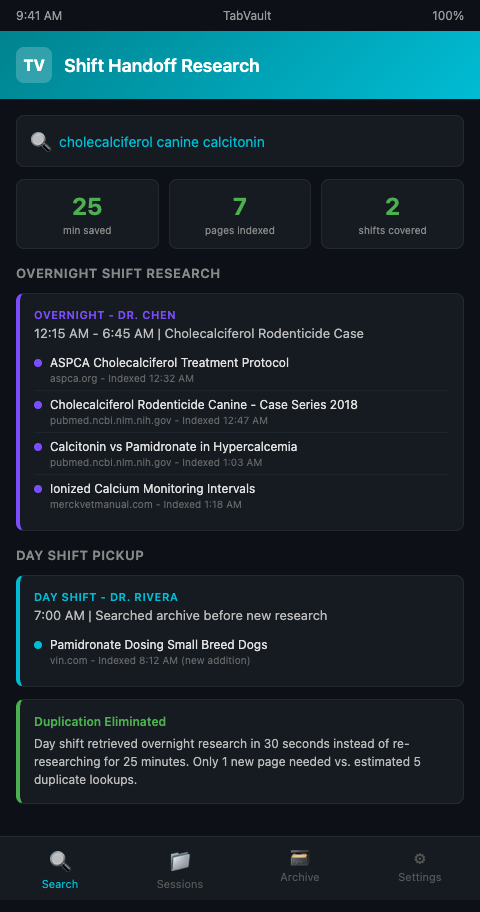
The veterinary shift handoff protocol for complex toxicology cases improves when the incoming clinician can verify the outgoing clinician's research independently. Instead of accepting the verbal summary at face value, the day-shift vet can review the actual PubMed case series, read the ASPCA consultation summary, and confirm the calcitonin dosing rationale. This is not about distrust — it is about giving the incoming clinician the same evidence base that informed the overnight decisions.
Emergency vet shift change research continuity also prevents the "telephone game" effect across multiple shift transitions. A case that spans three shifts — overnight, day, evening — often involves three separate clinicians, each of whom may re-research aspects of the same toxin. With indexed sessions, the first clinician's research persists through all subsequent shifts. The second and third clinicians search the archive, find the original references, and add new research that also gets indexed. The archive grows across shifts rather than resetting at each transition.
The hidden cost of duplicate research applies across professions. Genealogy researchers face an identical problem when duplicate research wastes hours on parentage investigations, and the solution is the same: index once, search forever.
When clinics reach the point where every veterinarian's research benefits the whole practice, the shift handoff problem dissolves. That progression from individual indexing to clinic-wide research sharing is the same path that leads to institutional toxicology knowledge — and it starts with eliminating redundant research at the individual shift level.
Shift Handoff Research Tactics
Make the indexed archive part of the verbal handoff. When briefing the incoming clinician, mention the search terms that will retrieve your case-specific research. "I researched this case — search 'cholecalciferol calcitonin monitoring' in TabVault and you will find every reference I used." This takes five seconds and saves the incoming vet 20 minutes of duplicate research.
Index during the case, not after. The research that matters most for the next shift is the research conducted in real time during patient care. Index your browsing as you go, and the archive captures the pages you actually used for clinical decisions, not a post-hoc reconstruction of what you think you looked at.
Search the archive before starting new research. The cost of duplicate research compounds across every shift transition. When you begin a shift and pick up a complex toxicology case, search TabVault before opening a single new browser tab. If the previous shift already researched the toxin, the key references are already indexed. Start with what exists rather than duplicating it. This single habit — search before you research — eliminates the majority of redundant toxicology research at shift handoff.
Use timestamps to identify which shift generated which research. The indexed pages carry timestamps that correspond to specific shifts. If you want to see what the overnight vet researched versus what the day vet added, filter by time range. This makes it possible to trace the research lineage of a complex case across multiple shift changes. The Joint Commission on Accreditation of Healthcare Organizations has identified handoff communication as a national patient safety priority, and traceable research archives support that goal in veterinary settings.
Extend handoff indexing to consultation calls. When the overnight vet calls a board-certified toxicologist for consultation and then opens reference pages based on the specialist's recommendations, those pages get indexed too. The day-shift vet inherits not just the overnight vet's independent research but also the specialist-informed references, giving the incoming clinician access to the highest-quality evidence from the previous shift.
Stop Paying the Duplication Tax
Every shift transition that triggers redundant research is a tax on clinical efficiency. TabVault eliminates that tax by making one shift's browser research searchable by the next shift's clinician. If your emergency hospital handles complex toxicology cases across shift changes and you are losing hours to duplicate toxin lookups, join the waitlist and make shift transition research continuity the default.
The overnight clinician leaves at 7 AM, and her twenty-five minutes of cholecalciferol research stays behind in the archive. The day-shift veterinarian picks up the case, searches "cholecalciferol canine calcitonin monitoring" in TabVault, and finds every PubMed abstract, ASPCA consultation summary, and Merck Manual entry the overnight clinician consulted — timestamped, full-text searchable, and ready to inform the next treatment decision without a single minute of redundant research. Across a week of shift transitions on complex multi-day toxicosis cases, TabVault eliminates the duplication tax that costs emergency practices hours of clinician time every month.