When Every Vet's Research Benefits the Whole Clinic
The Invisible Tax of Isolated Research
An eight-veterinarian emergency practice in Denver runs two clinicians per shift, four shifts per day. Each clinician averages six toxicology-related web searches per shift. That is 48 toxicology research sessions per day, 336 per week, over 17,000 per year. According to the ASPCA Animal Poison Control Center, which manages more than 400,000 cases annually, the most common toxin categories — chocolate, rodenticides, NSAIDs, xylitol, and plants — account for the majority of emergency presentations. This means the same toxins get researched repeatedly, by different clinicians, across different shifts, week after week.
A 2022 study in the Journal of the American Veterinary Medical Association examined time allocation in veterinary emergency practice and found that clinicians spend between 8 and 15 minutes per case on reference consultation during toxicology emergencies. If even 30 percent of that research duplicates what a colleague already found, the practice loses roughly 1,500 hours per year to redundant research. That is the equivalent of one full-time veterinarian's annual clinical hours consumed by looking up information someone else already located.
The knowledge exists within the practice. The problem is access. Browser tabs are private by default. When Dr. Nakamura closes her browser at the end of a shift, her research disappears. When Dr. Pham opens his browser for the next shift, he starts from zero. The American Association of Veterinary State Boards tracks continuing education requirements across states, and the emphasis is consistently on acquiring new knowledge — but practices hemorrhage existing knowledge every time a browser session ends.
This is not a training problem or a communication problem. It is an infrastructure problem. The practice has no system for preserving and sharing the browser-based research its clinicians generate during every shift.
Research Pooling Through Shared Indexing
The fix is structural: capture every clinician's browser-based toxicology research automatically and make it searchable by the entire team. This is the clinic-wide research sharing workflow that turns individual browsing into collaborative veterinary toxicology knowledge.
TabVault implements this by indexing the full text of every toxicology reference page each clinician visits. When Dr. Nakamura researches grape and raisin toxicosis on Saturday night, every page she opens — the ASPCA treatment protocol, the VIN discussion thread on small-breed dosing thresholds, the PubMed meta-analysis on delayed renal effects — gets indexed locally. When Dr. Pham encounters a similar case on Tuesday, he searches the practice's shared archive and finds Dr. Nakamura's research immediately. The forty-five minutes she invested become a thirty-second search for him.
This is veterinary team research pooling at the practical level: turning chaotic browser sessions into a searchable private database where every session contributes to the collective resource. The pooling happens passively, as a byproduct of normal clinical browsing. No clinician needs to save bookmarks, write summaries, or email links. The indexing is automatic, and the search is shared.
The shared veterinary research benefits extend beyond simple deduplication. When eight clinicians contribute to a shared archive over twelve months, the resulting corpus reflects a broader range of clinical experience than any individual could generate. Dr. Nakamura may gravitate toward VIN as her primary reference. Dr. Pham may prefer PubMed case reports. Dr. Chen may rely heavily on the Merck Veterinary Manual. The shared archive captures all three perspectives, giving every team member access to resources they might not discover on their own.
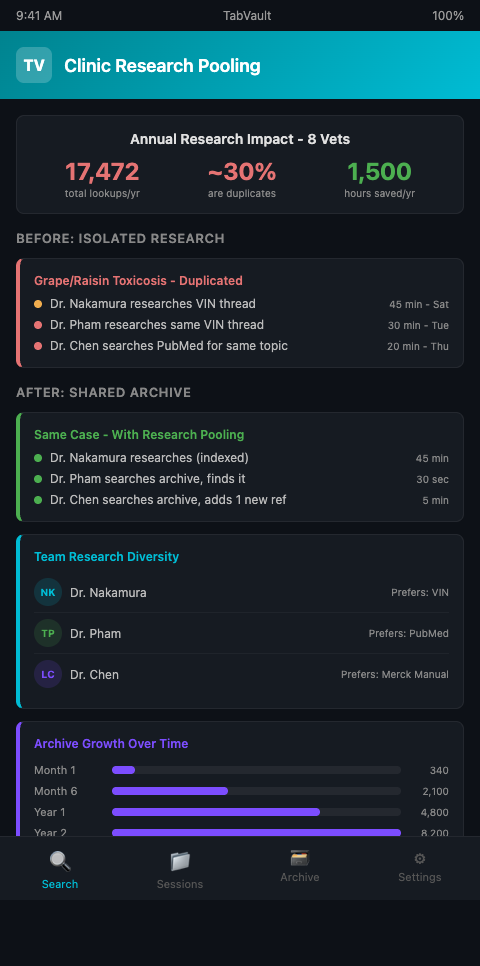
The compound effect is what makes this approach substantial. In the first month, the shared archive contains a few hundred indexed pages. After six months, it holds thousands. After two years, it represents a comprehensive, practice-specific toxicology library built entirely from the team's actual clinical research. New clinicians joining the practice inherit this entire corpus on their first day — a collective emergency vet knowledge base that took years to build, searchable in seconds.
This is the bridge between individual expertise and institutional toxicology knowledge. The knowledge does not depend on any single clinician's memory or tenure. When a senior veterinarian retires, their years of indexed research remain in the archive, searchable by every clinician who follows.
The workflow also strengthens when it extends to multi-veterinarian practice architectures with role-based access. A senior toxicology specialist's indexed research carries implicit authority — pages they consulted for complex cases become the practice's most trusted references, surfaced alongside general resources when junior clinicians search for similar cases.
Maximizing the Shared Research Advantage
Track the most-queried terms monthly. The practice's search logs reveal which toxins and protocols the team researches most frequently. If "xylitol hepatotoxicity" appears in fifty searches per month but the archive contains only three indexed pages on the topic, that gap represents a quality improvement opportunity. Proactively building out indexed coverage for high-frequency queries ensures the shared archive meets actual clinical demand.
Highlight high-value finds. When a clinician discovers an unusually thorough case report or a definitive treatment protocol during a research session, a simple annotation marks that page as a high-value resource. Future searches surface annotated pages first, creating a curated layer within the broader archive. This is the collaborative veterinary toxicology knowledge equivalent of a senior colleague pointing a junior to the best reference on the shelf.
Build regional knowledge bases from team browsing patterns. Different geographic regions present different toxicology profiles. A practice in the Desert Southwest encounters different plant toxicities than one in the Pacific Northwest. The shared archive naturally builds a region-specific reference library that reflects local hazards — sago palm toxicosis in Florida, blue-green algae in the Upper Midwest, toad poisoning (Bufo alvarius) in Arizona.
Use the archive for case conference preparation. Weekly or monthly case conferences become more productive when clinicians can pull the complete research trail for discussed cases from the shared archive. Instead of relying on memory or recreating searches, the presenter can display the actual pages consulted during the emergency, grounding the discussion in specific references rather than general recollections.
Measure research efficiency over time. A 2024 review in the Journal of Veterinary Internal Medicine noted that clinicians frequently underutilize available evidence because the effort to locate and synthesize sources exceeds time available during clinical decisions — a barrier that shared indexed archives directly reduce. As the shared archive matures, average research time per case should decrease. Track this metric quarterly. A declining trend confirms that veterinary team research pooling is delivering its promised efficiency gains. A flat or increasing trend indicates gaps in the archive that need attention.
Identify and amplify clinical champions. In most practices, one or two clinicians emerge as the most thorough researchers — the ones who consistently find the deepest references and the most specific protocols. The shared archive makes their contributions visible. When a search for a rare toxin consistently returns pages indexed by the same clinician, that pattern identifies expertise the practice can leverage. Encourage those clinical champions to proactively index references for toxins the practice encounters infrequently, building coverage in areas where the archive is thinnest. Their research investment multiplies across every colleague who later searches for the same toxin, creating a disproportionate return on the time they spend browsing reference material during quieter shifts.
Make Every Research Session Count Twice
Every time a clinician at your practice opens a browser tab during a toxicology emergency, they generate knowledge that could benefit the entire team. Without a shared index, that knowledge disappears at the end of the session. TabVault captures it automatically and makes it searchable by every colleague, on every shift, for every future case. Join the waitlist to stop losing the research your team has already done.
Dr. Nakamura's forty-five-minute thorough review of grape and raisin toxicosis on Saturday night becomes Dr. Pham's thirty-second search on Tuesday morning. TabVault captures every clinician's browsing automatically and makes it available to the entire team through a shared searchable archive. Eight veterinarians contributing research across four daily shifts build a collective knowledge base that covers more sources, more toxin presentations, and more treatment approaches than any individual could assemble alone. After a year, the shared archive represents thousands of vetted reference pages shaped by the practice's actual caseload — a resource that gets richer with every shift and benefits every clinician who queries it.