How Indexed Sessions Build Institutional Toxicology Knowledge
The Knowledge That Leaves When Clinicians Leave
Dr. Martinez spent eleven years at a 24-hour veterinary emergency hospital. During that time, she treated over 2,000 poisoning cases, called the ASPCA Animal Poison Control Center hundreds of times, and built an encyclopedic mental library of treatment protocols for toxins ranging from common chocolate ingestions to rare blue-green algae hepatotoxicosis. In November, she accepted a position at a university teaching hospital. On her last day, she returned her badge, cleared her locker, and walked out.
The clinic kept her medical records. It kept the treatment protocols she wrote for the hospital manual. What it did not keep was the vast research trail she generated during 11 years of browser-based toxicology lookups — the PubMed case reports she found at 3 a.m. for rare exposures, the ASPCA consultation references she bookmarked on her personal account, the AnTox database queries she ran for unusual compounds, the Veterinary Information Network discussions she followed for emerging toxin trends. All of that knowledge existed in her browser sessions, her personal bookmarks, and her memory. When she left, it left.
This is not a hypothetical scenario. Staff turnover in veterinary emergency medicine is high. A 2022 survey by the American Veterinary Medical Association found that burnout and turnover remain persistent challenges in the veterinary profession, with emergency and critical care practitioners reporting particularly high rates of career dissatisfaction (AVMA, 2022). Every departing clinician takes undocumented knowledge with them.
The concept of institutional memory loss is well-studied in organizational psychology. Research on knowledge management in healthcare settings shows that explicit knowledge — written protocols, published guidelines — transfers across personnel changes, but tacit knowledge — the "I know which PubMed search finds the best permethrin case series" or "the ASPCA consultant recommended this specific monitoring interval last time" — does not survive turnover (Argote & Ingram, 2000). In a veterinary emergency hospital, tacit toxicology knowledge is arguably the most clinically valuable, and it is the most fragile.
The scale of the loss increases with seniority. A clinician with two years of experience takes two years of research knowledge. A clinician with eleven years takes eleven years. The American College of Veterinary Emergency and Critical Care certifies specialists whose expertise represents years of concentrated training and case experience — knowledge that belongs to the individual, not the institution.
From Individual Browsing to Institutional Archive
Building an institutional toxicology knowledge base from indexed browser sessions requires a shift in perspective: turning chaotic browser sessions into a searchable private database that belongs to the practice, not the individual. Instead of viewing each clinician's research as a personal activity that exists only in their browser and their memory, treat it as institutional data that persists beyond any individual's tenure. When every clinician's browser sessions are indexed, the clinic accumulates a searchable archive that reflects the collective research of every veterinarian who has ever worked there.
TabVault enables this veterinary clinic knowledge management at the session level. When Dr. Martinez researches a blue-green algae case at 2 a.m. and opens PubMed case reports, ASPCA protocols, and Merck Manual entries, TabVault indexes all of those pages. When she leaves the clinic eleven years later, those indexed pages remain in the clinic's archive. The next clinician who faces a blue-green algae case searches "microcystin hepatotoxicity canine" and retrieves every reference Dr. Martinez consulted across multiple cases over multiple years — a research trail that would have been irretrievably lost without indexing.
This is what indexed session institutional memory looks like in practice. The archive does not contain opinions or interpretations — those leave with the clinician. It contains the raw reference material: every PubMed abstract, every ASPCA protocol page, every formulary entry, every VIN discussion thread that any clinician at the practice ever viewed during a toxicology case. The institutional memory is the evidence base, not the conclusions drawn from it.
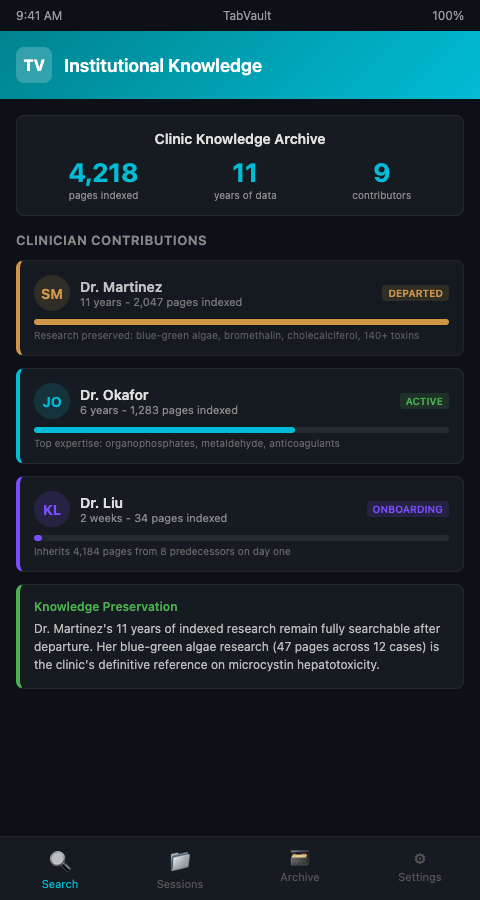
TabVault's toxicology research knowledge sharing happens passively. No clinician needs to write a summary, compile a reading list, or transfer bookmarks. The indexing is automatic. The knowledge sharing occurs when any clinician at the practice searches the archive and finds pages indexed by any other clinician during any previous shift. The clinic-wide poisoning case intelligence grows with every shift worked by every veterinarian on staff.
The accumulation effect is what distinguishes institutional knowledge from individual knowledge. One clinician's research on permethrin toxicosis covers the cases she treated. Five clinicians' indexed research on permethrin covers a broader range of presentations, dosing approaches, and outcome data. The archive becomes richer and more representative than any single clinician's experience. After several years of indexing across a full clinical team, the practice's institutional archive represents a collective clinical experience that no individual could match.
This progression connects directly to the shift handoff research continuity problem. Shift handoffs are micro-transitions where knowledge transfers (or fails to transfer) between individuals. Staff departures are macro-transitions where knowledge transfers (or fails to transfer) between eras of the practice. Indexed sessions address both: the archive persists across shifts and across careers.
The value of making CE session resources permanently searchable feeds directly into institutional knowledge. When one clinician attends a toxicology CE webinar and indexes the references, those references become available to every clinician at the practice through the shared archive. The CE investment multiplies across the team rather than remaining siloed in the attendee's memory.
The concept of indexed institutional knowledge applies across fields. Genealogy researchers who share indexed research through reunion registries face the same fundamental question: how do you make one person's research available to an entire community? The mechanism is the same: index the research when it happens, and the archive makes it shareable by default.
Strategies for Building Institutional Knowledge
Start indexing clinic-wide, not just individually. The institutional value of indexed sessions scales with the number of clinicians contributing. A single veterinarian's archive is valuable. The combined archive of every veterinarian on staff is transformative. Encourage every clinician to use TabVault during their shifts. The more people index, the richer the institutional knowledge base becomes.
Identify your clinic's toxicology fingerprint. After six months of clinic-wide indexing, search the archive for the top ten toxins by frequency. The results reveal your practice's toxicology profile — which toxins your team researches most often, which ones generate the most extensive research trails, and which ones have sparse coverage. Use this fingerprint to identify knowledge gaps and direct future indexing efforts toward underrepresented toxins.
Preserve departing clinicians' research automatically. When a clinician gives notice, their indexed sessions are already in the archive. No exit interview can capture eleven years of browser-based research. No bookmark export comes close. The indexed archive captures it all, and it persists after the clinician's departure. This is the most powerful institutional knowledge preservation mechanism available.
Use the institutional archive for onboarding. When a new veterinarian joins the practice, direct them to search the TabVault archive for the toxins most commonly seen at the hospital. They inherit years of curated reference material from their predecessors, with the most-consulted pages appearing most frequently in search results. This accelerates the onboarding process from "learn everything from scratch" to "learn from the collective experience of every clinician who came before you." The Association of American Veterinary Medical Colleges emphasizes competency-based training, and an institutional archive provides a practice-specific supplement to formal education.
Conduct quarterly knowledge audits. The approach mirrors how genealogy communities share research through registries to avoid duplicated effort. Every three months, review the institutional archive for emerging gaps. Are there new toxins appearing in cases that have no indexed references? Are there old references that need updating? The archive provides a living inventory of what the clinic knows and what it does not yet know, making knowledge management a deliberate practice rather than an accident.
Knowledge Should Outlast Any Single Career
Individual clinicians will come and go. The research they conduct during their tenure at your practice is either captured or lost. TabVault turns indexed browser sessions into an institutional toxicology knowledge base that persists across careers, grows with every shift, and makes clinic-wide poisoning case intelligence searchable by anyone on the team. If you want your practice's collective knowledge to outlast any single veterinarian's tenure, join the waitlist and start building institutional memory that never walks out the door.
Dr. Martinez spent eleven years researching thousands of poisoning cases at your hospital. When she leaves, her indexed research stays. Every blue-green algae microcystin protocol, every rare exotic animal toxicosis reference, every VIN discussion thread she consulted at 3 AM during a complex case — all permanently searchable in the practice's shared archive. The new clinician who replaces her inherits a decade of curated toxicology references on day one, and every shift she works adds her own research to the institutional corpus. The knowledge compounds across careers instead of resetting with each departure.