Building Regional Salvage Knowledge Bases From Team Browsing
Regional Knowledge Trapped in Individual Browsers
Research on knowledge management published through Springer's knowledge management series demonstrates that organizational learning depends on knowledge transfer processes including creation, acquisition, storage, sharing, and utilization. When knowledge stays locked in individual employees' heads or browser histories, the organization cannot learn from its own collective activity. For salvage operations, this means that the sourcing intelligence generated by each buyer's daily browsing benefits only that individual buyer, not the team.
The National Trust for Historic Preservation has documented the reuse imperative driving the salvage industry, noting that reusing building materials avoids the embodied carbon emissions generated when new materials are manufactured. As the reuse market grows, the volume of online sourcing activity grows with it. A four-person buying team generating a thousand browsing sessions per week accumulates over fifty thousand sessions per year. That volume of regional reclamation sourcing data, if searchable, constitutes a deep intelligence base covering suppliers, pricing, material availability, and market trends across the team's entire operating territory.
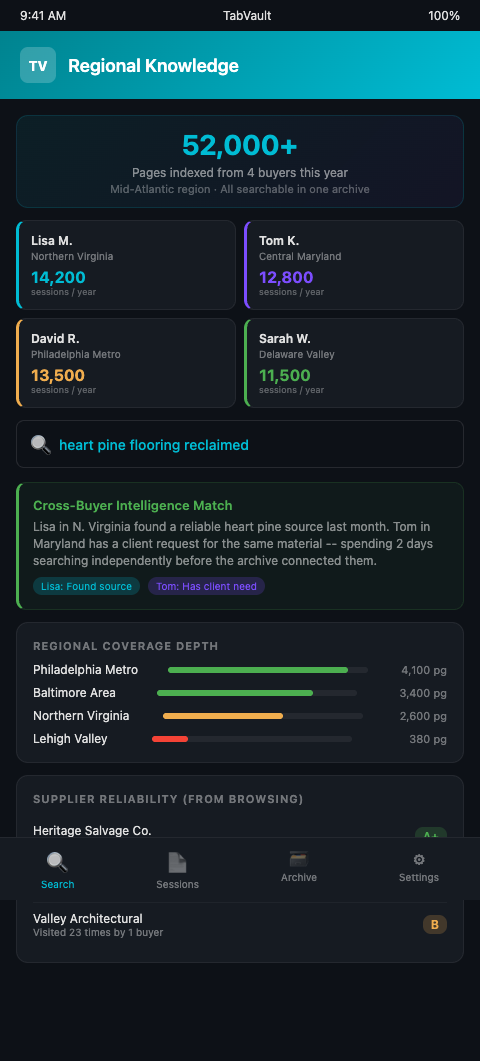
Without a shared salvage sourcing database, each buyer rebuilds knowledge independently. The buyer covering northern Virginia discovers a reliable source for reclaimed heart pine flooring. The buyer covering central Maryland, handling a client request for that exact material, spends two days searching for a supplier that his colleague already found. The knowledge existed within the organization. The infrastructure to share it did not.
This duplication of effort is the most visible cost of fragmented team browsing. The invisible cost is the cross-regional connections that never form. A demolition contractor mentioned on a Philadelphia listing may also operate in Delaware, where another buyer is searching for sources. A supplier who carries Victorian hardware in one listing may have Craftsman-era fixtures buried deeper in their inventory. These connections require visibility across the entire team's browsing history, not just one buyer's sessions.
The problem intensifies as the team grows. A two-person operation can maintain informal knowledge sharing through daily conversation. A four-person team spread across a region cannot. The EPA's data on C&D debris catalogs the material categories within demolition waste, including steel, wood products, drywall, brick, and concrete, each of which requires its own sourcing expertise. A four-person team where each buyer specializes in different material categories generates deep but siloed knowledge. The steel specialist knows every structural steel supplier in the region but has never seen the wood specialist's network. The shared archive breaks these silos by making every specialist's browsing history searchable by every other team member.
Turning Team Browsing Into Regional Intelligence
TabVault transforms team browsing salvage intelligence into a shared resource by turning chaotic browser sessions into a searchable private database that the entire team contributes to. The buyer in northern Virginia and the buyer in central Maryland both feed into the same indexed archive. A search for "heart pine flooring" returns results from every team member's sessions, regardless of who found the listing or which region it came from.
The regional salvage knowledge base that emerges from this shared archive reflects the team's collective browsing footprint. Over months, the archive maps which suppliers operate in which territories, which material types are concentrated in which regions, and which demolition patterns generate predictable sourcing opportunities. This intelligence emerges organically from browsing activity rather than requiring deliberate data entry.
The connection to staff onboarding is direct. When a new buyer joins the team, they inherit the full regional knowledge base built from months or years of team browsing. Instead of spending their first six months learning which suppliers carry which materials in which areas, they search the archive and get answers immediately. The accumulated intelligence of the entire team is available from day one.
Building salvage knowledge from browsing also addresses the succession problem that plagues small salvage operations. When a veteran buyer retires, their regional knowledge typically leaves with them. Relationships can be documented in a contact list, but the deep understanding of which neighborhoods yield high-value materials, which auction houses consistently undervalue specific categories, and which demolition contractors provide advance notice, that knowledge exists only in the veteran's browsing history and memory. An indexed archive preserves it in searchable form.
The shared archive supports multi-location operations by creating a unified knowledge layer across geographically distributed teams. A buyer at a yard in Richmond and a buyer at a yard in Baltimore contribute to the same regional intelligence base. Neither location operates as an island. Both benefit from the other's sourcing activity.
The principle is the same across research-intensive professions: browsing activity is knowledge work, and capturing it systematically converts individual effort into organizational intelligence.
The regional knowledge base doubles as a market monitoring tool. As the team browses across the region, the archive captures pricing trends, supplier inventory fluctuations, and competitive activity patterns. A search for a specific material type, filtered by date range, shows how availability and pricing have changed over the past six months. This market intelligence emerges from the team's organic browsing activity without requiring anyone to maintain a separate pricing database or market report.
The depth of the shared archive creates a defensible competitive position. A team that has been building its regional salvage knowledge base for two years possesses intelligence that a new competitor cannot replicate without investing the same amount of browsing time. The archive is not just a tool. It is accumulated institutional knowledge in searchable form, a business asset that grows more valuable with each browsing session added.
Advanced Regional Knowledge Building
Structure the team's browsing around geographic territories to maximize the archive's regional depth. Assign each buyer a primary territory but encourage overlapping coverage in high-value areas. The overlapping sessions provide cross-buyer validation: if two buyers independently identify the same supplier as a strong source for a specific material, that convergence strengthens the intelligence.
Run monthly knowledge extraction sessions where the team reviews the archive's growth. Pull search queries against each territory to identify areas of deep coverage and areas with gaps. If the archive shows dense coverage in the Philadelphia metro area but sparse coverage in the Lehigh Valley, redirect browsing effort toward the underserved region.
Use the archive to track seasonal patterns in material availability. Demolition activity peaks during specific months in each region. Estate sales follow different seasonal rhythms. Auction houses adjust their schedules around holidays and weather. The archive, accumulating sessions over a full annual cycle, reveals these patterns without requiring manual tracking.
Cross-reference the regional knowledge base against client request patterns. If clients consistently ask for materials from a specific period or region, the archive should reflect concentrated research in that area. Gaps between client demand and archive depth indicate sourcing opportunities that the team should prioritize.
Build supplier reliability scores from the archived browsing data. The ArchDaily analysis of deconstruction policy notes that standardized supplier evaluation is becoming essential as cities formalize material reuse chains. If a buyer visits a supplier's website repeatedly over months and consistently finds high-quality inventory, that pattern is visible in the archive. Conversely, if a supplier's listings repeatedly disappoint upon follow-up, that pattern is also visible. These patterns, emerging from organic browsing behavior rather than formal reviews, provide an unbiased assessment of supplier quality across the entire regional territory.
Establish regional material availability maps from the archived data. Over time, the archive reveals geographic patterns: reclaimed brick concentrates in certain areas, old-growth timber appears more frequently near specific types of demolition projects, and architectural hardware clusters around neighborhoods built during specific periods. These patterns, invisible when each buyer holds their data independently, become actionable intelligence when the full team's browsing history is searchable.
Professional genealogy firms face the same challenge when building team knowledge bases from individual researchers' browsing sessions, and the solution is the same: a shared, searchable archive that converts individual effort into organizational intelligence.
Leveraging Regional Intelligence for Growth
Use the regional knowledge base to respond to RFPs and large project requests with confidence. When a restoration firm sends a sourcing request for a dozen material categories, the team can search the shared archive for each category and provide a preliminary availability assessment within hours rather than days. This responsiveness, powered by accumulated team browsing intelligence, wins contracts that competitors handling the same request through manual research cannot match in speed.
The knowledge base should also capture negative intelligence. When a buyer researches a supplier and finds that their inventory does not match their listings, or that their pricing is inconsistent, that finding prevents other team members from wasting time on the same dead end. Negative intelligence is just as valuable as positive intelligence when it is shared. Without a shared archive, each team member independently discovers the same disappointing suppliers, duplicating not just the research effort but the frustration.
Build Your Regional Knowledge Base
Every page your team browses adds to the collective intelligence of your operation. TabVault indexes that browsing into a shared, searchable archive that turns individual effort into regional expertise. Join the waitlist to start building the knowledge base your salvage operation needs.
Four buyers generating a thousand browsing sessions per week build a regional knowledge base of over fifty thousand indexed pages per year. That archive maps supplier territories, tracks pricing trends, captures seasonal availability patterns, and preserves the collective sourcing intelligence of the entire team. A new hire searching this archive on their first day has access to more regional market knowledge than a solo dealer accumulates in a decade. The team that shares its browsing intelligence outcompetes the team that keeps it siloed in individual browser histories.