Building Team Knowledge Bases for Professional Genealogy Firms
The Knowledge Drain in Professional Genealogy
The Salt Lake Institute of Genealogy published project management guidance emphasizing that well-managed genealogy projects provide clarity, reduce risk, control cost, and deliver value to the client. For professional firms, project management is inseparable from knowledge management. A firm handling forty client cases simultaneously, with multiple researchers contributing to each case, must ensure that every researcher can access the relevant work history for any case they touch.
In practice, this rarely happens. Most professional genealogy firms rely on a combination of shared spreadsheets, email threads, case management notes, and verbal handoffs. The actual research, the browser sessions where records were examined, DNA matches were analyzed, and conclusions were formed, lives in individual researchers' browser histories and personal bookmarks. When a researcher finishes her portion of a case and passes it to a colleague, the colleague receives a summary but not the full research context.
The Association of Professional Genealogists promotes high ethical standards in dealings with clients, which includes the obligation to deliver thorough, well-documented research. But documentation quality drops when the team genealogy research management system does not capture research activity at the session level. A case file that says "Searched Ohio vital records, no results" is less useful than an indexed archive showing exactly which Ohio databases were searched, on which dates, with which search terms, and what pages were examined.
The knowledge drain becomes acute during personnel transitions. A firm that loses an experienced researcher to retirement or career change also loses that researcher's browser history, bookmarks, and the tacit knowledge of which research avenues were explored and abandoned for each active case. Rebuilding that context from written notes is possible but slow, and some context is inevitably lost.
The problem extends beyond departures. Even routine case handoffs between active team members create knowledge gaps. Researcher A spent two weeks exploring a particular branch of a family tree before concluding it was a dead end. If her notes say only "Branch explored, not productive," Researcher B has no way to know exactly what was examined and may re-explore the same branch, wasting days on work that was already completed. The tacit knowledge of what was tried and why it failed is the hardest knowledge to transfer and the most valuable to preserve.
Building a Shared Knowledge Base From Indexed Sessions
TabVault addresses the team knowledge management problem by turning each researcher's chaotic browser sessions into a searchable private database that can be selectively shared across the firm. Instead of relying on manual research logs, the firm builds its knowledge base automatically from the research activity itself. Every page visited, every search conducted, and every session's full context becomes part of the firm's institutional archive.
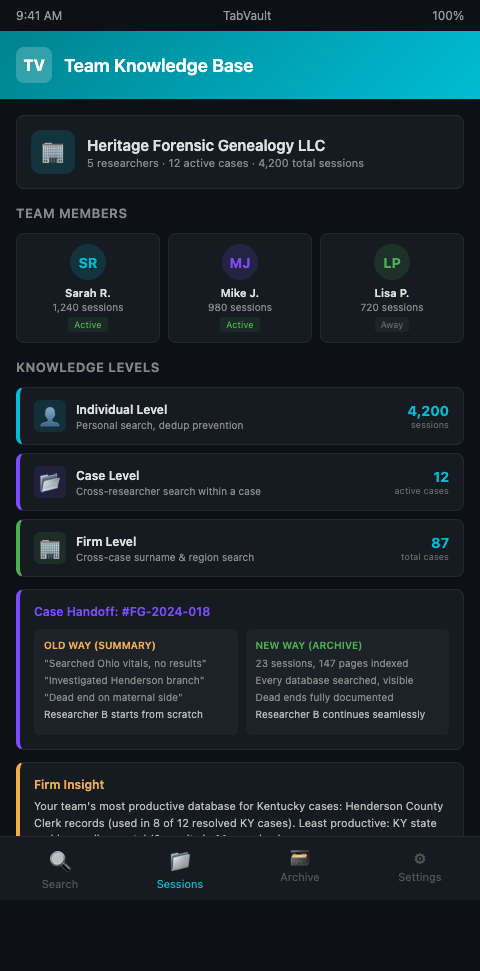
The practical workflow for a professional genealogy firm knowledge base operates on three levels. At the individual level, each researcher benefits from personal full-text search across her own sessions, catching duplicate research before it happens and retrieving past findings instantly. At the case level, researchers working the same case can search across each other's indexed sessions, seeing not just what was found but what was examined and ruled out. At the firm level, cross-case search reveals connections between cases that share surnames, geographic regions, or record sources.
This three-level architecture directly addresses the team knowledge problem. When Researcher A completes her portion of a case and hands it to Researcher B, the handoff includes not just a summary document but a searchable archive of every session Researcher A conducted. Researcher B can search that archive by surname, date, platform, or any term that appeared in the indexed content. The context transfer is comprehensive rather than filtered through whatever Researcher A chose to include in her notes.
The difference between a summary-based handoff and an archive-based handoff is substantial. A summary might say: "Investigated maternal branch through Henderson County, Kentucky records. Found marriage record for Thompson-Wilson, 1897. No further leads." An archive-based handoff provides access to the twenty-three pages visited during that investigation, including the five other marriage records that were examined and ruled out, the census records that were checked for corroboration, and the newspaper search that returned no results. Researcher B can see not just what was found but what was examined and eliminated, which prevents her from re-investigating avenues that have already been explored.
The same architecture supports the research sharing workflows that firms use when collaborating with external partners like reunion registries and search angel networks. A shared genealogy case database built on indexed sessions provides a common ground of documented research that external collaborators can reference without requiring access to the firm's internal systems.
For firms concerned about privacy, the knowledge base respects the genetic data privacy principles that govern sensitive research. Session archives can be shared selectively, with specific sessions or date ranges exported for team access while the researcher's broader browsing activity remains private. The firm controls what enters the shared knowledge base and what stays personal.
Scaling Team Knowledge Across a Growing Firm
The first scaling consideration is onboarding. A new researcher joining the firm faces a steep learning curve: understanding the firm's research methodology, familiarizing herself with active cases, and learning which record sources have been productive for which types of cases. A searchable knowledge base built from hundreds or thousands of past sessions provides an onboarding resource that no training manual can replicate. The new researcher can search the archive for the type of case she has been assigned and see exactly how experienced colleagues approached similar problems.
The second consideration is quality control. A firm's reputation depends on the consistency and thoroughness of its research. When all research activity is indexed and searchable, a research manager can review a case's session archive to verify that the claimed research was actually conducted. This is the same audit capability that regional knowledge bases in architectural salvage provide for verifying provenance research: the indexed archive shows what was actually examined, not just what was reported.
The third consideration is institutional learning. Over time, a firm's knowledge base accumulates patterns that transcend individual cases. Searches for a specific record source across all cases reveal which sources have been productive and which have consistently yielded nothing. Searches for a geographic region reveal the firm's accumulated expertise in that area. This institutional knowledge, built organically from actual research activity rather than from someone's decision to write it down, becomes the firm's competitive advantage.
The Board for Certification of Genealogists recognizes practitioners who meet uniform standards of competence. For firms seeking to maintain that standard across a team, a shared knowledge base provides both the documentation to demonstrate compliance and the infrastructure to ensure that every researcher benefits from the team's collective experience.
A fourth consideration is cross-case knowledge transfer. Over time, a firm accumulates expertise in specific geographic regions, ethnic communities, and record types. A researcher who has worked five cases involving Swedish immigrant families in Minnesota develops deep knowledge of the relevant databases, naming conventions, and migration patterns. That expertise lives in her indexed sessions. When a new case involving Swedish immigrants in Minnesota arrives, any researcher in the firm can search the archive for those earlier sessions and benefit from the accumulated knowledge, even if the original researcher is unavailable.
Professional genetic genealogy team tools must balance collaboration with privacy, comprehensiveness with usability, and individual autonomy with firm-wide consistency. A knowledge base built on indexed browser sessions achieves that balance by capturing research activity as it happens, sharing it on demand, and keeping it searchable long after the original researcher has moved on.
A fifth consideration is client communication. Professional firms regularly update clients on case progress. A shared genealogy case database built from indexed sessions allows the firm to generate detailed progress reports showing what research was conducted, which databases were searched, and what was found or ruled out. These reports demonstrate value to the client and justify the research hours billed. A client who receives a report saying "Searched 47 databases across three states over 12 sessions" backed by a searchable archive has far more confidence in the firm's work than one who receives a summary email.
The long-term vision for a professional genealogy firm knowledge base is a living institutional resource that grows with every case the firm handles. After five years and hundreds of cases, the archive contains a comprehensive picture of the firm's research activity: which databases are most productive for which types of cases, which geographic regions the firm has deep expertise in, and which research approaches have proven most effective for specific case types. This accumulated knowledge is the firm's intellectual capital, and it exists only if the research activity was captured and indexed as it happened.
Give Your Firm an Institutional Memory
Genealogy firm collaboration starts with shared access to research context. TabVault builds that shared context automatically from your team's browser sessions, creating a professional genealogy firm knowledge base that grows with every case. Join the waitlist to turn your team's individual research into collective intelligence.
When a team member leaves your firm, their institutional knowledge should not leave with them. TabVault captures every researcher's session-level activity into a searchable archive that the firm retains regardless of personnel changes. New hires can search the accumulated sessions of experienced colleagues to learn which databases proved productive for specific case types, which geographic regions the firm has deep expertise in, and which research approaches resolved similar cases in the past. Firms that build this shared knowledge base from their first month of indexed sessions report measurable reductions in onboarding time and duplicate research across the team, turning individual expertise into a collective asset that compounds with every case the firm handles.