Scaling Tab Search for Multi-Location Salvage Operations
The Coordination Gap in Multi-Location Salvage
Black Dog Salvage, one of the most recognized names in the industry, has described how merchandizing salvaged products at high volumes makes it nearly impossible to record each item's history individually. That challenge multiplies with every additional location. According to Black Dog Salvage, many salvage operations take in products at such high volume that comprehensive tracking becomes the first casualty of growth. Now add a second yard two hundred miles away, staffed by a separate crew with separate browsing habits and separate supplier relationships.
The EPA estimates that 600 million tons of construction and demolition debris were generated in the United States in 2018 alone, with only about 30 percent of building materials currently reused or recycled. That gap between what is demolished and what is salvaged represents the opportunity that multi-location salvage operations exist to capture. But capturing it requires coordination that spreadsheets and phone calls cannot deliver.
A buyer in Portland spots a lead on reclaimed Douglas fir beams from a school demolition. The buyer in Austin is sitting on three client requests for exactly that species and dimension. If those two browsing sessions exist in separate browser histories on separate machines, the connection never happens. The beams go to a competitor, or worse, to a landfill.
Multi-location salvage operations face this exact failure mode daily. Each yard develops its own sourcing rhythm, its own bookmarked auction sites, its own relationships with demolition contractors. Without a shared record of what every team member has found, researched, and evaluated online, each location operates as an island.
The coordination challenge extends beyond sourcing into pricing intelligence. A salvage business running multiple yards needs consistent pricing across locations. When the Atlanta yard prices reclaimed heart pine at twelve dollars per square foot while the Savannah yard lists identical material at eight, the inconsistency damages client trust and leaves money on the table. Pricing consistency requires knowing what every yard has found, where, and at what acquisition cost. That knowledge lives in browsing sessions.
The National Trust for Historic Preservation has documented the reuse imperative driving the salvage industry, emphasizing that reusing building materials avoids the embodied carbon emissions created when new materials are manufactured. Multi-location operations are uniquely positioned to maximize this reuse potential because they can match salvaged materials with buyers across a broader geographic footprint. But only if the sourcing intelligence flows between locations rather than pooling at each site independently.
Unifying Distributed Sourcing Into One Searchable Record
TabVault addresses the multi-site reclamation sourcing problem by turning chaotic browser sessions into a searchable private database that spans every location in the operation. When a buyer at yard one browses a demolition listing, that session becomes indexed and searchable by every other team member across the organization. The content of the page, not just the URL, enters the shared record.
The practical workflow looks like this. Each morning, the sourcing lead at each yard runs searches through the same indexed archive. A query for "Victorian transom" returns results from every team member's browsing history, tagged by location, date, and session context. The sourcing lead in Portland sees that the Austin buyer browsed a transom listing three days ago. She clicks through to the session, reads the page content as it appeared at the time of the visit, and decides whether to follow up.
This distributed salvage team search capability changes how multi-location operations handle commercial salvage projects. A large commercial demolition generates hundreds of potential salvage items. When the research is distributed across three or four team members at different yards, the indexed archive ensures nothing falls through the cracks.
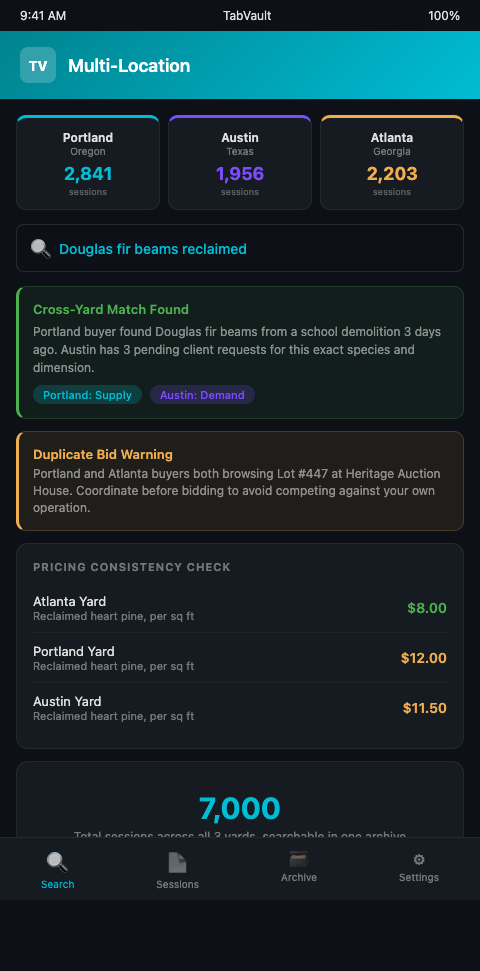
The scaling salvage sourcing tool also solves the duplication problem. Two buyers at different yards bidding on the same lot drives up the price against their own organization. When every browsing session is indexed and searchable, a quick search before placing a bid reveals whether a colleague has already engaged with that listing. This alone can save thousands of dollars per quarter for a salvage business running multiple yards.
Building regional knowledge from distributed team browsing becomes possible only when every session from every location feeds into one archive. The alternative is what most multi-location operations currently rely on: weekly calls where buyers verbally report what they found, hoping nothing important gets forgotten between Monday's browse and Friday's meeting.
The unified archive also supports inter-yard material transfers. Yard two receives a client request for a specific type of Victorian newel post. A search reveals that yard one evaluated three newel post listings last week but passed because no local buyer needed them. The inter-yard connection, visible only through the shared archive, turns a missed opportunity at one location into a sale at another.
Consider the inventory planning implications. Sortly's analysis of multi-location inventory challenges found that communication breakdowns and lack of shared visibility across sites make it nearly impossible to maintain accurate records — a problem that applies to sourcing intelligence just as much as physical stock. Each yard's browsing history reveals demand patterns through the types of materials buyers search for and evaluate most frequently. Aggregating that demand intelligence across all locations gives leadership a market-wide view of what clients want, what suppliers offer, and where the gaps are. A salvage business running multiple yards that can see demand and supply across all locations allocates acquisition budgets more effectively than one making those decisions yard by yard.
Advanced Tactics for Multi-Site Scaling
The first operational adjustment is establishing location-based session tagging from day one. Each yard should use a consistent naming convention so that searches can be filtered by location when needed but combined across locations by default. This prevents the archive from becoming a undifferentiated mass of sessions as the operation grows.
The second adjustment involves coordinating team workflows around the shared archive. Assign sourcing territories by material type rather than geography. One buyer across all locations handles hardwood flooring leads. Another handles hardware and fixtures. TabVault's full-text search supports this specialization because each specialist can search across all locations for their material category without sifting through irrelevant results.
The third consideration is onboarding. New hires at any location inherit the full browsing history of the organization. As noted in research on organizational learning, knowledge management directly supports organizational competitiveness. A new buyer at the third yard can search for how previous buyers evaluated specific suppliers, which auction sites produced the best results, and which demolition contractors were reliable. That institutional knowledge, built from months of accumulated browsing sessions, compresses the learning curve from months to days.
Multi-location operations should also establish a weekly cross-yard review where each location's sourcing lead presents their top finds from the archive. The archive makes this review efficient because each lead can pull their most valuable sessions with a few searches rather than relying on memory. Over time, this practice builds a feedback loop where successful sourcing patterns at one yard spread organically to the others.
Finally, consider how the archive supports strategic decisions about expansion. Before opening a fourth yard in a new region, leadership can search the existing archive for how much sourcing activity already targets that geography. If buyers across three yards have collectively browsed hundreds of listings in the target region, that browsing pattern validates the expansion hypothesis with real data rather than gut instinct.
Performance benchmarking across locations becomes data-driven when the archive tracks browsing activity by yard. A yard whose buyers generate fewer sessions per week may need additional staffing or training. A yard whose sessions convert to purchases at a higher rate may have sourcing practices worth replicating across the organization. The archive provides the raw data for these comparisons without requiring buyers to fill out activity reports. As Cin7's analysis of multi-location inventory challenges documents, without centralized visibility across sites, businesses risk costly discrepancies that compound as the number of locations grows — the same principle applies to sourcing intelligence, not just physical stock.
The scaling challenge also has a communication dimension. As the operation grows beyond three or four locations, the weekly call format breaks down. There are too many participants, too many listings to discuss, and too little time. The shared archive replaces much of that verbal communication with searchable records. A buyer who wants to know whether anyone has sourced a specific material type runs a search rather than waiting for the next call. The call itself shifts from information sharing to strategy discussion, because the information sharing happens continuously through the archive.
Start Scaling Your Sourcing Operation
Multi-location salvage operations deserve sourcing infrastructure that matches their ambition. TabVault gives distributed teams a single searchable archive where every browsing session from every yard becomes permanently retrievable. Join the waitlist to see how unified search transforms a scattered multi-yard operation into a coordinated sourcing machine.
When the buyer in Portland finds reclaimed Douglas fir beams and the buyer in Austin has three client requests for that exact material, the shared archive connects them in seconds. After six months of unified indexing across all locations, your operation possesses a searchable intelligence base that no single-yard competitor can match. Pricing stays consistent, sourcing stays coordinated, and no lead falls through the gap between yards. Multi-location salvage operations deserve sourcing infrastructure that matches their geographic reach.