Tab Indexing for Large-Scale Commercial Salvage Projects
The Scale Problem
A salvage operation in Cleveland bid on the interior strip-out of a 1920s department store slated for demolition. The building contained three floors of original terrazzo flooring, brass elevator surrounds, ornamental plaster cornices, and a mezzanine-level skylight with leaded glass panels. Researching the bid required the team to review the demolition permit, the building's historical survey, environmental abatement reports, three competing material appraisals, and the general contractor's project timeline — each document on a different website, each loaded in a separate browser tab. When the project lead's laptop froze during the research sprint, half the tabs failed to restore. The team spent two days re-finding documents they had already reviewed.
Commercial demolition projects are substantially more complex than residential salvage pulls. The Ellen MacArthur Foundation on commercial deconstruction documents that commercial buildings require skilled labor teams and detailed material inventories that residential deconstruction does not demand. The EPA notes that C&D debris totals 600 million tons annually in the United States, and the commercial segment drives a disproportionate share of that volume.
For salvage dealers pursuing commercial demolition salvage leads, the research phase alone can span weeks. A single project might require browsing city permit portals, county assessor databases, environmental consulting firm reports, historical preservation office records, general contractor bid packages, and material pricing references. Each source opens in a new tab, and the number of tabs grows with the project's complexity. A 200,000-square-foot office building generates more research tabs than a 2,000-square-foot bungalow by an order of magnitude.
The New York State Department of Environmental Conservation promotes building material reuse and deconstruction as alternatives to conventional demolition, noting that deconstruction recovers 70-90% of materials compared to standard demolition. For commercial projects, this recovery rate translates to potentially massive volumes of salvageable material — structural steel, terrazzo, architectural metalwork, institutional lighting, elevator components — that require detailed research to evaluate, price, and bid.
The tab management problem at commercial scale is not merely inconvenience — it is a business risk. A missing document, a misremembered price point, or a lost contractor contact can cost thousands of dollars on a project where bid accuracy determines profitability. The enterprise salvage sourcing workflow demands a research infrastructure that matches the scale of the projects being pursued.
Indexing the Entire Research Sprint
TabVault addresses the commercial building salvage research problem by turning chaotic browser sessions into a searchable private database, indexing every page you visit during the research phase — not only the tabs you think are important, but all of them. The enterprise salvage sourcing workflow shifts from "save the important tabs" to "browse naturally and search later." Every permit page, every environmental report, every contractor profile, every pricing reference enters your local index automatically.
The practical benefit surfaces when you need to find something specific in a sea of research. Searching for "terrazzo" returns every page you viewed that mentions terrazzo — the listing that described the flooring, the demolition permit that categorized the building materials, the pricing reference that quoted removal costs, and the historical survey that documented the original installation date. Large-scale salvage tab indexing collapses weeks of multi-source research into a single search bar.
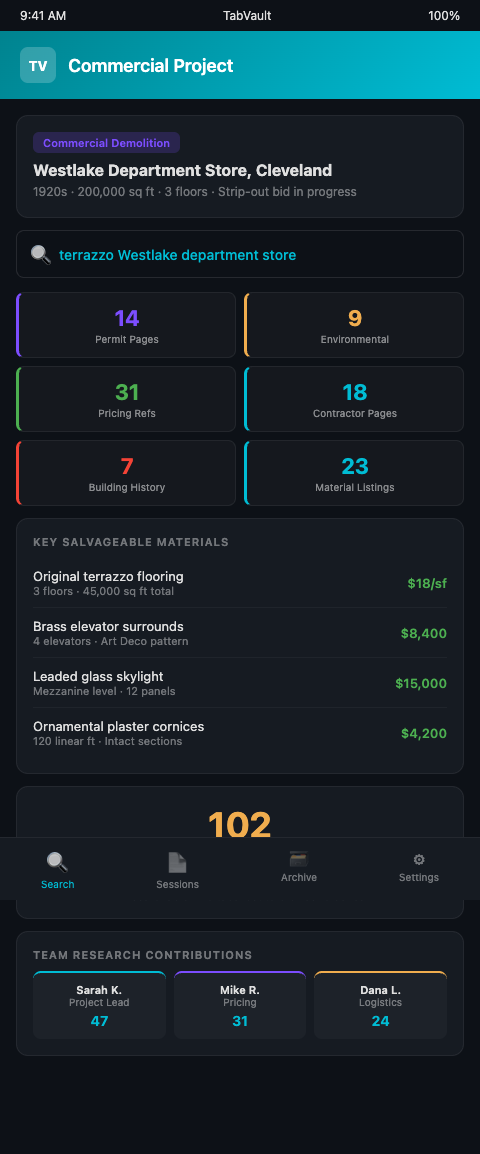
For commercial projects, the archive doubles as a project record. When you submit a bid, you can reference the specific pages you reviewed during your research — the permit details, the material inventories, the comparable pricing data, the environmental reports, and the contractor profiles. This documentation adds credibility to your proposal and demonstrates the thoroughness of your assessment.
The same approach scales across multiple simultaneous projects. A busy commercial salvage operation might be researching three or four potential projects at once. Without indexing, each project's research lives in a different set of tabs, and switching between projects means navigating a tangle of windows and tab groups. With indexing, a search for any project-specific term — the address, the contractor name, the building type — surfaces all related pages regardless of when they were viewed or which project they belong to.
The commercial building salvage research archive also creates institutional memory for your operation. When you bid on a hotel demolition in 2026, your archive might contain research from a similar hotel project you evaluated in 2025 — the material inventories, the removal cost estimates, the contractor contacts. That historical data makes your next bid faster and more accurate. Over time, the archive becomes a reference library of commercial salvage project types, each one enriching your knowledge base for future opportunities.
The large-scale salvage tab indexing approach also addresses the collaboration challenge inherent in commercial projects. Residential salvage is often a one-person operation — the dealer finds the lead, evaluates the site, and pulls the materials. Commercial projects involve teams: a project lead researching the bid, a field team evaluating the site, a pricing specialist estimating material values, and a logistics coordinator planning the pull. When the project lead's research is indexed and searchable, every team member can access the same information without asking the lead to forward emails or share bookmark lists. The research becomes shared infrastructure rather than a personal resource.
TabVault's price intelligence capabilities become especially valuable at commercial scale. A bid on a commercial interior strip-out requires pricing dozens of material categories. Your indexed archive of past pricing data — from residential and commercial sources alike — provides the comparable data you need to bid accurately.
Advanced Tactics for Commercial Projects
Create project-specific search routines. For each commercial project, identify three to five key search terms — the building address, the general contractor's name, the primary material categories — and run these searches periodically as your research progresses. Each search reveals newly indexed pages that have entered your archive since the last check.
Index environmental reports thoroughly. Commercial demolitions almost always involve environmental assessments — asbestos surveys, lead paint reports, hazardous material inventories. These reports identify which building components require abatement before salvage, directly affecting your cost calculations and timeline. Make sure you view the full report pages, not only summary PDFs, so the text content enters your index.
Research the contractor network. Commercial demolition projects involve general contractors, environmental consultants, structural engineers, and subcontractors. Your indexed archive captures every contractor website and profile page you visit. Over multiple projects, you build a searchable directory of who works on what types of projects — intelligence that helps you identify and approach the right people early. The approach parallels how veterinary responders build contact networks through after-hours consultation indexing.
Plan for multi-location operations. If your commercial salvage work spans multiple cities, each project generates research across different municipal systems. Your indexed archive unifies all of that research regardless of jurisdiction, so a search for "commercial demolition" returns results from every city you have researched.
Bid with data, not estimates. When preparing a commercial salvage bid, search your archive for comparable projects. If you researched a similar building six months ago, the indexed pages from that research — including material quantities, removal timelines, and pricing — provide a baseline for your current bid. This data-driven approach distinguishes your proposal from competitors who are estimating from memory.
Use the archive to spot recurring material types across projects. The Build Reuse network has documented that commercial deconstruction projects consistently yield high volumes of structural steel, institutional lighting, and commercial-grade doors. After researching several commercial demolitions, your index reveals which materials appear most frequently — terrazzo, structural steel, institutional lighting, commercial-grade doors. These recurring materials represent your volume opportunities. Focus your storage, sales channels, and contractor relationships around the materials that commercial projects consistently yield.
Document the regulatory landscape. Commercial demolitions involve environmental regulations, hazardous material abatement requirements, and permitting processes that vary by jurisdiction and building type. Pages you browse about these regulations get indexed alongside the project-specific research, building a reference library of regulatory knowledge that applies to future projects. When you encounter a similar building type in a different city, your archive tells you what regulatory hurdles to expect.
Track bid outcomes. After you submit a commercial salvage bid, note the outcome in a follow-up search. If you won, the indexed research pages become a case study for future bids. If you lost, review the research to identify what you might have missed or mispriced. Over time, your archive accumulates not only research data but lessons learned from actual bidding outcomes.
Commercial Scale Demands Commercial Tools
The difference between residential and commercial salvage research is not only volume — it is complexity. A residential salvage pull involves one property, one owner, and one set of materials. A commercial project involves multiple stakeholders, regulatory requirements, environmental considerations, and material categories that span every trade in the building. The research burden scales accordingly, and the consequences of losing or misplacing research data scale with it. Residential salvage research fits in a few dozen tabs. Commercial projects overflow any browser. TabVault indexes the entire research sprint for every commercial project you pursue, making months of accumulated research searchable in seconds. Join the waitlist and bring enterprise-grade research infrastructure to your commercial salvage project sourcing.
A single commercial demolition research sprint generates hundreds of browser tabs across permit databases, environmental reports, and contractor registries. TabVault indexes every page from that sprint into one searchable archive. When the bid deadline arrives, a search for "terrazzo" or "brass elevator" retrieves every relevant document in seconds -- not from scattered bookmarks, but from the full text of every page your team reviewed. Over multiple commercial projects, your archive accumulates institutional knowledge that makes each successive bid faster, more accurate, and better documented than the last.