Tab Indexing for After-Hours Poison Control Consultations
Alone at 2 a.m. With a Poisoning Case
The overnight shift at a veterinary emergency hospital is typically staffed by a single veterinarian and one or two technicians. When a poisoning case arrives at 2 a.m., the clinician does not have a colleague at the next workstation to consult. The board-certified toxicologist who might advise on a complex case is not available until morning. The clinician's resources are the internet, the ASPCA Animal Poison Control Center hotline, and whatever clinical references they can access from the treatment area computer.
This is the after-hours reality for thousands of emergency veterinarians. The Bureau of Labor Statistics reports approximately 88,000 practicing veterinarians in the United States (Bureau of Labor Statistics), and a substantial portion of emergency hospitals operate with minimal overnight staffing. The ASPCA Animal Poison Control Center provides 24/7 phone consultation, but the hotline charges a fee per case and wait times vary (ASPCA). Many overnight clinicians try to resolve questions through their own research before calling, especially for toxins they have treated before.
The research challenge intensifies at night. Cognitive performance declines during overnight shifts — a well-documented phenomenon in both human and veterinary medicine. A study on medical errors and shift work found that extended duration shifts and overnight work are associated with increased attentional failures and reduced clinical performance (Landrigan et al., 2004). The clinician working at 2 a.m. is researching toxicology protocols with reduced cognitive reserve, which makes rapid information retrieval even more critical. The slower the lookup, the more taxing it is on an already fatigued brain.
The compounding problem is that overnight veterinary emergency research often covers the same ground as previous shifts. The toxin that arrives at 2 a.m. Tuesday may be the same toxin that arrived at 11 p.m. Friday. But Friday's research died with Friday's browser session. The on-call vet toxicology reference that was perfectly adequate three days ago is inaccessible because no one indexed it.
Indexed Sessions as the On-Call Safety Net
Indexing browser sessions transforms the after-hours research problem from "find the information" to "retrieve the information." This is the core value of turning chaotic browser sessions into a searchable private database: the distinction matters most at 2 a.m. Finding means navigating to PubMed, constructing a search query, scanning results, evaluating relevance, and reading the article. Retrieving means typing a few keywords into a search bar and getting back pages you have already read, evaluated, and found useful.
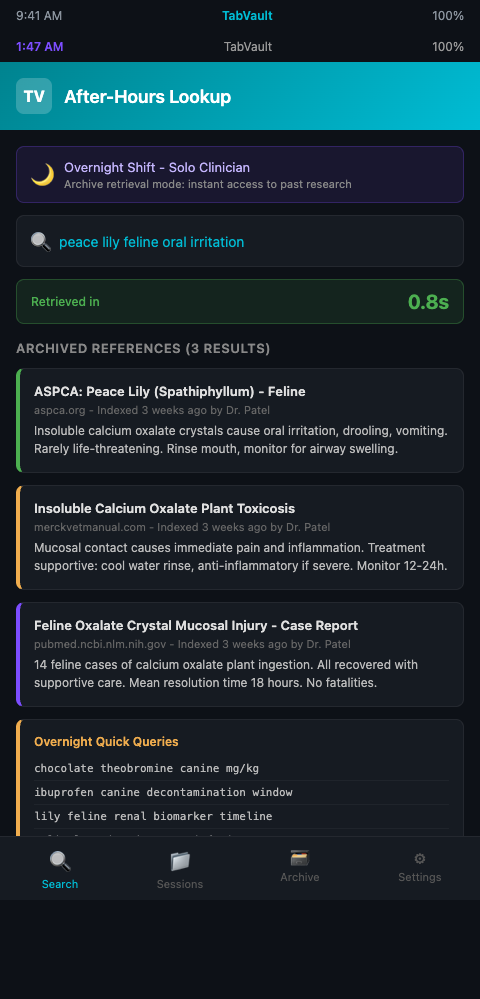
TabVault makes this late-night toxin exposure lookup fast enough to match the pace of emergency care. When the peace lily cat arrives at 1:30 a.m., the overnight vet types "peace lily feline oral irritation" into TabVault. The ASPCA protocol page from last week's similar case appears. The Merck Manual entry on insoluble calcium oxalate plants appears. A PubMed case report on feline oxalate crystal mucosal injury appears. All of these were indexed during previous shifts by previous clinicians. The overnight vet reads the cached references, confirms the treatment approach, and returns to the patient. The entire lookup took 45 seconds instead of 10 minutes.
The poison control consultation tab archive grows with every consultation. When a clinician calls the ASPCA hotline and then opens browser tabs to verify or expand on the consultant's recommendations, those tabs get indexed. The next clinician who faces a similar case can retrieve those post-consultation reference pages — the specific dosing guidelines the toxicologist recommended, the monitoring parameters they suggested, the PubMed references they cited. The consultation becomes a durable archive, not a one-time phone call that fades from memory.
The after-hours poison control consultation search is especially valuable for uncommon toxins. A 2 a.m. case involving a dog that ate a sago palm is less common than chocolate or rodenticide but far more dangerous — sago palm ingestion carries a mortality rate of approximately 50% in dogs according to published case series. The overnight vet may have seen only one or two sago palm cases in her career. If a colleague indexed the research from a previous sago palm case, that archive could contain the critical cycasin hepatotoxicity timeline, the aggressive decontamination protocol, and the liver monitoring parameters. The index compensates for the individual clinician's limited experience with rare toxins.
This directly extends the value of the tab search emergency triage toolkit into the most challenging clinical hours. Triage decisions are harder at night when staffing is thin and cognitive resources are depleted. An indexed archive that provides instant access to previously researched protocols reduces the cognitive burden on the overnight clinician.
The overnight veterinary emergency research problem also connects to the shift handoff issue. The after-hours shift generates research that the morning shift needs. Without indexing, that research vanishes at shift change. With indexing, the overnight research becomes part of the clinic's permanent knowledge base.
The challenge of isolated after-hours work exists in other professions. Salvage dealers working large-scale commercial projects often need to reference research conducted during previous phases of a multi-week project, and the retrieval challenge is analogous: past research must be accessible on demand, regardless of when or by whom it was conducted.
After-Hours Research Strategies
Pre-index common overnight toxins before your shift. If you know that chocolate, rodenticide, and NSAID cases are the most frequent overnight presentations, spend 15 minutes before your shift searching your TabVault archive for those toxins. Verify that the key protocol pages are indexed and current. If gaps exist, open the relevant Merck Manual and ASPCA pages to index them. This pre-shift preparation ensures that the most common after-hours lookups are already in your archive.
Index the ASPCA case number and recommendations. When you call the ASPCA Animal Poison Control Center and receive a case number, make a note that includes the case number and open any reference pages the consultant recommends. Those pages get indexed with the same temporal context as the consultation. Searching for the case number later retrieves the complete post-consultation research set.
Use the archive as a cognitive crutch. At 3 a.m., your ability to recall dosing specifics from memory is diminished. Instead of relying on recall, rely on retrieval. Search your archive for the toxin and the treatment parameter you need — "xylitol canine dextrose infusion rate" — and let the indexed pages provide the specifics that fatigue has blurred. The National Institute for Occupational Safety and Health documents the cognitive effects of shift work, and indexed archives directly mitigate the information-retrieval component of cognitive decline during overnight hours.
Build an overnight-specific query cheat sheet. Professionals managing large-scale projects across multiple phases use the same pre-built query approach. Keep a brief list of your most-used overnight search queries on a sticky note near the workstation. "Chocolate theobromine canine mg/kg." "Ibuprofen canine decontamination window." "Lily feline renal biomarker timeline." These pre-constructed queries eliminate the cognitive effort of composing a search at 2 a.m. and direct you straight to your indexed references.
Review overnight research at morning handoff. Before leaving your shift, spend two minutes reviewing the pages you indexed overnight. This brief review reinforces your memory of the cases and ensures that the indexed material is available and retrievable for the incoming shift. It also gives you a chance to note any cases where your archive lacked adequate coverage, flagging gaps to address during your next study session.
Your Archive Does Not Sleep
The overnight shift is when veterinary emergency clinicians are most isolated and most cognitively taxed. TabVault ensures that the collective research of every previous shift is available at 2 a.m. when you need it. If you work after-hours emergency shifts and want an on-call vet toxicology reference that retrieves answers in seconds, join the waitlist and let your archive work the overnight shift alongside you.
At 2 AM with a sago palm hepatotoxicity case and no colleague to consult, TabVault becomes the collective memory of every clinician who has worked before you. A search for "cycasin hepatotoxicity canine" retrieves the aggressive decontamination protocol a colleague researched during a previous sago palm case, the PubMed survival statistics another clinician reviewed during a CE session, and the ASPCA liver monitoring parameters from a consultation last quarter. Your overnight cognitive reserves stay focused on the patient instead of being spent reconstructing research that already exists in the archive, waiting for a query that takes less time than opening a single new browser tab.