Tab Indexing Strategies for Multi-Generational Family Reconstruction
Five Generations, Five Hundred Tabs, Zero Continuity
A genetic genealogist working an unknown parentage case needed to reconstruct a family tree spanning five generations: from a suspected great-great-grandparent born in 1870 to the living DNA matches she was trying to connect to her client. Each generation required its own research: census records to establish household composition, vital records to confirm births and marriages, church records to fill gaps in civil registration, and city directories to track migration patterns.
By the time she reached the third generation, she had visited over three hundred web pages across FamilySearch, Ancestry, FindAGrave, and multiple state vital records portals. By the fourth generation, the pages from the first generation's research were distant memories. She needed to verify whether the 1900 census entry she found two weeks ago listed three children or four -- but the tab was long closed, and she could not remember which county's census she had been viewing.
Multi-generational family reconstruction is inherently a long-duration research project. GEDCOM, the standard file format for storing genealogical data developed by FamilySearch, exists precisely because family trees must persist beyond any single research session. But GEDCOM captures the conclusions -- the names, dates, and relationships you enter into your tree software. It does not capture the research process: the census pages you read, the vital records you examined, the dead ends you explored and abandoned.
The FamilySearch GEDCOM 7.0 specification, the most recent version released in 2021, added features like rich-text notes and internet-linked media. But even with these improvements, GEDCOM captures the product of research, not the research itself. The hundreds of browser tabs that informed your tree-building decisions exist only as long as they remain open.
Indexing Each Generation's Research as You Build
TabVault fills the gap between the research process and the research product by indexing every page you visit during your ancestral line browser research. The approach turns chaotic browser sessions into a searchable private database that persists alongside your GEDCOM file. Your tree software holds the conclusions. Your indexed sessions hold the evidence trail.
The workflow for genealogy multi-generation research looks like this. You dedicate a session to one generation -- say, the second generation (the suspected grandparents). You visit census records, vital records, and newspaper archives for every individual in that generation. TabVault indexes every page. When you move to the third generation in your next session, the second generation's research is preserved and searchable. When a detail from the second generation becomes relevant to the fourth generation -- as it almost always does in family reconstruction -- you search your archive instead of re-navigating the original sources.
This cumulative approach addresses the fundamental challenge of multi-generational family reconstruction: the research for early generations informs the research for later generations, but the time gap between them erodes the researcher's memory of the earlier work. A searchable archive eliminates the gap.
Researchers who are integrating tab search into their genetic genealogy workflow already have the foundation for this approach. Multi-generational reconstruction adds a temporal dimension: the indexed sessions span not just multiple platforms but multiple research phases spread over weeks or months.
Structuring Sessions by Generation and Branch
The most effective family tree reconstruction indexing approach organizes research sessions along two axes: generation and family branch.
Generation-focused sessions. Work one generation at a time across all branches. Research every individual in the third generation before moving to the fourth. This ensures completeness within each generation and prevents the common mistake of following one promising branch deep while neglecting others. Each generation's research becomes a searchable block in your archive.
Branch-focused sessions. When a specific branch requires deeper investigation -- perhaps because a DNA cluster points to one particular grandparent line -- dedicate sessions to that branch across multiple generations. Search your archive by the branch's key surnames to pull up every relevant page from every generation. The Board for Certification of Genealogists emphasizes thorough research across all relevant sources, and branch-focused sessions ensure that no source is missed within a line of inquiry.
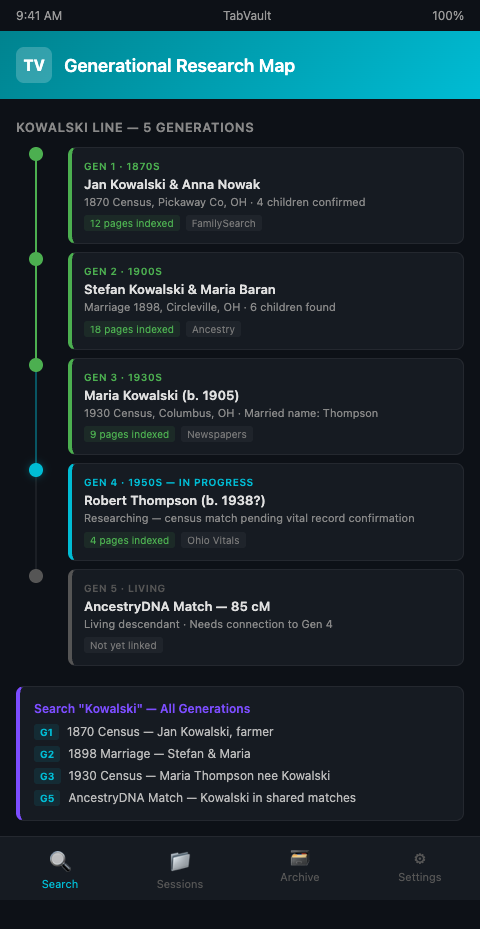
Connecting sessions across generations. The real power of family tree reconstruction indexing emerges when you search for a name that spans generations. Search for "Kowalski" and your archive returns the 1870 census entry showing Jan Kowalski in the first generation, the 1900 marriage record for his son Stefan in the second generation, the 1930 census for Stefan's daughter Maria in the third generation, and the AncestryDNA match profile for Maria's granddaughter in the fifth generation. The entire lineage surfaces in one search, assembled from research sessions conducted over weeks.
GEDCOM family tree building alongside indexed sessions. As you enter individuals into your tree software and export GEDCOM files, index the tree-building pages too. When you add a person on FamilySearch or Ancestry, the platform page that shows the newly added individual and their relationships gets indexed. This creates a parallel record: the GEDCOM holds the structured data, and the indexed sessions hold the source pages that justify every entry. Researchers who practice advanced GEDCOM cross-referencing with indexed match sessions build this dual-record system as standard practice.
Advanced Tactics for Multi-Generational Research
Use your archive to identify generation gaps. After completing research on multiple generations, search your archive for each generation's key individuals. Generations with thin results -- few indexed pages, few source pages visited -- are the ones that need more research. This gap analysis is faster than manually reviewing your tree for missing citations.
Cross-reference DNA matches against specific generations. When a DNA match shares 85 cM with your client, the Shared cM Project suggests a range of possible relationships spanning multiple generations. Search your indexed sessions for the surnames associated with each possible generation. If the match's surname appears in your third-generation research but not your second-generation research, that narrows the relationship hypothesis.
Track migration patterns across generations. Families move. A family that appears in county records in Ohio in 1880 may appear in Indiana in 1900 and Illinois in 1920. Your indexed sessions across generations create a searchable migration record. Search for city or county names to see when and where the family appeared across your research. Researchers monitoring demolition notices across multiple city portals track geographic patterns across sources in the same way.
Verify GEDCOM consistency against your source pages. When you export a GEDCOM file, compare the individuals and dates in the file against the source pages in your indexed sessions. Discrepancies between what the GEDCOM says and what the source pages show indicate data entry errors in the tree. This verification step catches mistakes before they propagate through shared trees and research handoffs. Researchers practicing after-hours research continuity use the same principle of verifying current work against indexed prior sessions.
Build descendancy trees from your archive outward. Instead of starting with the ancestor and building down through census records, start with your indexed session archive and search for every individual who shares the ancestor's surname and location. The archive may already contain descendant records you viewed during earlier research phases but did not recognize as relevant at the time. Family tree reconstruction indexing makes serendipitous re-discovery possible.
If your multi-generational reconstruction is losing continuity between the first generation and the fifth, TabVault keeps every generation's research in one searchable archive. Join the waitlist to build family trees that remember everything you found, no matter when you found it.