Advanced GEDCOM Cross-Referencing With Indexed Match Sessions
The Disconnect Between GEDCOM Files and Research Evidence
The GEDCOM file format, originally developed by the Family History Department of The Church of Jesus Christ of Latter-day Saints, is the de facto standard for exchanging genealogical data between software platforms. A GEDCOM file encodes individuals, relationships, events, and sources in a structured plain-text format. Version 7.0, released in 2021, added UTF-8 encoding and expanded media support. But across all versions, GEDCOM files share a fundamental limitation: they represent conclusions, not the research process that produced them.
A family tree exported as a GEDCOM says that John Smith married Mary Jones in Henderson County, Kentucky, in 1892. It may include a source citation pointing to a marriage record. What it does not include is the research context: the three DNA matches whose shared ancestors led the researcher to Henderson County, the newspaper obituary that confirmed Mary Jones's maiden name, the two alternative candidates who were investigated and ruled out, or the session where the researcher first noticed the geographic cluster that pointed to this family.
For genetic genealogists, this disconnect creates a verification problem. When a researcher builds a speculative family tree from DNA match evidence and exports it as a GEDCOM, the tree looks like any other family tree. Nothing in the file distinguishes a well-documented conclusion from a guess. Nothing links the individuals in the tree to the specific DNA matches and research sessions that support each relationship. GEDCOM DNA match correlation is a manual process that lives in the researcher's notes and memory, not in the file itself.
The verification problem compounds with tree size. A speculative tree built to identify an unknown parent might contain 80 to 150 individuals across five or six generations. Each individual was added based on some combination of DNA match data, vital records, and documentary evidence found during browser-based research. Verifying that the evidence supports every individual means tracing back through dozens of research sessions conducted over weeks or months. Without a searchable archive of those sessions, the verification is prohibitively time-consuming, and as a result, it often does not happen with the rigor it requires.
This matters most during multi-generational family reconstruction, where a single tree may contain dozens of individuals added based on DNA evidence. Verifying each individual means tracing back to the original match data, which means finding the research session where that evidence was examined. Without a system for connecting tree individuals to session data, verification is slow and error-prone.
Cross-Referencing GEDCOM Individuals Against Indexed Sessions
TabVault creates the missing bridge between GEDCOM tree structure and browser-based research evidence. By turning chaotic browser sessions into a searchable private database, TabVault gives the researcher a way to look up any individual from the GEDCOM and find every session where that person's name, location, or associated records appeared. The GEDCOM provides the "what" of the family tree; the indexed session archive provides the "how" and "why."
The advanced GEDCOM analysis workflow operates in two directions. Forward verification starts with an individual in the GEDCOM and searches the session archive for supporting evidence. The researcher takes a name and date range from the tree file, searches TabVault, and retrieves the sessions where that person's records were examined. This confirms that the individual was actually researched rather than speculatively added. Reverse discovery starts with a search result in the archive and checks whether the individual appears in the GEDCOM. A surname that appears in an indexed session but not in the current tree may represent an unexplored lead or a branch that needs to be added.
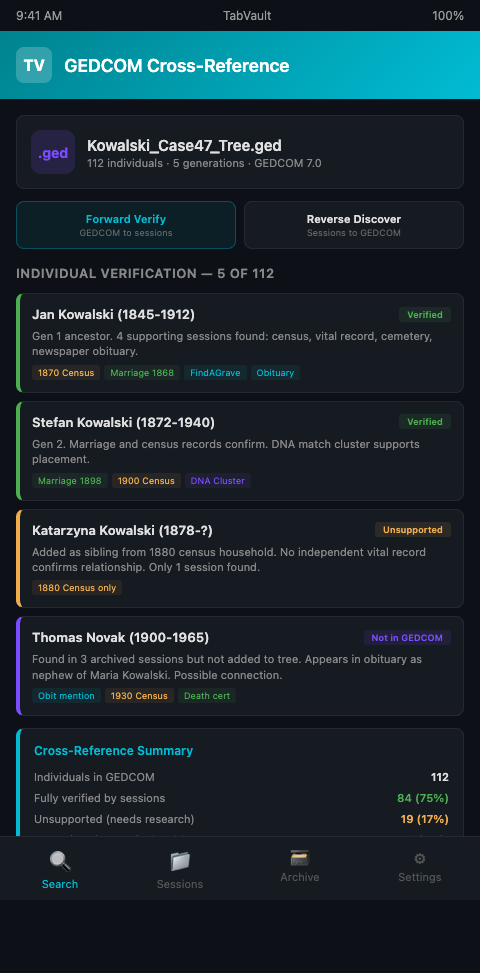
For GEDCOM import match verification, this bidirectional workflow catches two common problems. The first is the unsupported individual: someone added to the tree based on a reasonable inference that was never confirmed through documented research. The second is the overlooked connection: a person who appeared in research sessions but was never added to the tree, either because the researcher forgot or because the connection was not apparent at the time.
The cross-referencing process also supports the kind of provenance research that architectural salvage professionals conduct when tracing the history of a building component. In both fields, the challenge is the same: linking a structured record (a tree individual, a salvage item) to the unstructured research sessions that document its history. Full-text search across indexed sessions provides the link.
Family tree file cross-reference becomes particularly powerful when the GEDCOM contains individuals from multiple family branches. A researcher working a forensic case with four branches can search the archive for each branch's key surnames and quickly identify which branches have strong evidentiary support and which need additional research. This audit step, running a systematic cross-reference between the tree and the archive, should be a standard practice before any GEDCOM is exported for sharing or submitted as part of a forensic report.
The cross-referencing workflow also catches a common source of error in speculative trees: individuals who were added to the tree based on assumptions about family structure that were never verified through independent research. For example, a researcher may add a person's siblings to the tree based on a census record showing all children in the household, without verifying through other records that all listed children were biological offspring of the household head. Cross-referencing that individual against the session archive reveals whether separate vital records research was conducted to confirm the relationship or whether the census record was the sole source. The distinction between a well-supported individual and an assumed one becomes visible through the depth of the associated session archive.
Advanced Cross-Referencing Strategies
The first advanced strategy is temporal cross-referencing. GEDCOM files include event dates for individuals, and session archives include timestamps for research activity. Cross-referencing the two reveals the research timeline: when each individual was first investigated, when supporting evidence was found, and how long each branch took to develop. This temporal view is valuable for professional genealogists who need to detect patterns across months of sessions and for case documentation that shows the progression of the investigation.
The second strategy is conflict detection. A GEDCOM may contain two individuals with similar names and dates who were determined to be distinct people. The indexed session archive can show the research that led to that determination, the sessions where both candidates were investigated and the evidence that distinguished them. Without that session-level documentation, a future researcher reviewing the GEDCOM might question whether the two entries are duplicates.
The third strategy involves GEDCOM cross-referencing indexed sessions across related cases. A professional firm working multiple cases in the same geographic region may have GEDCOM files that share surnames or locations. Cross-referencing those shared elements against the firm's full session archive can reveal connections between cases. The Wikipedia entry on GEDCOM notes that the format is designed for data exchange between software systems, but the data's value increases when it can also be exchanged with the research evidence that produced it.
The Board for Certification of Genealogists requires that forensic genealogy work meet the standards applied to expert testimony. A GEDCOM file submitted without documented research support is a conclusion without demonstrated methodology. A GEDCOM file accompanied by a searchable archive of every session that contributed to its construction is a conclusion with a verifiable evidence base. The difference determines whether the work survives professional scrutiny.
Researchers should build the cross-referencing habit into their export workflow. Before exporting a GEDCOM for any purpose, whether sharing with a client, submitting to a forensic case file, or uploading to a collaborative platform, run a systematic check: for each key individual in the tree, search the session archive to confirm that documented research supports their inclusion.
A fourth strategy involves using the cross-reference as a quality gate before publishing or sharing any GEDCOM file. Genealogists who upload trees to collaborative platforms like FamilySearch's shared tree or Ancestry's public tree system are contributing to a collective resource that other researchers will build upon. A tree individual who enters that shared space without adequate research support can propagate errors across hundreds of descendant trees. The GEDCOM import match verification workflow, where every key individual is cross-referenced against session evidence before the tree is shared, acts as a quality check that protects both the researcher's reputation and the broader genealogy community's data integrity.
The Library of Congress guide on genetic genealogy emphasizes that modern genealogy combines DNA analysis with traditional documents to provide reasonably exhaustive research and more reliable conclusions. GEDCOM files serve as the standard exchange format for this combined data. That universality makes quality control at the point of export especially important. Once a GEDCOM enters circulation, its contents are difficult to correct across all the systems that have imported it. The cross-reference between tree and session archive is the researcher's last opportunity to verify accuracy before the data leaves her control.
Link Your Trees to the Research Behind Them
GEDCOM files without research context are conclusions without proof. TabVault gives genealogists the searchable session archive that connects every individual in the tree to the evidence that put them there. Join the waitlist to close the gap between your GEDCOM exports and your research documentation.
A GEDCOM file without a documented research trail is a conclusion without proof. TabVault builds that trail automatically. Every GEDCOM individual you add to your tree traces back to indexed sessions where the supporting census record, vital record, or DNA match profile was examined. Before exporting any GEDCOM for sharing, you can run a systematic cross-reference: search your archive for each key individual's name and verify that documented research supports their inclusion. Researchers who adopt this verification step before publishing trees to collaborative platforms report catching unsupported entries in roughly one out of every ten individuals, preventing errors from propagating across shared databases where they become exponentially harder to correct.