How One Researcher Solved a 40-Year Parentage Case With Tab Search
Forty Years and Counting
The client was sixty-two years old. She had been searching for her biological parents since her early twenties, starting with adoption agency inquiries in the 1980s and progressing through every available tool as technology evolved: sealed-record petitions, reunion registries, and finally, in 2018, a direct-to-consumer DNA test. The DNA test produced over 1,200 matches on AncestryDNA, but none closer than a predicted second cousin. For three years after testing, the case went nowhere.
This pattern is common. Research published in Forensic Genomics documents the difficulty of compound unknown parentage cases, where both biological parents are unknown and the adoptee must reconstruct two entirely separate family trees from DNA matches alone. The complexity doubles compared to a case where one parent is known. Each DNA match could belong to the maternal or paternal side, and without a close relative to anchor either tree, sorting matches into the correct branch is painstaking work.
The researcher who took the case in 2022 was a professional genetic genealogist with experience in parentage investigations. She estimated the case would require three to six months of active research. It ended up taking nine. The breakthrough, when it came, did not emerge from a new DNA match or a newly digitized record. It came from finding a connection between two browser sessions that had occurred four months apart.
Cases like this are more common than the public realizes. The Criminal Legal News reports that hundreds of cold cases have been resolved using forensic genetic genealogy since the technique gained prominence in 2018. But behind each resolution headline lies months of painstaking browser-based research. The DNA databases provide the raw material; the researcher's ability to organize, retrieve, and connect findings across sessions determines whether that material produces an answer.
The Research Trail That Almost Got Lost
The researcher's workflow followed standard practice for unknown parentage case investigations. She exported the client's DNA match list, sorted matches by shared centimorgans, and began building speculative family trees for the top matches. Each match required its own research session: checking the match's public tree (if one existed), searching for vital records, cross-referencing with newspaper obituaries, and looking for geographic patterns.
Over nine months, the researcher logged an estimated 300 separate browser sessions across AncestryDNA, FamilyTreeDNA, Newspapers.com, state vital records portals, and FindAGrave. She maintained a spreadsheet tracking her top fifty matches and the family trees she had built for each. But the spreadsheet captured summaries, not the full context of each session. It recorded that she had investigated a particular match on a particular date, but not every page she visited, every search she ran, or every tangential clue she encountered along the way.
The researcher described the spreadsheet's limitations bluntly: it held roughly 200 rows of structured data, while her actual research across 300 sessions had touched thousands of individual web pages. Census records, obituary search results, cemetery indexes, marriage record lookups, DNA match profile pages, shared match comparison screens. Each page carried details she might or might not have noted in the spreadsheet. The gap between what was recorded and what was actually viewed widened with every passing month.
The three false leads consumed substantial time. The first involved a family whose geographic location and surname pattern matched the client's birth circumstances, but whose DNA connection was ultimately traced to the client's maternal side rather than paternal. The second false lead arose from a match whose family tree contained an adoption in the same generation, creating a superficial parallel that did not hold up under closer examination. The third involved a name variant that appeared to connect two clusters but turned out to be coincidental.
The turning point came when the researcher adopted TabVault midway through the case. With her sessions now being indexed as a searchable private database, she ran a retrospective search on a surname that had appeared in a new match's family tree. The search returned a hit from a session four months earlier, one where she had been investigating a completely different match on the other side of the family. In that earlier session, she had visited a FindAGrave memorial page that listed the same unusual surname in a spouse's maiden name field. She had noticed it at the time but could not connect it to anything and moved on.
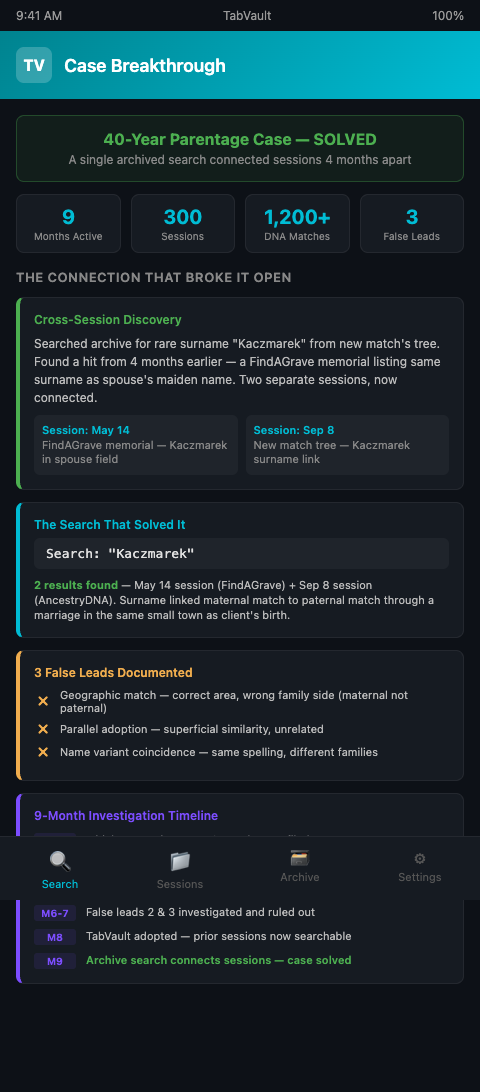
With both sessions now visible side by side, the connection was immediate. The surname linked a maternal-side match to a paternal-side match through a marriage that had occurred in the same small town where the client was born. This was the overlap point: the geographic and social connection that explained why the client's biological parents had been in the same place at the same time. From that single connection, the researcher built outward, confirming the maternal grandmother within two weeks and the biological mother within a month.
The 40-year adoption search resolution came not from new information entering the research ecosystem, but from old information being retrievable in a new context. The researcher had already seen the critical clue. She just could not find it again until her sessions were indexed and searchable.
What This Case Teaches About Research Retrieval
The first lesson is that parentage case breakthrough stories almost never hinge on a single dramatic discovery. They hinge on connections between discoveries, often made weeks or months apart. The DOJ's framework for investigative genetic genealogy requires exhaustive research before conclusions are drawn, and exhaustive research generates an enormous volume of browser-based activity. The critical question is whether that activity is retrievable.
The second lesson is that spreadsheets and research logs capture what the researcher decides to record, not what actually happened during the session. The FindAGrave page with the critical surname was not in the researcher's spreadsheet because at the time it seemed insignificant. Only full-text indexing of the actual browser session captured it. This is the same principle that drives forensic genealogy case work: the evidence you need is often the evidence you did not know was important when you first encountered it.
The third lesson concerns the emotional and professional toll of stalled cases. This genetic genealogy success story ended well, but the researcher estimated she had spent approximately fifteen hours on duplicated research, revisiting pages and re-running searches she had already conducted in earlier sessions, before TabVault's indexing made her prior work retrievable. For professional genealogists billing by the hour, duplicated research is a direct cost to the client. For adoptees who have waited decades for answers, every month of unnecessary delay carries a deeply personal weight. Statistics compiled by Legacy Tree Genealogists suggest that DNA matches lead to successful adoption search outcomes in a majority of cases, but the timeline from test to resolution varies enormously depending on how efficiently the research is managed.
A fourth lesson applies to the growing community of search angels and volunteer researchers who work adoption cases without compensation. These volunteers often juggle multiple cases simultaneously, which compounds the retrieval problem. A detail noticed during one client's research may be relevant to a different client's case, but only if the volunteer can search across all her archived sessions. The indexed archive transforms the volunteer's accumulated experience into a reusable resource rather than a collection of isolated, gradually forgotten sessions.
The cold case genealogy resolution in this story was always possible. The DNA evidence was there from the beginning. What was missing was the ability to connect a breakthrough across sessions, to find in September what had been seen but not understood in May. The researcher did not need better DNA matches or newly digitized records. She needed a system that remembered her own prior research better than she could.
The timeline of this case illustrates the compounding cost of poor retrieval. The researcher spent months one through five building family trees for top matches on both sides, a standard and necessary process. But during that period, she visited hundreds of pages containing details she could not yet evaluate for relevance. The FindAGrave page with the critical surname was one of dozens of tangential pages she viewed during a session focused on a different question entirely. No researcher can predict which of those tangential findings will matter later. The only defense against losing them is to index everything and make it searchable.
The researcher who solved this case now runs a pre-session search before every new research block on every case she handles. The habit takes three minutes per session and has prevented duplicated research on multiple subsequent cases. She describes the practice as the single most significant change to her workflow in a decade of professional genetic genealogy.
Stop Losing the Clues You Already Found
Unknown parentage case investigations produce hundreds of sessions and thousands of pages of browser-based research. The answer is often already in your history, waiting to be found a second time. TabVault makes sure that second finding takes seconds, not hours. Join the waitlist to give your hardest cases the retrieval system they deserve.
The clue that broke this forty-year case had been sitting in the researcher's own browsing history for four months, invisible because browser history stores URLs, not content. TabVault ensures that never happens again. Every FindAGrave memorial, every speculative tree page, every match profile you view during an investigation enters a full-text index where a single surname search can bridge sessions that are months apart. Researchers handling complex parentage cases find that the archive pays for itself the first time it connects a forgotten detail to a fresh lead, turning what would have been another round of duplicate research into the breakthrough that closes the case.