Keeping Veterinary Case Research Offline and Audit-Ready
When the Internet Goes Down, the Emergency Does Not
On January 15, 2024, an ice storm knocked out power and internet service across much of central Tennessee for 36 hours. Emergency veterinary clinics that maintained generator power could keep treating patients, but those relying on web-based toxicology references found themselves unable to access the resources they used every shift. The ASPCA Animal Poison Control Center remained reachable by phone, but at $95 per consultation, calling for every case during a high-volume storm event — when panicked pets eat antifreeze from burst radiators and anxious dogs chew through medication bottles — adds up fast and creates wait times.
This is not an edge case. The Federal Communications Commission reports that approximately 24 million Americans still lack access to reliable broadband internet, and rural veterinary practices disproportionately operate in these underserved areas. Even urban practices experience outages. A 2023 report from the Bureau of Labor Statistics confirms that veterinary employment continues to grow, with emergency practice expansion pushing into suburban and rural areas where infrastructure reliability varies. When a toxicology reference is only available online, an internet outage becomes a clinical hazard.
The reliance on web-based references has deepened over the past decade. Emergency clinicians routinely access VIN, the Merck Veterinary Manual online edition, PubMed, and the ASPCA toxin database during active cases. These resources have replaced the shelf of physical reference books that once stood in every treatment room. The convenience is undeniable — until the connection drops.
Offline-First Veterinary Research Local Storage
The architecture that solves this problem is offline-first by design. Instead of depending on live internet access to retrieve toxicology references, the practice maintains a local archive of every page its clinicians have consulted — fully indexed, full-text searchable, and available whether the router is working or not. This is the practical meaning of veterinary research local storage: a local copy of your practice's accumulated clinical research, turning chaotic browser sessions into a searchable private database that persists independently of network connectivity.
TabVault creates this offline archive automatically. Every toxicology reference page a clinician visits during normal browsing gets indexed and stored locally — the full rendered text, not just a bookmark or URL. The ASPCA's ethylene glycol treatment page, the Merck Veterinary Manual's metaldehyde entry, the PubMed abstract on fomepizole pharmacokinetics — all captured at the moment of first viewing and stored on the practice's own hardware.
When the internet fails, the archive does not. A clinician searching for "bromethalin seizure protocol" at 3 AM during a network outage retrieves the same results they would find with the internet running: every page the practice has ever indexed containing those terms. Offline toxicology reference access means the practice's research history becomes its emergency reference library, available regardless of connectivity.
The offline emergency vet protocol access extends beyond outage scenarios. Rural mobile veterinary services treating farm animals in areas with no cellular data coverage can carry the same indexed archive on a laptop. Emergency field work during natural disasters, where communications infrastructure is compromised, benefits from the same principle. The reference material travels with the clinician because it lives on local storage, not on a remote server.
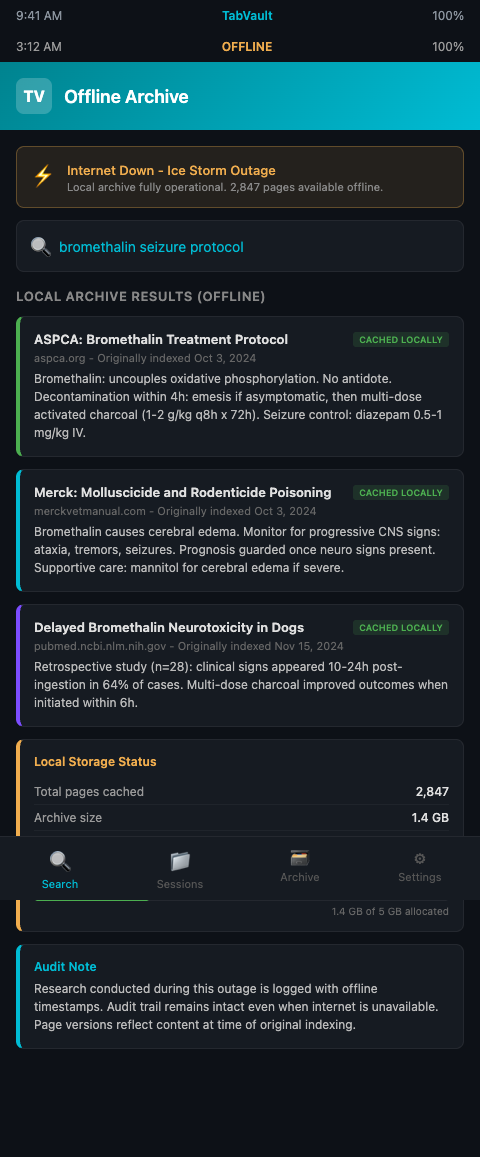
The audit-ready dimension adds a second layer of value. Veterinary case research offline audit-ready means the same archive that provides offline clinical reference also serves as a compliance and documentation trail. Each indexed page carries a timestamp showing when it was first accessed and by which workstation. During a quality review or regulatory audit, the practice can demonstrate exactly which references informed a treatment decision — even for cases handled during an outage when online access was unavailable.
This dual function — clinical reference and audit documentation in a single local archive — is what makes TabVault's approach fundamentally different from simply downloading PDFs or printing protocol sheets. A static PDF collection requires manual curation and becomes outdated. An indexed archive grows automatically with every clinical session and preserves the version of each resource that was current when the clinician consulted it.
The consultation archive approach extends naturally into offline readiness. Every specialty consultation page, every telemedicine toxicology service reference, every board-certified toxicologist's recommendation that a clinician reviews online gets captured in the local archive. When connectivity is lost, the accumulated wisdom of past consultations remains searchable.
Advanced Offline and Audit Strategies
Schedule quarterly offline drills. Disconnect a treatment room workstation from the network and attempt to handle a simulated toxicology case using only the local archive. This exercise reveals gaps in the indexed collection — toxins that the practice encounters but has not yet researched enough to build a robust offline reference. Address gaps by proactively browsing key reference pages for those toxins during the next connected session.
Maintain workstation-level backups. The indexed archive lives on local hardware, which means it is subject to hardware failure. Standard backup practices — daily incremental, weekly full — protect the archive the same way they protect medical records. Audit-ready case documentation loses its value if the storage medium fails and no backup exists.
Sync archives across workstations. A multi-room emergency practice should synchronize indexed archives across treatment room workstations so that an outage affecting one machine does not leave a clinician without access to the collective archive. The local storage principles for protecting source material apply equally to protecting clinical research material.
Version-stamp critical protocols. When a major reference — the ASPCA's treatment protocol for a common toxin, for example — is updated, the new version gets indexed alongside the old one. Both versions persist in the archive with their respective timestamps. During an audit, the practice can show which version of a protocol was current at the time of treatment, even if the online version has since changed.
Integrate offline access into onboarding. Most cloud-only practice management systems require an internet connection to operate, and as Veterinary IT Services notes, practices should have a backup plan in place before an outage occurs rather than scrambling during one. New clinicians joining the practice should understand that the local archive exists and how to search it. A five-minute orientation on querying the indexed archive during an outage could prevent a dangerous delay during the clinician's first network failure event.
Build offline coverage for your highest-frequency toxins. Review your practice's most common toxin presentations over the past year and verify that the key protocol pages for each one are present in the local archive. If your clinic treats chocolate toxicosis cases weekly but the last indexed Merck Manual chocolate page is six months old, proactively browse the current version during a connected session to refresh the archive. This targeted offline preparation ensures that the toxins most likely to present during an outage already have robust local coverage. Practices in regions prone to seasonal storms, wildfire-related power disruptions, or rural connectivity gaps benefit from quarterly coverage audits that align with the geographic and seasonal hazards most likely to coincide with both infrastructure failures and increased toxin exposure rates.
Your Reference Library Should Not Depend on Your Router
Internet outages do not pause veterinary emergencies. Clinics that rely exclusively on live web access for toxicology references accept a risk that is entirely avoidable. TabVault builds an offline, audit-ready archive of every toxicology page your team consults — searchable without internet, preserved with timestamps for compliance, and growing with every shift. Join the waitlist to build the offline reference library your emergencies require.
The ice storm knocks out your internet at 1 AM, and a dog is seizing from suspected bromethalin ingestion. With TabVault, your treatment protocol is already on the workstation — indexed locally during a previous case, stored on your own hardware, searchable without any network connection. The ASPCA bromethalin treatment page, the Merck seizure management entry, the PubMed article on multi-dose charcoal timing — all available offline because they were captured at the moment of first viewing. Rural mobile practices, disaster response teams, and any clinic in an area prone to connectivity disruptions gain the same benefit: a toxicology reference library that travels with the clinician and never depends on a router.