Investigative Documentation Standards and Browser-Based Research Logs
The Documentation Gap in Podcast Investigations
The Society of Professional Journalists' Code of Ethics establishes that journalists should "verify information before releasing it" and "use original sources whenever possible" (SPJ). These principles assume a documentation practice that most investigative podcast producers lack. When a subject of an investigation demands to know how a producer arrived at a specific claim, the producer needs more than the published episode — they need a verifiable record of the research process: which sources were consulted, when, and in what sequence.
Investigative Reporters and Editors trains journalists in documentation methodology through its Watchdog Workshop series, covering public records navigation and database analysis as foundational investigative skills (IRE). But IRE's guidance presumes a newsroom infrastructure — databases, shared drives, institutional record-keeping — that independent podcast producers typically do not have. A solo producer or a three-person team working from home offices has no systematic research log beyond browser history, scattered bookmarks, and a shared Google Doc that has not been updated in weeks.
The Reporters Committee for Freedom of the Press has documented how journalists increasingly need to demonstrate the integrity of their evidence chain, particularly when stories involve public officials or corporate entities with legal resources to challenge reporting (RCFP). For podcast producers, the research audit trail is not optional. It is insurance against legal exposure and a prerequisite for editorial credibility.
Browser-based research logs fill this gap by automatically documenting every source a producer consults during an investigation. The log is not a summary written after the fact — it is a real-time record of the research as it happened. Every page visited during a research session carries a timestamp, a source URL, and the full rendered text of the page — creating an investigation research logging system that builds itself as a byproduct of normal browsing behavior.
Building an Automatic Research Audit Trail
Most investigative documentation standards assume manual logging: the researcher writes down each source, the date of access, and relevant findings. This works for structured research — a FOIA request has a tracking number, a court filing has a case number. But browser-based investigation work is inherently unstructured. A producer might visit 30 web pages in a single research session, jumping between county records, news archives, corporate filings, and social media profiles. Manually logging each page is impractical, and the pages that seem unimportant during the session may turn out to be critical months later. The gap between the standard and the practice is where investigative documentation breaks down — not because producers are careless, but because the manual logging requirement is incompatible with the pace and volume of browser-based research.
TabVault automates this logging by turning chaotic browser sessions into a searchable private database, indexing the full text and metadata of every page a producer visits during a research session. Each indexed entry carries a timestamp, a source URL, and the rendered text of the page at the time of visit. This creates a browser-based research log that satisfies investigative documentation standards without requiring the producer to stop researching and start record-keeping.
The practical value emerges when documentation is challenged. Suppose a city official disputes a claim in Episode 7 that they owned property adjacent to a rezoned parcel. The producer searches their TabVault archive for the official's name and the parcel address. The search returns the county assessor page indexed on March 3, the deed transfer record indexed on March 5, and the zoning board minutes indexed on March 8. Each result includes the full text of the page as it appeared on that date, the source URL, and the index timestamp. That is a research audit trail that satisfies editorial review, legal scrutiny, and the SPJ's requirement for source verification.
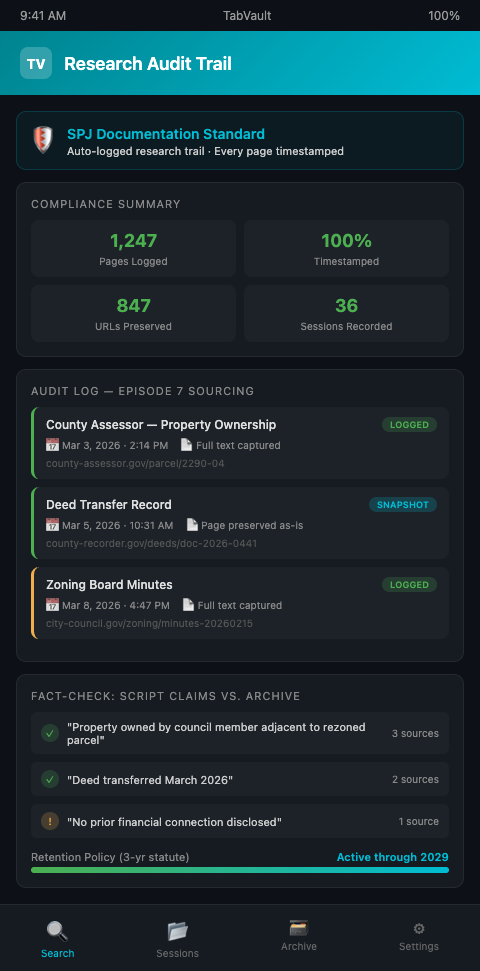
TabVault's documentation capability also supports the indexing strategy that producers use to organize their research by episode, season, or investigation thread. Each session label becomes a chapter in the investigation research log, making it possible to reconstruct the research chronology for any specific claim.
The documentation standard extends beyond defense against challenges. A well-maintained research log accelerates editorial review. When an executive producer or fact-checker needs to verify the sourcing for a segment, they can search the archive for the relevant keywords and see every page the producer consulted, in chronological order. This transforms fact-checking from a conversation — "Where did you find that?" — into a search — "Show me every page mentioning the contract."
The Visualping journalism monitoring guide emphasizes that "high-stakes investigative work may require demonstrating the integrity of your evidence chain" by documenting when each source was first consulted and maintaining records of the research methodology (Visualping). TabVault's automatic timestamping satisfies this requirement without requiring the producer to manually record access dates. Each indexed page carries its access timestamp as metadata, creating a forensic-grade research trail.
Browser-based research logs also protect against a subtler risk: source amnesia. After months of research, producers sometimes cannot recall where they first encountered a specific fact or claim. Did the zoning change date come from the city council minutes, a news article, or a source interview? Without a research log, the answer requires searching multiple platforms manually. With an indexed archive, a search for the claim's distinctive language surfaces the original source page — complete with the date it was indexed and the URL where it was found.
Teams that implement compliance audit trail practices from adjacent fields find that the same structural approach — automatic logging, timestamped entries, full-text searchability — satisfies documentation requirements across multiple regulatory and editorial contexts.
Strengthening Your Documentation Practice
Log research sessions, not only findings. The audit trail should capture the full research process, including pages that did not yield useful information. If a challenge arises, demonstrating that you searched a particular database and found nothing is as important as showing what you did find. TabVault indexes every visited page, including dead ends.
Preserve page snapshots for dynamic sources. Government databases update records, news sites revise articles, and social media posts get deleted. The indexed text in your TabVault archive preserves the content as it appeared when you visited the page. This snapshot capability is critical for documentation standards in journalism — it provides evidence of what the source said at the time of your research, not what it says today.
Establish a retention policy. Decide how long research logs should be preserved after publication. Legal statutes of limitations for defamation vary by state, but most range from one to three years. The Digital Media Law Project notes that this relatively short limitations period reflects the importance of free speech principles, but it also means producers need their documentation readily accessible during that window. Retaining your indexed research archive for at least that duration provides a documented defense if challenges arise after publication.
Separate on-record and off-record research. If part of your investigation involves confidential sources or legally sensitive material, establish clear boundaries in your research logging. TabVault's local-only storage means your source protection protocols remain intact — but you should still maintain organizational separation between on-record research that can be disclosed and off-record material that cannot.
Use the log for episode planning. A chronological research log is also a planning tool. When you review the log for a particular investigation thread, the sequence of pages visited reveals the narrative arc of your research — the initial hypothesis, the confirming evidence, the contradictions, the resolution. That arc maps directly to the narrative structure of the episode.
Build documentation into your workflow, not around it. The most effective investigation research logging systems are invisible during the research process. If documentation requires the producer to stop researching and start logging, it will be abandoned under deadline pressure. TabVault's background indexing means the log builds itself while the producer focuses entirely on the investigation. The documentation standard is met as a side effect of the research process, not as a separate task competing for the producer's attention.
Cross-reference the log against published claims. After an episode is scripted, search the TabVault archive for every factual claim in the script. Each claim should map to at least one indexed page. Claims that cannot be traced to an indexed source represent either an undocumented source (a conversation, a physical document) or an assumption that needs verification. This cross-referencing step catches sourcing gaps before publication rather than after a challenge.
Share the log format with legal counsel. If your production involves pre-publication legal review, demonstrate the research audit trail podcast format to your attorney early in the production process. Attorneys who understand the log's structure and completeness can provide more targeted legal advice and can use the log to defend specific claims if challenged. The log's searchability means the attorney can self-serve — running their own queries rather than asking the producer to compile documentation manually.
Your Research Log Is Your Reputation
Investigative podcast producers stake their credibility on every published claim. A browser-based research log built from automatically indexed sessions provides the documentation standards journalism demands and the research audit trail that editorial integrity requires. TabVault creates this log silently, in the background, every time you research. If you are publishing investigative work without a systematic audit trail, join the waitlist and start building the documentation standard your work demands.
When a city official disputes a claim in your published episode, the difference between a defensible position and a retraction comes down to documentation. A TabVault archive produces the county assessor page indexed on March 3, the deed transfer from March 5, and the zoning board minutes from March 8 -- each with full text, source URL, and timestamp. One investigative team used their indexed archive to respond to a legal challenge within four hours, producing a complete research audit trail that would have taken days to reconstruct from scattered bookmarks and notes. Join the waitlist and build the documentation standard your reporting integrity demands.