Matching Cochineal Crimson on 16th-Century Cope Panels
Why 16th-Century Cochineal Is Irreplaceable
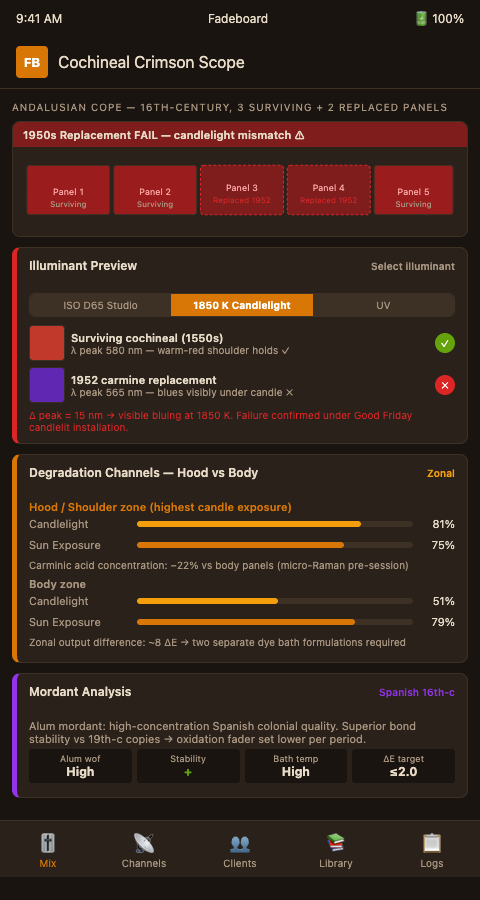
The Andalusian cope arrived with three panels intact and two replaced — the replacements done in the 1950s, using what a treatment note described as "best available carmine." Under studio lighting the replacements were close. Under the sanctuary's candlelit Good Friday installation, they read visibly bluer and less saturated than the survivors. The conservator's task was to match the surviving crimson so precisely that two new panels could replace the 1950s work without the congregation noticing.
The failure of the 1950s replacements was not a matter of color measurement skill — spectrophotometric tools of that era were limited, and visual matching under laboratory conditions was state of the art. The failure was a failure to test the result under the liturgical illuminant: beeswax candlelight at a Good Friday installation, where the full sanctuary complement of candles produces a spectral environment that weights the 600–700 nm red channel far more heavily than studio daylight. Under that illuminant, the 1950s carmine's slightly cooler reflectance peak — approximately 565 nm versus the surviving cochineal's 580 nm — produced the visible bluing effect that the congregation had noticed without being able to articulate its cause.
Cochineal had an extraordinary position in the 16th-century dye market. The Spanish colonial monopoly through Seville and Cadiz made it the world's most expensive dye commodity across the 16th through 18th centuries — by 1565, 115 tonnes were being exported to Spain annually (Mexican Cochineal and Global Trade 16th–19th Centuries, Springer). Church hierarchy was the primary European demand driver, and the crimson produced on silk with alum mordanting at peak 16th-century production occupied a chromatic position that carmine lake and modern carmine simply do not replicate without adjustment (Cochineal Red — The Art History of a Color, Metropolitan Museum of Art PDF).
Cope construction had been elaborate and standard for high-status commissions since at least the 12th century, with the cope as a primary object of church textile manufacture and conservation attention (Cope — Textile Research Centre Leiden). A cope from a major Andalusian diocese in the 1550s would have been produced with silk from Italian or Levantine weavers, mordanted at a Spanish dye house using the best available cochineal, and assembled with orphrey panels embroidered at a regional workshop. Each element had its own fading profile.
Building the Cochineal Crimson Target
Fadeboard's channel framework for a 16th-century cope begins with the surviving panels as colorimetric input. These panels have been exposed to five centuries of sanctuary light, combustion-product deposits, and handling — but they have also been protected in their deeper folds and under orphrey overlays, leaving micro-zones of less-degraded color that function as internal reference points.
The sun-exposure fader models five centuries of cumulative photooxidation on silk dyed with carminic acid (the chromophore in cochineal). Carminic acid's degradation curve under UV is well-characterized: it shifts from a warm, high-saturation crimson toward a cooler, duller red-orange as the chromophore loses electron density. The fader's position for five centuries of sanctuary use is substantially higher than for a 19th-century copy, and the resulting backward-projected original is distinctly more saturated and warmer than the surviving panel reads.
The oxidation channel addresses 16th-century mordanting chemistry. Spanish cochineal at peak quality was typically mordanted with alum at high concentration, which produces a more durable and more saturated bond than subsequent periods used. The oxidation fader for this material should be set to reflect the superior mordant stability — meaning less oxidation-driven fade than a 19th-century cochineal piece of equivalent age would show.
The candlelight fader is particularly important for cope panels. A cope worn at the high altar during solemn pontifical Mass accumulates combustion-product exposure concentrated on the hood and shoulder panels — the sections closest to the sanctuary's candles. The surviving Andalusian cope studied by XRF, SEM-EDX, and micro-Raman spectroscopy showed silk core with silver-gold wrap in the orphrey, with identifiable degradation patterns consistent with concentrated altar exposure (Analysis of Fabrics and Metal Threads from Andalusian Liturgical Vestments, European Physical Journal Plus/Springer). The diagnostic insights from that analysis directly inform where to set the candlelight fader for the body panels.
Significance and conservation assessment frameworks for prioritizing church textile treatments confirm that a cope panels treatment requires this level of documentary precision before any dye work begins (Determining Treatment Priorities for Ecclesiastical Textiles, ScienceDirect). For a cope panel that will return to active liturgical use at a Pentecost or high-feast installation, this documentary precision is not optional: a color target that cannot withstand a diocesan significance assessment is a color target that will eventually require a repeat treatment.
Advanced Tactics: Light-Testing the Output
The failure mode of the 1950s replacement panels — correct under studio light, visibly wrong under candlelight — illustrates a fundamental principle that Fadeboard's framework addresses by design. Color matching for liturgical textiles must be validated under the actual illumination conditions of use, not just under standardized studio conditions.
The carmine lake tracing from Aztec use through European luxury textile adoption shows that the stable, vibrant crimson of peak cochineal production was characterized by its exceptional behavior under warm, low-intensity candlelight — it held saturation and warmth where other reds degraded toward orange or brown (Pigments through the Ages: Carmine Lake History, WebExhibits). A restoration target derived from studio measurements alone will miss this characteristic unless the dye bath is tested under candlelight conditions before commitment.
The Fadeboard workflow incorporates a candlelight preview mode: after the channel settings produce a colorimetric restoration target, you preview the projected color under a simulated candlelight spectral profile before sending the specification to your dye house. This step has prevented mismatches in multiple cope restoration projects.
Common Pitfall: Ignoring the Hood and Shoulder Differential
On a cope, the hood and shoulder panels receive substantially higher combustion-product exposure than the body panels, because they sit closest to candles and thurifers during processions and solemn celebrations. Conservators treating all cope panels as a single degradation unit will systematically underestimate the hood's degradation and overestimate the shoulder's remaining saturation relative to the body. The Fadeboard candlelight fader should be set separately for the hood zone and the body zone — a zonal application that most studio workflows do not implement until it becomes obvious from mismatched output.
For the Andalusian cope described above, the hood panel's carminic acid concentration — measured by micro-Raman before the session — was approximately 22% lower than the body panels in absolute terms, but the apparent color difference under studio lighting was less than 6 delta-E because the body panels had also received higher overall light dose. The candlelight fader captured this divergence correctly only when the hood zone was assigned a higher combustion-product exposure than the body zone in the channel configuration. The resulting per-zone targets differed by approximately 8 delta-E in the final restoration specification — a difference that the dye house prepared as two separate bath formulations rather than a single uniform application.
For conservators whose cope panels also include Byzantine-influenced embroidery with gold-ground elements, the interaction between crimson silk and gold-ground threads under different light sources adds an additional complication. The gold-ground's reflectance profile changes the apparent saturation of adjacent crimson differently under ISO D65 than under candlelight — which is why the Byzantine gold-ground vestment restoration workflow always tests the target color against the gold-ground before finalizing. The historical context of competing red dyes that preceded and followed cochineal's dominance is examined in kermes and cochineal scarlet comparison on copes. For parallels in secular textile contexts, music hall aniline dye matching demonstrates analogous light-source validation challenges.
Commissioning Fragment-Exact Cope Panels
Your surviving 16th-century cope panels carry enough colorimetric information to reconstruct the original cochineal crimson — if you extract that information through a systematic degradation-channel workflow rather than visual matching. Fadeboard converts your panel measurements into a dye-bath specification your Lyon silk house or Florentine supplier can reproduce. When the replacement panels come back from the dyer, the candlelight test will confirm the match before the cope leaves your studio. That is the standard your diocese should expect.
If your conservation studio is ready to treat 16th-century cochineal crimson as the multi-century dye-chemistry problem it actually is, the Fadeboard waitlist is open to vestment conservators now. Join before the next high-feast cope commission lands on your bench — the candlelight validation step alone is worth scheduling your first soundboard session.