Matching Aniline Dyes on 1880s Music Hall Dresses
The Dye That Made Victorian Stages Blaze — and Fade
William Henry Perkin synthesized mauveine by accident in 1856, and within a decade, aniline dyes had transformed Victorian textile markets. Music hall costume departments adopted them immediately: the dyes were cheap, intensely saturated, and produced colors that gaslight footlights rendered as vivid and theatrical. A dress that cost the same as a naturally-dyed alternative could produce twice the stage impact. (William Henry Perkin and the World's First Synthetic Dye — Science and Industry Museum Blog)
The problem was lightfastness. Aniline dyes — mauveine, fuchsine, aniline yellow, rosaniline, crystal violet — were synthesized through processes that produced chromophores with weak photostability. The Science Museum UK has documented this extensively: the same chromogenic structure that made aniline dyes so brilliantly saturated also made them susceptible to photooxidation, with some compounds losing half their depth of shade after as few as forty hours of exposure to daylight or footlight. (The Colourful Chemistry of Artificial Dyes — Science Museum UK)
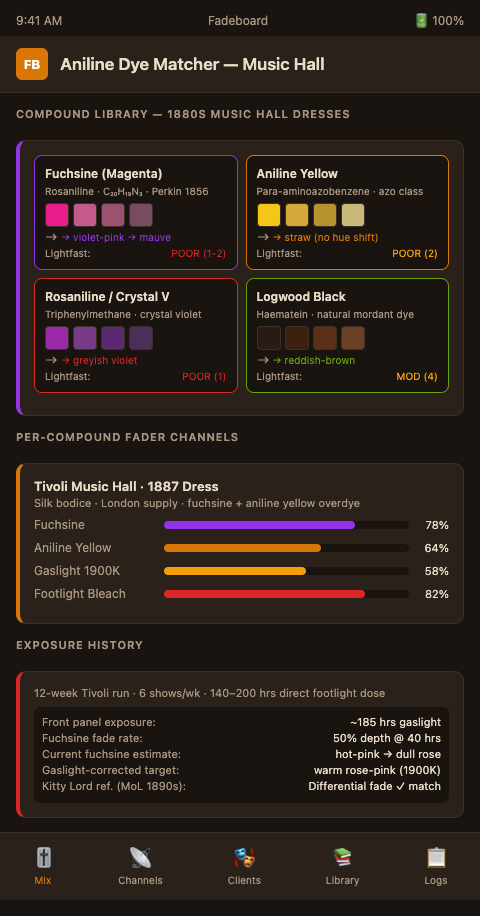
For an 1880s music hall dress worn six nights a week under gas footlights, the mathematics of that exposure rate was severe. A London music hall run of twelve weeks at six performances per week, each performance two to three hours long, meant the garment's front panels received 140–200 hours of direct footlight exposure during a single engagement. A magenta that started as a sharp, hot pink would shift toward a dull rose; an aniline yellow would move toward straw; a green compounded from blue and yellow anilines would shift toward blue as the yellow component faded faster.
A documented case study from the Museum of London examines preserved music hall performer costume from this exact period: Kitty Lord's padded symmetricals, a garment from an 1890s music hall context, show precisely this differential fading pattern — the frontmost panels have shifted in hue while the rear panels and lining retain higher saturation. (Kitty Lord's Padded Symmetricals — Journal of Victorian Culture Online) The spatial pattern of differential fade is itself a datum for the soundboard model.
Calibrating the Aniline Channel in Fadeboard
Fadeboard assigns each dye type its own fader because different aniline dyes fade at different rates. Treating the entire garment as a single "faded" channel produces a model that cannot accurately predict either the original palette or the interaction between dye types.
The practical setup begins with dye identification. Modern chemical analysis has made this non-destructive for many aniline types. Reflectance spectrophotometry — measuring how the fabric absorbs and reflects light across the visible spectrum — produces a spectral signature that can be compared against reference libraries for common Victorian dye compounds. A study in npj Heritage Science demonstrated non-destructive identification of dye mixtures on period woolen fabric using exactly this approach, resolving individual dye components from a mixture without sampling. (Exploring Elucidation of Red Dye Mixtures on Woolen Historical Textiles — npj Heritage Science)
Once you know what dyes were used — and in an 1880s music hall gown, the primary candidates are fuchsine, aniline yellow, rosaniline, and logwood black — you set up independent faders for each. Each fader's range is calibrated against the known lightfastness profile of that compound. Fuchsine (aniline magenta), for example, fades toward a cooler, more violet pink as the red chromophore component photolyzes. Aniline yellow fades toward transparent straw rather than shifting hue. These profiles are different, and the faders reflect that.
The result is a channel map that shows not just how far each dye has faded, but in what direction. When you roll the fuchsine fader back toward original, you move the color away from violet and back toward the warm hot-pink that gaslight would have intensified. For archivists managing vaudeville magenta restoration, this channel approach directly applies — vaudeville corsets from the same decade used the same fuchsine-based dye compounds.
The lighting-era interaction is critical here. Under a 5600K LED work lamp, a partially-faded fuchsine will look muted and slightly blue. Under a gaslight simulation at 1900K, that same fuchsine reads as a warm rose-pink — much closer to the designer's intent. Without the gaslight channel engaged, the archivist will overcorrect the fuchsine fader, targeting a saturation level that would look garish under period footlights.
Advanced Tactics for 1880s Aniline Matching
Use the V&A collection as a comparison reference. The Victoria and Albert Museum holds one of the most significant collections of 19th-century theatrical and fashion dress, including well-documented examples of aniline-dyed textiles from the 1860s through 1890s. (Costume — V&A Explore the Collections) When working with a music hall gown of uncertain date, comparing reflectance readings against dated V&A reference pieces narrows the production decade and helps calibrate which generation of aniline chemistry is in play.
Distinguish aniline mixes from single-dye applications. Not all Victorian music hall colors came from single anilines — budget wardrobe departments layered cheap dyes to approximate expensive ones, and greens were almost always created by overdyeing yellow onto blue (or vice versa) rather than using a single green chromophore. A dye-layer analysis approach should look for the telltale signs of layered fading: if the green has gone distinctly blue and the blue zones show no similar shift, the original color was almost certainly a yellow-over-blue compound. The fader for that garment needs two linked channels — yellow fade rate and blue fade rate — rather than a single green channel.
Account for regional chemistry differences. London music hall dyeworks did not all use the same suppliers. Manchester-sourced anilines in the 1870s–80s sometimes used slightly different base chemistry than London or Paris suppliers, producing fuchsines with subtly different violet undertones and different fade trajectories. Chemistry World's analysis of Perkin's original mauveine batches confirms that early aniline dyes had significant batch-to-batch variation even within the same manufacturer's production. (Dye Detective Work Uncovers Perkin's Chemistry Secrets — Chemistry World, RSC) If you are working with multiple costumes from the same production, do not assume identical fade trajectories — calibrate each garment's channels independently.
Run the footlight-bleach channel before the aniline-fade channels. Footlight exposure on an 1880s music hall gown was primarily from below-front. If you calibrate the aniline faders without first accounting for the spatial footlight bleaching pattern, the model will understate original saturation in the front panels and overstate it in the rear. Set the footlight-bleach fader first, using the rear panel as the less-exposed reference surface, then calibrate the aniline-specific faders against the corrected front-panel readings.
The Gilbert and Sullivan yellow dye analysis extends this methodology to the specific yellow aniline chemistry used in Savoy Theatre productions — an overlapping context that often informs work on contemporaneous music hall garments.
For archivists thinking about the intersection of aniline-era dye matching and glass-eye pigment analysis in doll collections — both involve systematic spectral comparison against known reference materials — the glass eye iris pigment matching workflow offers a transferable methodology.
Prepare Your Archive for the Next Remount
If your archive holds music hall dresses from the 1870s–1890s and a production team is asking whether restoration is feasible before a remount or exhibit loan, Fadeboard's aniline-specific channel model can give you a documented answer.
The earliest action in this workflow is dye identification — reflectance spectrophotometry or UV fluorescence, both non-destructive, both achievable without sampling. Once you know whether the bodice is carrying fuchsine, aniline yellow, or a layered compound dye, the fader range for each compound is calibrated against its known lightfastness and fade trajectory. A fuchsine-dyed bodice that has degraded for 130 years occupies a specific position on the photooxidation curve; the Fadeboard session calculates that position and models what the channel looked like before degradation began.
The gaslight interaction is the variable most production teams have not thought about. When the remount team asks "what color is this bodice?", they are usually asking what it looks like under their rehearsal room fluorescents. The Fadeboard session answers a different question: what color did the audience see under 1900K gas footlights at the Tivoli in 1887, and what does that same hue look like under your 3200K tungsten Fresnel rig tonight? The production lighting designer needs the second number to set gel filtration; the archivist needs the first to set the restoration target. Both numbers come from the same session.
Start the Fadeboard session before the production conversation, not after — so the archive record drives the costume decision. Apply for early access and we will work from your reflectance data or calibrated photographs to map the aniline palette and deliver a restoration scope document the production team can actually use.