Matching Glass Eye Iris Pigments Without Spectrometers
When the Eye Color Has Been Moving for a Century
A Jumeau Portrait doll from 1878 arrives at your studio with glass eyes that catalog notes describe as "cobalt blue." Under your workbench lamp they read blue-gray with a slight violet undertone. You assume slight discoloration, mix your inpainting tones to a clean cobalt, and return the doll. Two weeks later the client emails a photograph: under their display cabinet lighting, the eyes look purple against the pale bisque cheek.
The problem is not your mix. The problem is that the glass itself has shifted hue over 140 years, and without understanding which colorant caused the shift and how, you matched the wrong target.
Museum restoration case studies at the Museum of the City of New York specifically document the difficulty of matching glass eye iris colors that have shifted over time — noting that the shift is often invisible under certain light sources and dramatically apparent under others. This metameric failure is the core challenge of glass eye restoration in independent studios.
How Lauscha Glass Iris Colorants Shift
Lauscha glassblowers supplied the majority of glass eyes used in French and German bisque doll production from the 1860s onward. According to the history of Lauscha glass manufacturing, craftsmen used enamel color rods for iris drawing on a cryolite glass ground that was introduced to replace lead glass around 1835. The colorants were metallic oxide compounds fused into the glass matrix at high temperature — not surface pigments that can simply fade or oxidize at the surface.
This matters because metallic oxide colorants in glass do not fade the way organic pigments do. They shift. Research on glass coloring and color marking documents cobalt producing blue, manganese producing purple or black depending on oxidation state, and copper oxides producing blue-green. The stability of each compound differs substantially.
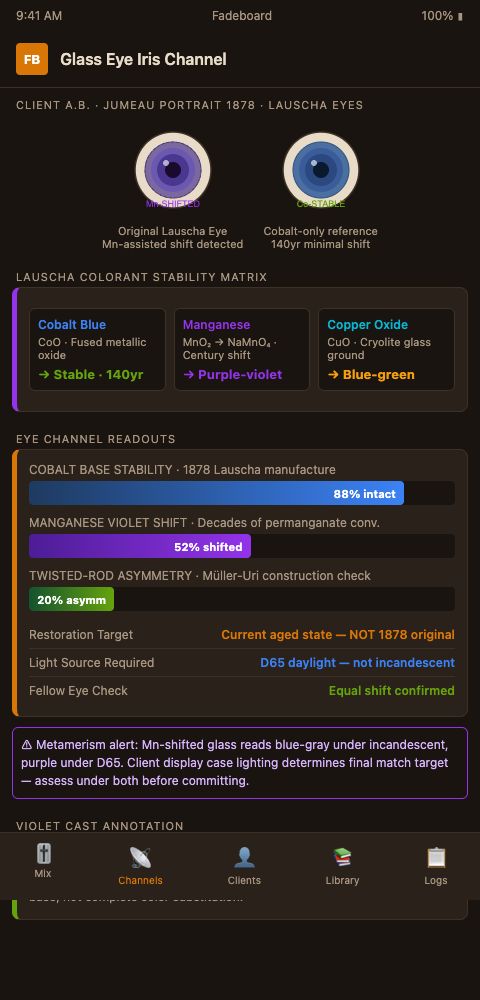
Manganese is the most problematic for restorers. Research on historical blue glass colorants in Central Europe documents that manganese converts to sodium permanganate over centuries, shifting glass color from neutral gray-brown toward a characteristic purple-violet. A Lauscha eye that was manufactured with a gray or brown iris can shift to purple over a century, and that shift is irreversible in the glass itself. More importantly for restoration, an eye that appeared "blue" in early catalog photographs may have been cobalt-based and remained stable, or it may have been manganese-assisted cobalt and shifted violet — and the visual distinction at your workbench, under a single incandescent lamp, is not reliable.
The Müller-Uri technique documented in Wertheim glass museum records provides a further complication: some Lauscha craftsmen twisted glass rods of different colorant compositions together rather than using enamel layer on cryolite. Twisted rod construction means the iris color is not uniform throughout the glass — it is a composite of two or more colorant compounds, each with its own shift behavior. The visual result can be streaked or asymmetrically shifted under directional light.
Fadeboard approaches glass eye color as a separate channel from bisque flesh tone, because the degradation physics are completely different. Rather than fade simulation, the glass-eye channel tracks colorant shift: which compound was likely used (from the manufacturer and date), and what direction does that compound shift over the relevant timespan? A cobalt-based iris from a Lauscha eye manufactured around 1880 shifts minimally in 140 years. A manganese-assisted iris shifts toward violet. The channel setting tells you how far the current visible color has drifted from original manufacture, and therefore what the restoration target should be. The same manufacturer-history reasoning that Fadeboard applies to glass eyes also governs 1890s painted boot work — factory colorant sourcing by era determines the degradation direction for logwood-iron boot blacks just as it does for Lauscha metallic oxide irises.
Comparative analysis of low-cost portable spectrophotometers confirms that affordable handheld colorimeters can rival calibrated cameras for color accuracy in heritage contexts — but independent restorers on kitchen workbenches rarely have even those. Fadeboard's channel model lets you work from manufacturer history and colorant chemistry rather than instrument measurement, producing defensible restoration targets without the equipment.
Advanced Tactics for Instrument-Free Eye Matching
Three habits improve glass eye restoration accuracy in studios without spectrophotometers.
Read under D65 daylight, not incandescent. GTI Graphic Technology's guidance on visual color assessment cites ASTM D1729 as the standard for reliable visual matching: standardized D65 daylight conditions. Metamerism between your inpainting mix and the shifted glass is most visible under D65. Reading under incandescent masks the purple-blue shift that manganese-assisted glass produces. A D65-equivalent viewing lamp is the single most cost-effective tool an independent restorer can add to a kitchen workbench for glass eye work.
Compare to the fellow eye, not to a catalog photograph. If both eyes are original Lauscha from the same doll, they will have shifted equally. The fellow eye is a perfect shift-matched reference for any inpainting work on surrounding tissue or iris border. A catalog photograph from 1890 shows the original color before shift — useful for manufacturer identification but not for setting your restoration target, which must account for 140 years of change. When only one eye is original and a replacement has been sourced from a secondary Lauscha supplier, the replacement may be set in a different colorant batch — compare both eyes under polarized light before assuming they match, because polarization suppresses specular reflection from the glass surface and reveals the true colorant hue.
Note the violet cast separately from the base hue. When assessing a potentially manganese-shifted iris, evaluate hue and violet cast as two separate observations, not one combined impression. The hue may still read blue-gray while the cast reads violet — which tells you the base cobalt is intact and the shift is a manganese overlay, rather than complete color substitution.
Common pitfall: matching the eye to the surrounding bisque tone. Glass eyes and bisque faces degrade through entirely different mechanisms — the glass shifts while the bisque oxidizes — and the two surfaces have moved in different directions over 140 years. Matching an iris mix to the surrounding bisque "for harmony" produces a restoration that harmonizes with the current aged state but diverges from the original relationship between face and eye that the manufacturer intended. Fadeboard keeps the glass-eye channel and the bisque-flesh channel independent precisely to prevent this conflation.
When your glass eye work is complete and you face the bisque surrounding context, low-light studio soundboard calibration covers the specific challenge of maintaining consistent tone reads when your display cabinet lighting differs from your workbench lamp — a problem that glass eyes make more acute because of their metamerism characteristics.
For restorers who also handle historic textile work, the challenge of matching indigo fade in Civil War-era quilts involves a parallel exercise in colorant-shift reading: indigo in aged cotton does not simply fade — it shifts hue as reduction products accumulate, requiring the same manufacturer-history reasoning that glass eye restoration demands.
Match the Shift, Not the Snapshot
Matching glass eye iris pigments without a spectrophotometer is a reading problem before it is a mixing problem. The iris colorant has been moving since the moment the doll left Lauscha, and your restoration target is not the original manufacture color — it is the current state of the glass, read under correct lighting conditions, with the shift mechanism understood.
Fadeboard's glass-eye channel gives independent restorers a structured framework for this kind of colorant-shift reasoning without lab infrastructure. If you currently manage glass eye matching by eye under a single lamp and have had clients report color mismatch under their display lighting, the waitlist is open now. Join and note which maker's eye glass — Lauscha standard, Müller-Uri twisted rod, or French enamel-on-crystal — gives you the most consistent trouble, and that input will shape the first manufacturer-specific channel calibrations in the early-access build.