Matching Indigo Fade on Civil War Piecework Quilts
The Indigo Problem in Civil War Piecework
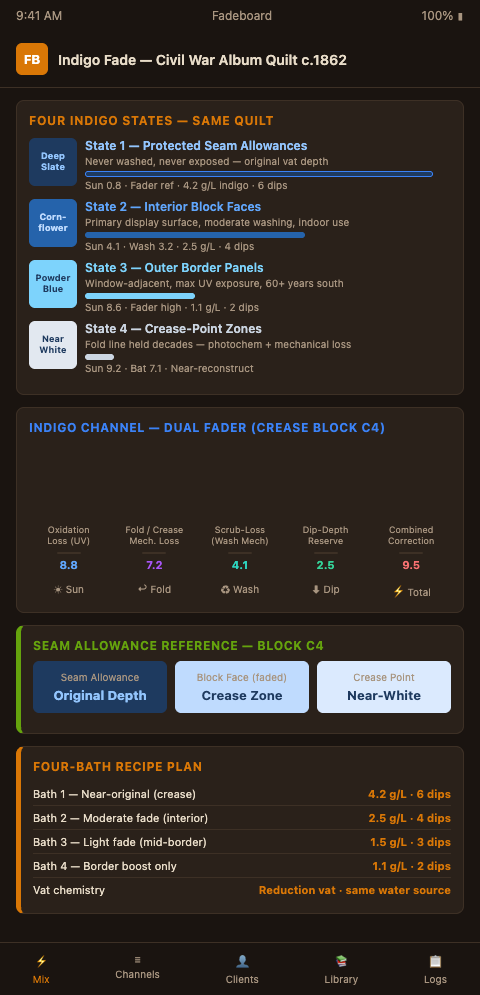
A conservator working on a circa-1862 album quilt made for a departing soldier found four visually distinct states of indigo across the same piece: deep slate-blue at the protected seam allowances (never washed, never exposed), medium cornflower blue at the interior of most blocks (primary display surface, moderate washing), pale powder blue at the outer border (window-adjacent, maximum UV exposure), and near-white at the crease points where the quilt had been folded along the same line for decades.
Each state required a different dye bath concentration. And each state told a story about the quilt's history that a single-bath approach would have obliterated.
Civil War quilts documentation research confirms that indigo blue was among the dominant fabric colors in period piecework quilts made for the war effort and for home use throughout the 1860s. The indigo was applied by vat dyeing — an oxygen-reduction process that builds dye in successive dips and does not use a metal mordant in the conventional sense. This vat-dyeing method produces the characteristic variation in indigo depth that makes Civil War quilt matching particularly complex.
Indigo's lightfastness on cotton rates at approximately level 4 on the wool scale but performs notably worse on cotton substrates — bleaching within 15 days of Paris sunlight under direct exposure conditions, according to historical dye testing records. This means that cotton quilts with indigo blue fade significantly faster than comparable wool or linen pieces, and that the gradient from protected to exposed areas is steeper and more visually dramatic.
How Indigo Fades: Photochemistry and Crease-Point Degradation
Indigo's photodegradation pathway is well-characterized. Photochemical research on indigotin shows that the molecule degrades to isatin via peroxide radicals under UV exposure — a process that first shifts the deep blue toward a blue-gray, then toward a washed-out slate, and finally produces the near-white result visible at severely exposed areas. The peroxide radical pathway accelerates dramatically in the presence of moisture, which is why crease points — where the folded fabric holds humidity — often show worse degradation than areas with equivalent UV exposure but no fold stress.
19th-century vat-dyeing methods for cotton produced variable penetration depth depending on the number of dip cycles. A fabric dipped four times builds more dye in the interior of the fiber than a fabric dipped twice. When the surface layer bleaches away under UV exposure, a four-dip fabric retains more visible color because there is deeper dye reserve to bleach through. A two-dip fabric reads pale much faster. This variation in original dip count — which you cannot determine visually from the finished quilt — means that two blocks that appear to have started the same color may have very different remaining dye reserves at the same fade stage.
Crease-point degradation adds a mechanical component to the photochemical loss. At a fold line, the fabric surface is mechanically stressed repeatedly — every time the quilt is folded and unfolded, the surface fibers flex. On cotton, this flex stress contributes to fiber surface damage at the crease, and on the damaged surface the indigo dye is more exposed to both UV and moisture than on the undamaged surrounding fabric. The result is that crease-point fade runs ahead of surface fade by a measurable margin.
In Fadeboard's channel system, crease-point zones get an elevated position on both the sun-exposure fader and the batting-contact fader (which also models fold-pressure degradation), because both mechanisms are active. GC-MS identification of isatin and isatoic anhydride as decay markers in historical indigo confirms that age and fade-stage assessment of historical indigo is chemically feasible — information that calibrates where on the fader scale a given panel sits.
Reading the Surviving Indigo: Seam Allowances as Reference Points
The most reliable color reference for a Civil War piecework quilt is not the block face — it is the seam allowance tucked inside the piecing. Seam allowances are protected from light, from washing (they are not typically agitated directly), and from batting contact. On a well-constructed 1860s quilt, the seam allowance fabric retains color closest to the original dye depth.
Open a small section of a non-critical seam — ideally one that shows signs of previous opening and re-stitching from repairs — and compare the allowance color with the block face color. The difference between these two readings gives you the cumulative fade across the full history of the quilt for that specific block.
The FORS protocol for distinguishing madder-based reds from cochineal is applicable to indigo co-analysis as well — the same spectral approach can confirm whether a blue colorant is true indigotin or a later synthetic substitute. On Civil War-era quilts, encountering an early synthetic blue (Prussian blue was available by the mid-19th century) is possible, and Prussian blue fades very differently from indigotin. Identifying which blue you are working with before setting the fader calibration matters significantly.
Once the seam-allowance reference reading is established, set the sun-exposure fader for that block to the position that represents the observed delta between the seam allowance color and the block face. A large delta (the face is much lighter than the allowance) means a high fader position and a concentrated replacement bath. A small delta (minimal fade) means a low fader position and a dilute bath.
Matching Across Multiple Fade States
The practical challenge in a Civil War piecework quilt with four visible indigo states is mixing baths efficiently. You need at minimum four concentrations: near-original for the crease-point zones, two intermediate concentrations for the moderate and mildly faded blocks, and the most dilute bath for the border zones that need only a slight color boost.
Work with a consistent base recipe — same mordant source, same vat chemistry, same water — and adjust only the dye concentration and the number of dip cycles to hit each target. This preserves the colorimetric consistency between baths: the deep replacement indigo should read as the same material as the light replacement indigo, just at a different developmental stage. If you switch water sources or mordant batches between concentrations, you risk introducing a color temperature shift that will be visible under different lighting conditions.
18th- and 19th-century quilt examples showing characteristic indigo fade at crease points confirm that the true indigo fading pattern favors crease-point bleaching over even surface bleaching — meaning a quilt with good surface color at the seams and poor color at the center folds is showing normal historic indigo behavior, not evidence of washing abuse.
For the madder variations present in many 1880s red-and-white quilts that were made contemporaneously with Civil War-era piecework traditions, the multi-state matching challenge is similar but the chemistry differs: madder's anthraquinone chromophores degrade at a different rate than indigotin, and the crease-point behavior is less pronounced.
For workshops that also handle dark-toned ecclesiastical textiles, the cochineal crimson analysis on 16th-century copes covers the equivalent process for identifying and matching multi-state fade in another historically significant red colorant.
Documenting the Indigo Match for Apprentice Handoff
Civil War quilts are high-significance objects — they carry family histories and sometimes institutional ownership — and the documentation of an indigo restoration should be detailed enough that a different practitioner could reproduce each panel's bath five years later. Record the Fadeboard fader positions for each panel, the resulting dye concentration (in grams of natural indigo per liter of bath), the number of dip cycles applied, and the test-swatch color at each concentration.
Shade drift between shift changes is a real risk when a multi-panel indigo restoration spans two or more workshop sessions. An effective logwood mourning quilt workflow addresses the same documentation discipline for a different colorant, with parallel lessons about maintaining consistent results across sessions when a single large quilt requires days of work.
Civil War piecework quilts are among the most emotionally significant pieces that come through a restoration workshop. Getting the indigo right — crease point to seam allowance, block by block — is what makes the restored piece read as a coherent historical object rather than a collage of mismatched replacement patches.
If your workshop is ready to move beyond single-bath indigo approximations and treat each block's degradation state as its own fader problem, sign up for the Fadeboard waitlist now. Bring your next Civil War-era piecework piece — include the block count, the estimated fold history, and any known laundering records — and we will walk through the crease-point fader calibration together.