Capturing Madder Variations on 1880s Red-and-White Quilts
The Red That Is Never Just Red
A workshop specialist received a circa-1882 Nine-Patch quilt in the classic red-and-white pattern. The client wanted to restore the faded blocks to "the original red." The specialist opened a seam allowance and found a deep, orange-tinged red — clearly turkey red mordant dye with its characteristic orange cast. She looked at the block faces and saw a range from that deep orange-red at the protected seam edges to a flat, slightly pink-neutral color in the block centers. She looked at a different block in the same quilt and found a version of red that read more crimson — cooler, without the orange cast. Same quilt, same visual pattern, two distinctly different reds.
The difference was in the madder chemistry. Research on anthraquinone colorants in madder root identifies more than 20 individual colorants in Rubia tinctorum root, with alizarin and purpurin as the dominant chromophores. Alizarin produces a clear, orange-red; purpurin produces a deeper, bluer red that reads more toward crimson. The ratio of alizarin to purpurin in any given historical dyebath varied depending on the root source, harvest time, mordant choice, and bath chemistry. Two dyers working in the same period could produce visually different reds from the same starting material.
The landmark American Folk Art Museum exhibition of 651 red-and-white quilts documents this color variation across three centuries of American red-and-white quilts, confirming that what appears to be a single dominant color is actually a family of related hues with significant variation across time, region, and production method.
Madder Chemistry: Alizarin, Purpurin, and the Fade Differential
Understanding the fade behavior of red-and-white quilts requires knowing which component has degraded and which has survived. MFA CAMEO's comprehensive madder reference documents that purpurin is less lightfast than alizarin under equivalent exposure conditions. As a madder-dyed fabric ages under light exposure, purpurin degrades faster — the deep crimson component fades while the orange-red alizarin component persists longer.
The visual result is a color shift. A madder-dyed fabric that started as a rich, slightly purple-red gradually shifts toward a flat orange-red as the purpurin degrades. If you match the "orange-red faded state" without accounting for the original purpurin component, your restoration color will read as period-correct at first but will not have the right aging character — it will look like it was dyed by someone who only used alizarin, not like the original madder bath with its full anthraquinone complement.
19th-century madder lake production methods confirm that 19th-century madder lake production involved precipitation from madder root extract onto a metal-salt substrate, and that purpurin-dominant madder lake fades faster than alizarin-dominant lake — creating the color shift visible in aged Victorian-era red textiles. The synthetic alizarin introduced after 1868 (following Perkin's synthesis) produced a purer, more orange-red than the natural madder it replaced, which is why post-1868 "turkey red" quilts read differently from pre-1868 natural madder quilts even after equivalent fade.
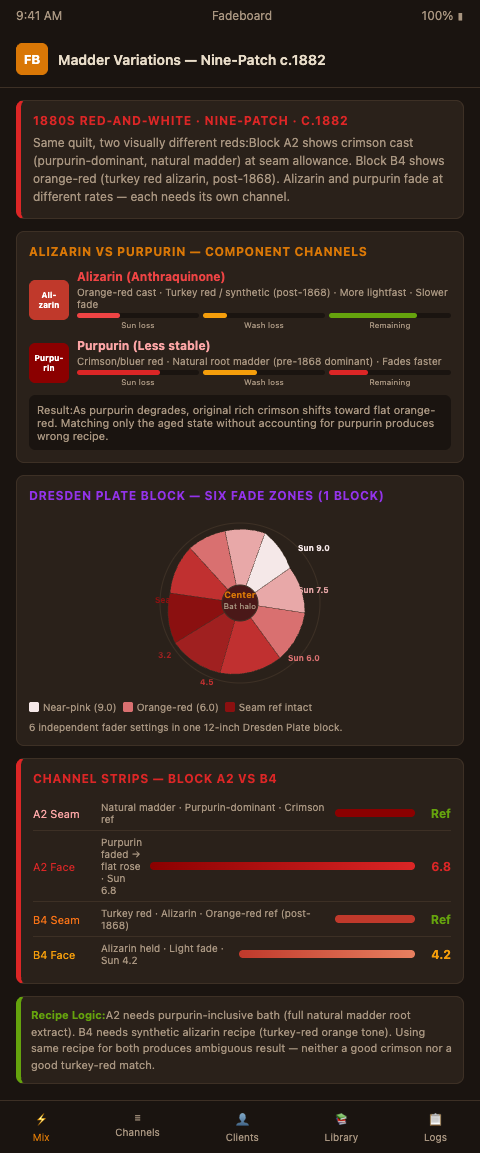
In Fadeboard, the sun-exposure fader position for a madder-dyed block captures the overall color deficit, but the block's channel strip also records the starting madder type (natural root madder, early synthetic alizarin, or late-19th-century commercial turkey red) because each type has a different fade trajectory and requires a different restoration recipe to hit the correct aged color.
Identifying the Madder Type in an 1880s Quilt
The practical identification of madder type in an 1880s quilt relies on several converging clues. First, color temperature at protected areas: natural root madder at the seam allowances reads warm and slightly brown-orange; early synthetic alizarin reads cleaner and more purely orange-red; turkey red (applied using the elaborate oil-scouring process developed for cotton) reads the deepest and most saturated orange-red, and is often the most lightfast of the three.
Second, construction date context. The synthetic alizarin process became commercially available in 1868–1869. A quilt documented as pre-1868 must use natural madder. A quilt from the 1880s may use either natural madder (declining in use but still present), early synthetic alizarin, or the increasingly dominant commercial turkey-red process. An undated 1880s quilt requires examination of multiple contextual clues before the madder type can be assigned.
FORS protocol for distinguishing madder from cochineal on historical textiles provides the spectroscopic method that confirms the anthraquinone identity without requiring destructive sampling. For workshop practitioners without FORS access, the combination of color temperature reading, construction date evidence, and the specific fade character of the block (how the hue has shifted with age) constitutes the practical identification approach.
The history of 1880s red-and-white quilts documents that the introduction of commercially produced turkey red alizarin after 1868 made red-and-white quilts affordable for middle-class quiltmakers for the first time — explaining the explosion of these quilts in the 1870s–1890s and the relative uniformity of their starting color compared to earlier madder-dyed pieces.
Setting the Faders for a Multi-Variation Red Quilt
When a single 1880s red-and-white quilt contains blocks in two or more of the madder types described above — a not-uncommon situation when a quiltmaker combined fabrics from multiple sources — the Fadeboard workspace needs separate channel strips for the different madder types as well as the standard panel-indexed position settings.
Block A2 may be natural madder with high purpurin content, showing a crimson cast at the seam allowance. Block B4 may be turkey red, showing the characteristic orange-red. Both appear as "faded red" in overall assessment, but they require different restoration recipes: block A2 needs a purpurin-inclusive madder bath (achieved by using full natural madder root extract rather than isolated alizarin), while block B4 needs a synthetic alizarin recipe that replicates the turkey-red orange tone.
The sun-exposure fader for each block is calibrated to the specific starting color of that madder type, not to a single universal red reference. The seam allowance of block A2 is the reference for block A2's restoration target; the seam allowance of block B4 is the reference for block B4's target. Mixing the references across madder types would produce a result that reads as ambiguous — neither a good crimson match nor a good turkey-red match.
For the logwood mourning quilt workflow that often appears as a secondary colorant in red-and-white quilts (logwood black was the standard dark accent used in appliqué outlines and sawtooth borders), the fader calibration follows the same multi-type logic: logwood on alum mordant produces a different hue than logwood on iron mordant, and the mordant type must be identified before the restoration recipe can be set.
Walnut brown in whole-cloth quilt restoration covers a related identification challenge — walnut-brown colorants in background fabrics often serve as the neutral foil for red-and-white designs, and their fade behavior affects how the red appears in context.
Advanced Tactics: The Six Fade Zones in One Dresden Plate
One of the most demanding single-block challenges in red-and-white quilt restoration is the Dresden Plate, where the "plates" are assembled from multiple wedge-shaped pieces. A single Dresden Plate with 20 wedges can contain six distinct madder states if the quilt has had complex light exposure, batting contact variation, and partial washing history.
The outermost wedges facing south may be nearly pink; the neighboring wedges shaded by a window frame may be orange-red; the center circle, which has the most batting contact, may show stitch-line halos; and the inner wedges may retain near-original seam-allowance color. Six independent fader settings for a single 12-inch Dresden Plate block is not theoretical — it is the actual condition of these complex geometric structures in heavily used antique quilts.
Fadeboard's channel-per-panel architecture handles this without simplification. Each wedge in the Dresden Plate can be treated as its own channel strip if the variation between wedges warrants it. Analytical methods for anthraquinone dye detection at nanogram levels confirm that the chemistry driving these six states is chemically distinct and therefore must be addressed with distinct recipes — not a single bath applied uniformly to the whole block.
For Byzantine gold-ground work on orthodox vestments — a different textile tradition but a parallel problem of identifying multi-component colorant systems in a single panel — the Byzantine gold-ground vestment restoration workflow addresses the equivalent challenge of tracking multiple color components with different degradation rates in a single, complex textile panel.
The Client Conversation for Red-and-White Quilts
Clients bringing 1880s red-and-white quilts to a restoration workshop often believe that "matching the red" is straightforward — there is only one color to match. The pre-treatment conversation needs to address the alizarin-purpurin variation clearly and early, because the restoration result may produce reds that look slightly different in different blocks (reflecting the different starting madder types), and clients need to understand that this variation is historically correct rather than a restoration error.
Use the seam-allowance reference comparison to show the client the actual starting color of each block type. Explain that the different oranges and crimsons at the seam allowances represent real historical variation in the original quiltmaker's fabric sources, and that the restoration is targeting each block's specific original color rather than blending everything toward a single contemporary approximation of "antique red."
Workshops ready to treat alizarin, purpurin, and turkey red as separate fader channels — rather than a single "red" problem — can subscribe to the Fadeboard waitlist and start with a free intake session on a red-and-white quilt from your current project list. Bring the construction date, any mordant identification notes, and the seam-allowance references for each block type.