Mixing Walnut Brown for 1890s Whole-Cloth Quilt Restoration
The Tide Line Problem
A Smithsonian-documented whole-cloth quilt from the 1790s to 1810s period — glazed wool, single color — establishes what these pieces looked like when new: uniform, even-toned, with a depth that came from multiple dye bath immersions applied to mordanted ground fabric. Early American whole-cloth quilt archival records show single-color construction that documents historical color standards. By the 1890s, the dominant construction had shifted to cotton ground fabric with earth-tone browns — particularly walnut hull dye — as the most common color choice for utilitarian whole-cloth pieces.
When a workshop receives an 1890s walnut-brown whole-cloth for restoration, the challenge is not identifying the dye. Walnut is unmistakable — its characteristic warm brown with slight greenish undertone in the shadows reads differently from madder, cochineal, or logwood-modified blacks. The challenge is that whole-cloth quilts were dominant style through mid-19th century transitioning to 1890s earth-tone brown as a common choice, which means the surviving examples span a wide range of dye histories: some were bath-dyed before quilting, some after; some mordanted with alum, some with iron, some with both in sequence.
The tide line forms when the restorer applies a corrective bath to a section of the quilt that has different dye and mordant history from the adjacent section. The restored section holds depth; the adjacent section was already at a different baseline. The seam between them is visible as a color step. On a solid ground fabric with no pattern to provide visual interruption, that step is immediately apparent to any observer.
Walnut dye ranks among the longest-lasting plant dyes due to its tannin content, with decades of color retention documented. That durability means the color differences that do appear in aged walnut-brown quilts are highly localized — sun-facing edges may show a 40% depth reduction while the center remains near-original. The restoration problem is therefore a panel-to-panel gradient, not a uniform whole-quilt correction.
Modeling the Walnut Gradient With Fadeboard
Walnut hull dye has a property that separates it from most other natural dyes used in quilt work: it is substantive on protein fibers and functions as a near-self-mordanting compound on cotton through its juglone content. Juglone in walnut hull acts as a direct dye on protein fibers; cotton requires full tannin-mordant pre-treatment. On 1890s cotton whole-cloth quilts, the original dye bath was almost certainly applied over a tannin pre-treatment, but the strength of that pre-treatment varied by maker. Some pieces have a robust tannin base that has stabilized the juglone bond for 130 years. Others have a thin tannin layer that allowed gradual juglone migration into the batting.
Fadeboard handles this variation through the batting-contact fader. Juglone migrates from face fabric into cotton wadding through moisture cycling — every time the quilt was wet-washed, a small portion of the juglone complex diffused downward into the batting, pulling color out of the ground. A panel over dense cotton batting, or a panel that sat in a chest near an exterior wall where humidity cycled frequently, will show deeper juglone loss than a panel over loose batting in a stable interior environment.
The batting-contact fader for whole-cloth walnut work is therefore set not by visible color difference alone but by a cross-examination of two variables: how much color has been lost (assessed visually under D65 lighting) and what the batting-contact history was (assessed by comparing face-side and back-side color depth under magnification). A panel where the face side reads lighter than the back side has likely lost juglone through downward migration into the batting. A panel where both sides read equally light has lost color through surface oxidation or wash.
The sun-exposure fader handles surface oxidation separately from juglone migration. Walnut hull powder is a substantive dye requiring no mordant on animal fibers but bonds directly to protein filaments; on cotton with tannin pre-treatment, the bond is less stable and more vulnerable to UV-driven chromophore breakdown. A panel that faced a south-facing window for forty years has lost surface juglone through photochemical oxidation rather than through batting migration — the degradation mechanism is different, and the corrective bath depth is calibrated differently.
Running both the batting-contact fader and the sun-exposure fader independently is the core of Fadeboard's value for whole-cloth walnut work. A panel at the south-facing edge of a quilt that also sat over dense batting has two separate losses compounding. Setting only the sun-exposure fader and ignoring batting-contact will produce a bath that is correctly targeted for UV loss but under-compensates for juglone migration — the panel will still read slightly lighter than its neighbors after correction.
For predicting natural dye fade, the walnut dye's substantive character means restored sections on a well-mordanted cotton ground can achieve lightfastness comparable to the original — one of the few natural dye scenarios where the restoration can realistically match the durability of the artifact.
Advanced Tactics for Walnut Brown Whole-Cloth Restoration
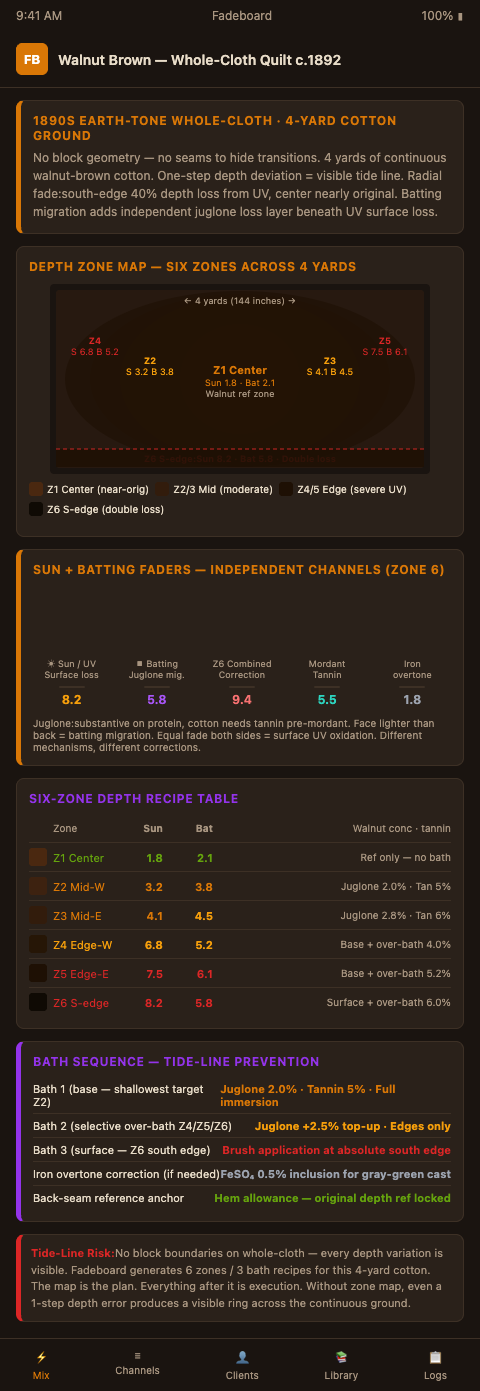
Gradient bath sequencing. Because the walnut brown whole-cloth quilt typically shows a radial fade pattern — darkest at center, lightest at edges and corners — the most efficient bath sequence is a full-immersion bath at the shallowest target depth (lightening the center correction) followed by selective over-bath on the most faded sections. Fadeboard's panel-indexed recipe identifies which sections need the over-bath step and at what additional depth. This avoids the risk of a deep single bath that corrects the edges but over-corrects the center.
Field test on an unexposed back-seam strip. Before applying any corrective bath to the face of a whole-cloth quilt, the restorer should locate a back-seam area (hem allowance, backing fold) that has never been exposed to light. This strip provides the best approximation of the original dye depth and can be used as the Fadeboard sun-exposure fader reference anchor. Field results showing walnut on untreated cotton without mordant produces pale result confirm that this back-seam reference will show the original mordant-backed depth, not the faded surface depth.
Walnut-iron overtone correction. Some 1890s whole-cloth walnut quilts show a slight gray-green cast in the most faded sections, indicating iron mordant was used in the original bath. The natural dye market's growing demand in heritage restoration has brought more practitioners to walnut work, but many mix from pure juglone extracts without the iron component, producing a warmer brown that reads differently from an iron-shifted original. The Fadeboard mordant-saturation fader should note iron or alum mordant type as a separate annotation — corrective baths for iron-mordanted walnut work require a small iron sulfate inclusion to match the original undertone.
Vat dye comparisons for display-bound pieces. When a whole-cloth walnut quilt is destined for display rather than storage, the long-term durability comparison between walnut (mordant dye) and synthetic brown alternatives matters. Comparing vat and mordant dyes for quilt restoration documents the fastness difference; for period-accurate restoration the authentic dye is usually preferred, but the display environment constraints must be weighed.
Gilbert & Sullivan yellows parallel. The shade-drift problem in whole-cloth restoration has a direct parallel in period costume work: aniline yellows in Gilbert and Sullivan costumes shows how uneven fade across a single-color garment creates the same tide-line risk when a corrective application is made without panel-indexed depth control. The Fadeboard approach is portable across both textile categories.
Four Yards Without a Seam to Hide Behind
The absence of block boundaries in a whole-cloth quilt removes the visual interruptions that normally mask minor color inconsistencies in piecework restoration. Every depth variation is visible. This means the Fadeboard panel-indexed workflow, which would be useful but not critical for a twelve-block sampler, becomes the minimum standard for whole-cloth work.
A four-yard walnut brown whole-cloth quilt in Fadeboard typically generates six to eight depth zones, each with its own sun-exposure and batting-contact fader position. The corrective bath plan will include two to three distinct bath recipes — a base bath, a selective over-bath, and possibly a targeted surface treatment for the most severely faded corner sections. That is the complete plan, and it is documentable, replicable, and safe to hand to an apprentice after the first bath.
Workshops handling whole-cloth quilts for the first time should build their first Fadeboard depth-zone map before anything else — before mixing dye, before mordant prep, before even choosing the dye source. The map is the plan. Everything after it is execution.